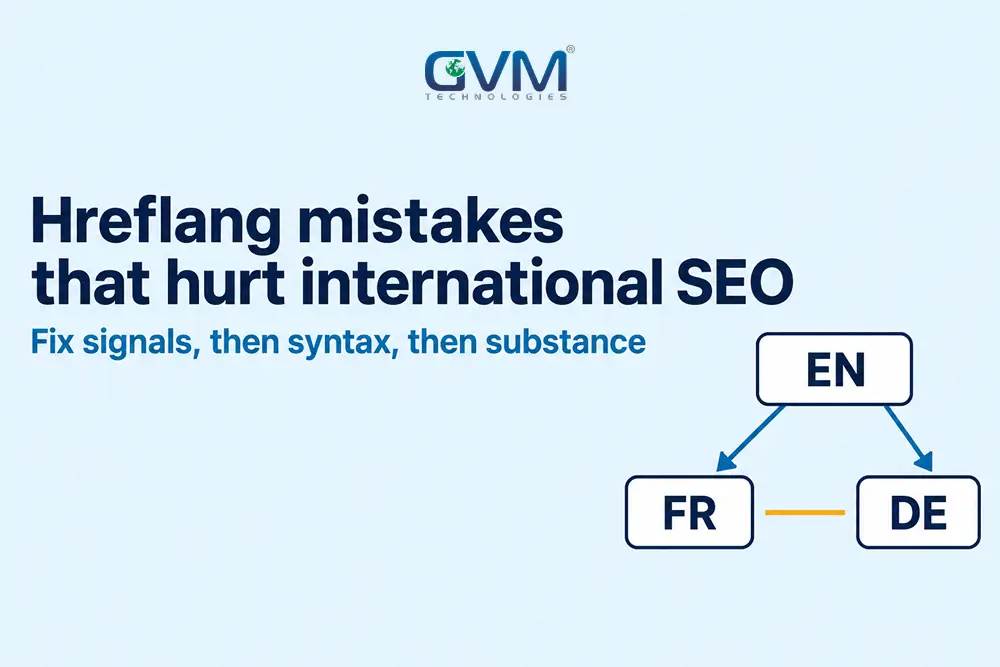
Hreflang is markup that links the language and country versions of a page. Most hreflang mistakes break nothing visible, so Google quietly ignores the tags and the wrong market sees the wrong URL.
This guide ranks the causes by damage and ends with a 5-step order for a technical SEO audit you can run in a day.
Quick answer: Hreflang mistakes fall into 4 groups: a set that should not exist, signals that overrule the tags, syntax Google ignores, and pages with nothing local to show. Fix them in that order. Hreflang routes the right URL to the right searcher, it does not raise rankings.
Hreflang mistakes start earlier: adding tags where Google has nothing to swap
Hreflang matters only when 2 or more URLs carry the same content for different languages or regions. A site with 1 language and 1 country has no alternates to link. A site with near-identical country copies has a bigger problem than its tags.
1. Sites with 1 language and 1 country need no hreflang
A 3-state US service business with English-speaking customers has no alternate pages, so the tags point at nothing. Google says in its localized versions documentation that it detects page language itself.
Competitors with 5 markets need it. A business with 1 market does better to invest in Google Business Profile optimization.
2. Same-language country copies that Google folds together
English sites for the US, UK and Australia with the same copy look like 1 page to Google. Bill Hunt describes a shoe brand with roughly 98 market sites, 38 of them near-identical English.
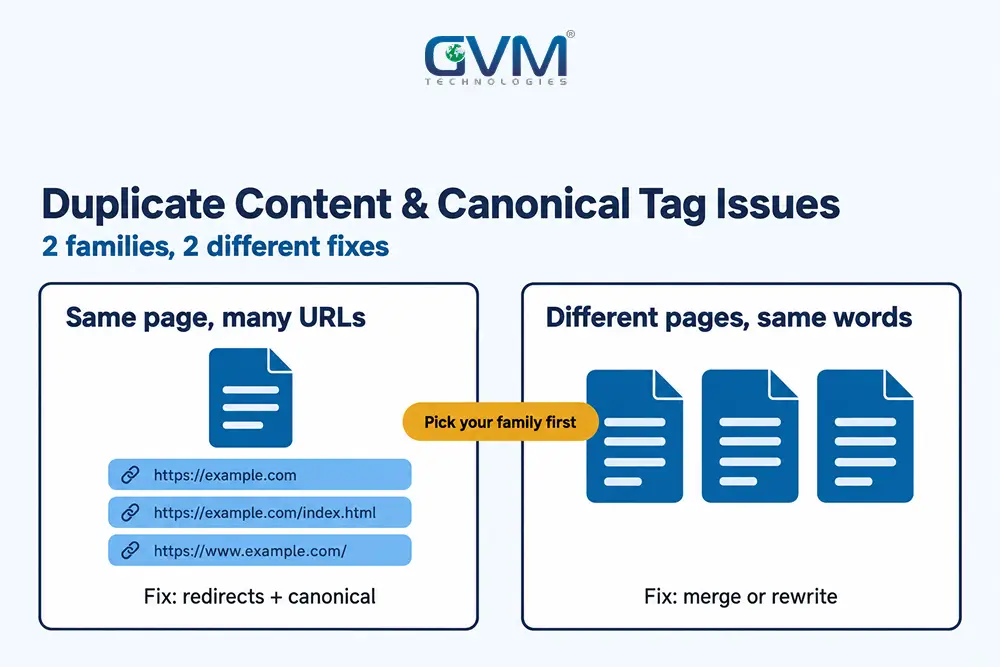
Google can index 1 version and still swap in the right URL. Search Console then shows only the clustered URL, 1 of the indexing statuses that confuse owners. Pick 1 of 3 paths:
- Localize: change price, shipping, tax, spelling and proof so each market page has its own job.
- Merge: keep 1 English page for all markets and 301 the country copies to it.
- Keep and accept: if law or billing forces separate sites, keep the tags and expect confusing reports.
3. Why translated pages are not duplicate content
Google says localized versions count as duplicates only when the main content stays untranslated. A German page with a German body is a different page, so the duplicate-penalty fear does not apply.
The exception is an English body under a translated menu and footer. Google would treat that page as a duplicate, so translate the body first.
How Google handles a hreflang set, and where hreflang acts
Google handles international pages in 4 stages: find the URLs, decide which are duplicates, index and score one, then pick the URL to show. Hreflang acts at the last stage. It swaps the right alternate for the right searcher and adds no ranking value.
- Discover: sitemaps, internal links and hreflang annotations reveal the alternate URLs.
- Canonicalize: Google decides which alternates are distinct. Canonicals, redirects and links vote here.
- Index and score: a clustered URL can share 1 index entry, and the scored page carries the ranking.
- Serve: Google picks the alternate that fits the searcher’s language and country.
In practice: If your US page already ranks in the UK, adding en-GB does not lift it. It changes which URL appears.
Because stage 2 comes before stage 4, a canonical conflict can remove a page before hreflang runs. That is why the next section comes first.
SEJ reports that Google’s Gary Illyes called swapped URLs alternate names in August 2026. Search Console may list them as not indexed.
Conflicting signals behind hreflang mistakes that look valid
Hreflang is a hint, so other signals can overrule it. When canonical, noindex or redirect signals disagree with the tags, Google has to guess which to follow. A noindex beats the hint outright, so test these conflicts before touching syntax.
1. A canonical that points at another locale
The classic case is a /fr/ page whose canonical points to /en/. The canonical says the French page duplicates English. Hreflang says show it to French users, so the French URL can drop out.
Ahrefs found that 8% of 374,756 domains pointed hreflang at non-canonical URLs. This hreflang canonical conflict comes from a template that copies 1 canonical across locales.
GVM’s technical SEO work treats canonicals, status codes and indexability as 1 check, because Google reads them together.
2. Alternates that redirect, error, carry noindex or sit behind robots.txt
Each alternate in a set should return 200, allow indexing and allow crawling. These 4 states create hreflang errors even when the tags are valid:
- Redirect: name the final 200 URL. Ahrefs found 16.9% of domains with redirected or broken targets.
- 404 or 5xx: the pair cannot form, so restore the page. See 404 errors and SEO.
- Noindex: SEJ’s guidance says search engines respect noindex over the hint.
- Blocked by robots.txt: Google cannot read that alternate’s tags to confirm the return link. See blocked by robots.txt.
A single redirect is fine: a global home page that redirects by location and carries x-default. Ahrefs documents that homepage-only setup as an approved pattern.
3. Auto-redirects by IP address or browser language
Google’s locale-adaptive crawling guide says Googlebot crawls mainly from US IP addresses and sends no Accept-Language header. A location redirect can therefore hide your alternates.
Google recommends separate locale URLs with hreflang. Visitors dislike redirects too, since a browser set to English can still open a German consent page. Instead:
- Give each language its own crawlable URL.
- Offer a visible language switcher and remember the choice.
- Suggest a switch with a banner instead of forcing it.
- If local law sets a default language, still keep other versions on their own URLs.
Syntax hreflang errors that Google ignores quietly
Syntax errors break nothing visible, much like schema markup errors, so teams miss them. Google ignores the annotation and picks a page itself. Ahrefs found at least 1 issue on over 67% of 374,756 domains, so these hreflang errors are normal.
| Error | Domains affected | What Google does | Priority |
|---|---|---|---|
| Missing x-default | 56.3% | Nothing, it is optional | Low |
| Missing self-reference | 18% | Breaks a Google guideline | Medium |
| Redirected or broken target | 16.9% | Pair cannot form | High |
| Missing return tag | 15.3% | Ignores the annotation | High |
| Non-canonical target | 8% | Canonical and hreflang conflict | High |
Frequency is not severity. The most common of these hreflang mistakes costs the least, while 3 high-priority rows each break a pair. Shares come from Ahrefs’ 2023 study, and priority is our judgment.
1. Missing return links and self-references
Google’s rule is simple: if 2 pages do not point to each other, the tags are ignored. That rule stops anyone else from claiming your page as an alternate. Each version must also list itself.
The cost grows fast, because a set of N pages puts N tags on each page:
- 3 pages: 9 annotations in total.
- 6 pages: 36 annotations.
- A 7th market: 13 more tags, 1 new line on each of 6 old pages plus a full set on the new one.
So a new market added to 1 template leaves the other 6 stale. A release test, as in our QA testing for startups guide, catches that gap.
A working set for 2 pages looks like this. Both pages carry the same 3 lines, and en-UK in place of en-GB would be ignored:
<link rel="alternate" hreflang="en-GB" href="https://example.com/uk/" />
<link rel="alternate" hreflang="fr-FR" href="https://example.com/fr/" />
<link rel="alternate" hreflang="x-default" href="https://example.com/" />
Google allows omitting some languages when a full set is hard to maintain. However, link new pages back to your dominant language first.
2. Invalid language and region codes
Google accepts an ISO 639-1 language code, then an optional ISO 3166-1 Alpha 2 region code, joined by a dash. A region alone is invalid, and a bad code can sit unnoticed because the page still loads.
| Value | Verdict | Why |
|---|---|---|
| en-GB | Valid | Language, then region |
| en-UK | Invalid | UK is reserved, so Google ignores it |
| es-419 | Unsupported | 419 is not an ISO 3166-1 Alpha 2 code |
| es_MX | Invalid | The separator is a dash, not an underscore |
| zh-Hans | Valid | Script code for Simplified Chinese |
Add a region only when the page differs for that region. A plain fr covers all French speakers.
3. Placement, URL format and x-default
These 4 checks catch the remaining hreflang errors:
- Inside a valid head: Google ignores link tags outside a well-formed head. A tag manager or script can inject an iframe above them and close it early.
- Absolute URLs: write https://example.com/fr/, not /fr/ or //example.com/fr/.
- 1 method: HTML, HTTP headers and sitemaps are equal to Google. If you combine them, they must match exactly.
- x-default as a fallback: Google designed it for language selector pages, so point it at a catch-all, not a localized page.
Hreflang mistakes that tags cannot show: the localization gap
Valid tags cannot give a page a reason to rank in a market. If the French page is the English page translated, with the same price, shipping and support, Google has no local evidence to prefer it. An AI answer engine has none either.
1. Translated pages with nothing local on them
An audit tool shows green while the page underperforms, because it reads as a translated copy. Local substance makes it a market page:
- Money: local currency, tax or VAT display and payment methods.
- Delivery: shipping times, returns rules and local fulfilment.
- Trust: local legal pages, support hours, phone number and reviews.
- Language: the phrases buyers use in that market, not a literal translation of your English keyword.
Search habits differ by market, so keyword research needs a second pass per language. Our keyword research best practices guide covers that pass.
GVM’s SEO service covers keyword research, content optimization and technical SEO, so each market page can start from its own research.
2. Internal links that default back to the main language
When navigation, blog and category links point to English URLs, authority and crawl priority tend to flow to the default language. Other versions then sit weaker, even with clean tags.
Check 4 things on each locale:
- Navigation and footer link to same-language URLs.
- Blog posts link to same-language pages.
- Category and hub pages reinforce their own language cluster.
- The language switcher links to the matching page, not the home page.
3. Translation tools, platform settings and stale tags after a move
These 3 situations rewrite your tags unseen:
- On-the-fly translation: a proxy-based tool can create unplanned URLs and missing canonicals. Test on 20 pages first.
- Platform settings: WPML, TranslatePress and Shopify Markets build locale URLs. See how to choose a CMS.
- Migrations: merge /en-us/ into the root with 301s and other locales still name /en-us/. See hosting migration SEO.
GVM’s DevOps team handles cloud migration, and moves are where stale return tags appear.
Google’s spam policies, updated 28 August 2026, list translating scraped content at scale without adding value as scaled content abuse. Reviewed translations of your own pages differ.
Audit hreflang mistakes in the order Google processes pages
Audit hreflang mistakes in the order Google processes pages: indexability and canonicals first, then return links and codes, and substance last. Work by template, not by single URL, because 1 template can repeat the same fault on thousands of pages.
- Indexability: confirm each alternate returns 200, allows indexing and is crawlable in URL inspection.
- Canonicals: confirm each indexable alternate canonicalizes to itself.
- Return links and self-references: crawl the set and filter for missing returns.
- Codes and mapping: check valid values, 1 URL per value and the same set on each page.
- Substance: check local content, same-language internal links and support.
Common hreflang errors show up as symptoms first:
| What you see | Check first | Likely cause |
|---|---|---|
| Wrong country sees the wrong page | Canonicals and return links | Canonical copied across locales |
| English URL shown for a French page | Duplicate cluster | Near-identical copies |
| Crawler reports missing return tags | Release changes | New market added to some templates |
| Alternate is not indexed | Status, noindex, robots.txt | Redirect or noindex on the alternate |
| Tags vanish in the live source | Rendered head | Script closes the head early |
| Tags valid, traffic flat | Substance | Translated copy with nothing local |
Alternates stuck in “Crawled, currently not indexed” need content, not tags. See crawled, currently not indexed. After a launch drop, use a sudden drop triage.
Google’s documentation names third-party testers, and Search Console’s International Targeting report was retired in 2022.
No official timeline exists for fixes. Google must recrawl each URL in the set, so expect weeks on a large site.
Template releases are where return tags go missing. GVM’s DevOps and QA teams build CI/CD pipelines and run automated testing. Add a hreflang crawl to your pre-launch checklist as 1 more test.
FAQs
1. Does hreflang improve rankings?
No. It tells Google which alternate to show and adds no ranking value. A page that already ranks keeps its ranking, and hreflang only swaps the URL.
2. Will 1 of these hreflang mistakes break the whole set?
No. Google ignores the invalid annotation and still reads pages that point to each other. However, a template error repeats on thousands of URLs, so fix the rule.
3. Do I need x-default?
No, it is optional. Add it when you have a language selector or catch-all page, and point it there. 56.3% of domains in Ahrefs’ study skip it.
4. Which is better: HTML tags, HTTP headers or a sitemap?
Google treats the 3 as equal, so pick 1 method.
5. Which wins in a hreflang canonical conflict?
Neither has a fixed rule. Ahrefs saw hreflang win in many cases, while noindex beats it outright. Make the signals agree instead of testing which wins.
Conclusion: fix the set before the syntax
Hreflang mistakes hurt most when they hide behind valid-looking tags: a canonical that disagrees, a redirecting alternate or a market page with nothing local. The tags are rarely the whole problem.
So work in the order Google reads a page. Check 1 template per locale first, then each alternate’s status and canonical, then return links and codes. Judge local content last.
Once the set is clean, add a hreflang crawl to your release checks so the next market does not bring hreflang errors back.
Talk to GVM Technologies about your multilingual site’s technical SEO
Each week the wrong page ranks in a market, local buyers land on a page they cannot use and your localization budget earns nothing.
GVM Technologies covers the technical side with search engine optimization for audits and per-market keyword research, and website development for clean, SEO-ready builds.
Our quality assurance testing and DevOps and cloud hosting teams cover release checks, CI/CD pipelines and migrations.
The GlobalRose case study shows this audit-first method on a US e-commerce site: technical and on-page fixes led to first-page rankings for several keywords within 3 months.