Quick Answer: doesn’t need to start with a hire on day 1. It needs 1 person accountable for quality, even if that person is a developer wearing a second hat.
Dedicated QA earns its cost the moment either of 2 things happens: manual verification eats more engineering hours than a QA salary would cost, or a production bug has already cost real revenue.
Below that line, automate the highest-risk flows only. Above it, hiring beats the alternative on pure math, not just peace of mind.
Key Takeaways
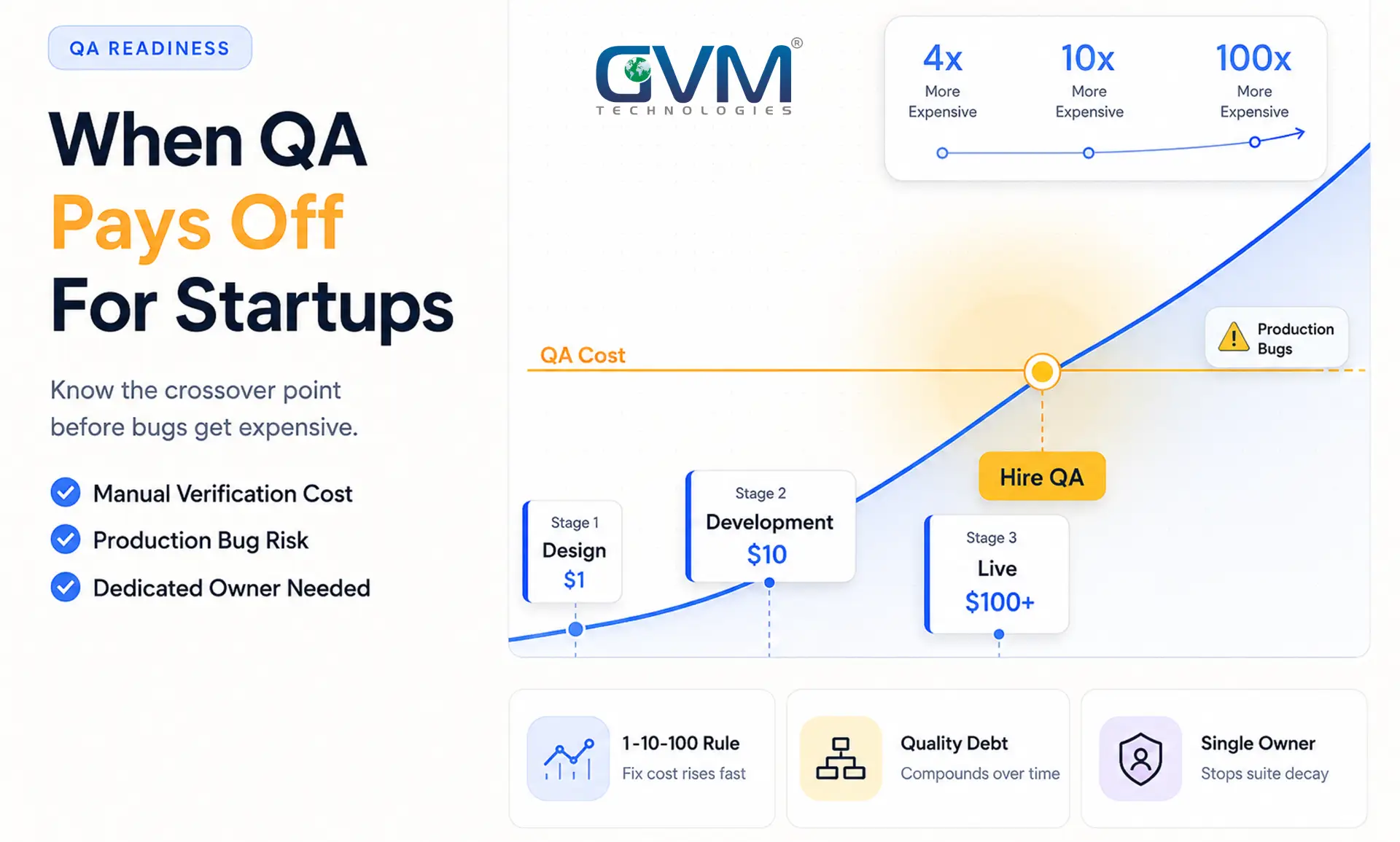
- Production bugs cost 4 to 100 times more to fix than bugs caught during development.
- 3 named incidents, Knight Capital, TSB Bank, and CrowdStrike, each destroyed more value in under an hour than years of QA salaries.
- Unowned test suites decay fast: some sit 40% skipped, with another 30% passing only after a retry.
- Automated tests catch known regressions. Manual testing catches what nobody thought to test for.
- By 2026, only 1 in 7 companies had fully operationalized AI in QA, so it’s additive, not a replacement.
Why This Debate Never Actually Resolves
The disagreement usually splits into 2 camps:
- Camp 1: QA is a dying job title. Good developers make it obsolete through disciplined automated tests, so a separate hire is often waste.
- Camp 2: Skipping it is exactly how quality debt becomes a board-level conversation 2 years later.
Both camps are correct. They’re just describing 2 different company sizes, a nuance that gets lost every time this debate resurfaces in broader technology and innovation discussions.
QA isn’t a job title, it’s a function that always exists in some form. Every piece of software gets tested by somebody: a paid specialist, a developer squeezed between features, or a paying customer who finds out the hard way.
Teams that claim to have “no QA” still have QA. It’s just assigned informally, usually to whoever got paged last.
Engineers who’ve lived through this transition describe the same arc almost every time. A team scales from a handful of people into the hundreds, and releases feel fine for a long stretch.
Then 2 or 3 regressions hit new markets in the same quarter, and quality debt stops being a backlog item.
It becomes something the board asks about directly. The bugs weren’t new; the volume had been quietly building the entire time.
What Skipping QA Testing for Startups Actually Costs
The cost of skipping QA isn’t a scare tactic. It’s measurable, and the research has stayed consistent for over a decade.
- The 1-10-100 rule: a defect costs $1 to fix at design, $10 in development, and $100+ once it’s live.
- 43% of failed startups cite product quality as a root cause, per CB Insights’ analysis of failed venture-backed companies.
- Close to a third of engineering time is lost to technical debt, per Stripe’s Developer Coefficient research.
- 85% of bugs are found by users, not testers. The customer base becomes the real QA department by default.
3 Real Incidents That Started as “Just 1 Small Bug”
Founders sometimes wave these stories off as massive-company problems with nothing to do with a 15-person team. That reaction misses the actual lesson.
The lesson was never the dollar figure. It was how small the original defect was.
| Incident | Root cause | Documented impact |
|---|---|---|
| Knight Capital, 2012 | 1 dormant test feature left active on 1 of 8 production servers during a deployment | $440 million lost in 45 minutes, detailed in this software testing retrospective |
| TSB Bank, 2018 | An inadequately tested and controlled core banking platform migration | 5.2 million customers affected, a £48.65 million regulatory fine confirmed by the UK Financial Conduct Authority |
| CrowdStrike, 2024 | A faulty content update pushed without adequate validation | 8.5 million Windows devices affected worldwide, per Microsoft’s own incident disclosure |
None of these began as a dramatic failure. Each began as 1 deployment that skipped a validation step somebody assumed wasn’t necessary.
A startup doesn’t need Knight Capital’s trading volume to feel a version of this. It only needs 1 untested deploy touching billing, authentication, or a customer record.
Client rebuilds inside GVM Technologies’ own software project portfolio show the same pattern at a much smaller scale. The incident that actually hurts a business is rarely the one anyone saw coming.
The Bug Cost Crossover Formula: A Number You Can Calculate Today
Most advice about “when to hire QA” stays vague on purpose. Here’s a formula that turns it into arithmetic instead of a feeling.
Crossover ratio = Monthly QA cost ÷ (Developer hourly rate × weekly manual-testing hours × 4.3)
If that ratio comes out below 1, a QA hire already pays for itself in engineering time alone, before counting a single prevented bug.
Worked example: a startup pays 1 senior developer $75 an hour, and that developer spends 8 hours a week manually re-checking releases. That’s $75 × 8 × 4.3, or roughly $2,580 a month in buried QA labor, done by someone paid to build features instead.
A part-time QA hire or embedded staff augmentation contractor at $2,200 a month already beats that number on cost alone, before adding the bugs a dedicated tester catches that a distracted developer misses.
Run this formula with a team’s actual numbers instead of guessing. It removes the emotional argument entirely and replaces it with a breakeven point anyone on the team can verify.
The Quality Debt Compounding Curve
Quality debt behaves like financial debt: invisible at first, then suddenly expensive. Engineering teams that track this closely describe a near-identical timeline.
- Month 1 without QA ownership: Nothing looks different. Releases still ship on schedule, and skipping QA feels like the correct call.
- Month 3: Debugging eats a visible chunk of the week, close to 40% of engineering time, once debt compounds.
- Month 6: Regression volume climbs even without headcount growth, roughly 15% more incidents a month.
- Month 12: The company either adds structured testing, automated or human, or absorbs an incident serious enough to force the decision. A third outcome rarely shows up.
The fix isn’t waiting for month 12 to arrive. It’s recognizing month 3 for what it actually is: the point where quality debt’s interest rate starts compounding faster than the team can out-work it.
The QA Readiness Score: Score Your Own Team in 2 Minutes
Score against these 10 questions honestly. 1 point for every “yes.”
- Has a bug already reached production that cost measurable revenue, a lost client, or an emergency hotfix?
- Do developers spend more than 5 hours a week manually re-verifying releases before they ship?
- Has the team shipped a payment, authentication, or data-deletion bug in the last 6 months?
- Is more than 20% of the automated test suite currently skipped, flaky, or quietly ignored?
- Have releases started feeling risky enough that engineers hesitate to ship on a Friday?
- Are there paying customers whose churn would meaningfully hurt monthly revenue?
- Has the team grown past 10 engineers without adding anyone accountable for test health?
- Would a security or compliance failure expose the company to legal or regulatory risk?
- Has “we’ll add QA later” been said more than once, with no specific trigger for when “later” arrives?
- Is there no single owner for test pass rate, flake rate, or time-to-repair?
Scoring: 0 to 2 means self-testing with light automation is still appropriate for this stage. 3 to 5 means it’s time for automated coverage on critical paths plus part-time QA support.
6 or more means dedicated QA, hired directly or brought in through the MVP development team already building the product, is very likely overdue.
3 Ways Startups Actually Handle Testing Today
| Approach | What it looks like | Where it works | Where it breaks |
|---|---|---|---|
| Founder or developer self-testing | Whoever writes the code checks their own work before shipping | Pre-product-market-fit, under 10 engineers, low blast radius per feature | Blind spots from implicit bias: a developer rarely tests for the bug they didn’t imagine could exist |
| Developer-owned automation, no dedicated QA | Unit, integration, and end-to-end tests owned by engineers, CI blocks merges on failures | Teams with strong engineering discipline and stable requirements | Suites rot without a single owner, so engineers stop trusting a pipeline full of skipped or flaky tests |
| Dedicated QA or embedded SDET | A specialist owns test strategy, exploratory testing, and often automation upkeep | Regulated industries, complex workflows, teams past 40 to 60 engineers | Can bottleneck releases if developers start treating “QA will catch it” as permission to stop caring |
None of these is universally correct on its own. The real mistake is picking 1 and never revisiting it as the company changes shape, which is the failure pattern engineering leads describe most often once a team outgrows its original setup.
What Engineering Teams Actually Say Once the Cameras Are Off
Public engineering discussions on this topic converge on a few blunt patterns that never make it into a vendor’s sales page.
1. Test Suite Decay Is the Real Silent Killer, Not a Missing Suite
An unowned end-to-end suite rots in a predictable way over about 18 months:
- 40% of tests end up permanently skipped.
- Another 30% only pass after an automatic retry.
- A green build stops meaning anything, and false confidence starts hiding real risk.
2. “Test If It Hurts, Do It More Often” Beats “Test Everything”
Credited to continuous-delivery pioneer Jez Humble, this principle beats chasing 100% coverage. Testing the parts that keep breaking, more frequently, closes more real risk than a comprehensive plan that never ships.
3. A Skilled Tester Is Genuinely Hard to Replace With Process Alone
A developer validates that code does what they built it to do. A tester validates what happens when a real user does something nobody anticipated, and engineers consistently describe missing that instinct once a strong tester leaves.
4. The Ratio That Keeps Surfacing: 1 QA-Minded Person per 2 to 3 Developers
That ratio holds whether it’s a formal hire or a rotating responsibility, once nobody has slack left to double-check a teammate’s work.
The bar-test joke, retold by every QA team at some point: a tester walks into a bar and orders 1 beer, then 2 beers, then 0 beers, then 999,999,999 beers, then a lizard, then negative 1 beer.
The developer who built the bar walks in, orders 1 beer, and declares the bar fully tested.
Developers verify the path they designed for. Testers try to break the paths nobody designed for, which is exactly the skill a checklist or a linter cannot replicate.
Where Practitioners Actually Disagree
Not every engineer agrees dedicated QA is worth the line item, and pretending otherwise would be dishonest.
- The skeptical case: hiring QA just patches bad engineering practices instead of fixing them.
- The case that wins in practice: QA is cheaper than a dev hour, so freeing up 1 dev hour is a net gain on its own.
Both camps are usually talking about teams at different levels of engineering discipline, not describing a universal rule.
The 3-Layer Testing Model That Actually Scales
Rather than trying to test everything at once, the most consistent advice across mature engineering teams is to layer coverage by what actually breaks in production.
1. Layer 1: User-Facing Flows
Signup, login, checkout, and any irreversible action a user can take. This layer is usually covered with tools like Playwright or Cypress, run against a properly built web application.
A broken experience here directly costs revenue or trust, since it’s the layer a customer actually sees.
2. Layer 2: API and Service Contracts
The agreements between a frontend, backend, and any third-party integration. These get validated with contract tests run through tools like Postman or Newman.
A silent contract break here rarely announces itself. It shows up as a mysterious bug 2 layers away from its actual cause.
3. Layer 3: Data Integrity
Whether records stay consistent across services after a write, a migration, or a retry. Most startups skip this layer entirely.
It’s also the exact layer behind both the TSB and Knight Capital failures above.
Teams building on this model inside a structured SaaS solution development process wire automated checks into all 3 layers before a feature ships, not after the first bug report arrives.
Manual Testing vs. Automated Testing: 2 Different Jobs
A common false debate treats manual QA and automation as though a team has to pick 1.
| Automated testing | Manual and exploratory testing | |
|---|---|---|
| What it catches | Known regressions on paths already defined | Unknown behavior nobody wrote a test for |
| Best on | Stable, high-traffic paths like authentication and checkout | New features, complex state transitions, edge cases |
| Consistency | Runs the exact same way every time | Varies with the tester’s judgment and instinct |
| Who does it | CI pipeline, triggered on every merge | A dedicated tester, a PM running exploratory sessions, or a rotating team member |
A mature setup runs both, treating them as complements rather than competitors. Automated checks act as a safety net for what the team already knows matters, while human testing covers the parts nobody’s written a test for yet.
AI Testing Tools in 2026: What They Fix, and What They Don’t Yet
AI-assisted testing has moved fast, and adoption numbers back that up. Around 55% of organizations now use AI somewhere in their testing workflows, and by 2026 close to 1 in 7 had operationalized it as a formal quality-engineering practice, while 9 in 10 were still experimenting rather than depending on it fully.
Where AI genuinely helps:
- Regression testing on stable, unchanging features that already have a known-good baseline.
- Auto-generating test scaffolding, so engineers start from a draft instead of a blank file.
- Flagging flaky tests that waste engineering time. Around 30% of CI failures turn out to be flake, not a real defect.
Where AI still falls short:
- Validating brand-new functionality. A well-built artificial intelligence system still needs a stable “correct” state to compare against, and week-old features don’t have one.
- Replacing human judgment entirely. Teams that lean on it fully ship a confident, all-green suite next to a broken product.
This is the same reason AI services integration work always budgets extra time for human validation on top of automated model output, not instead of it.
7 Mistakes That Turn “We’ll Add QA Later” Into a Crisis
1. Treating QA as the Final Step Instead of a Parallel One
Bugs caught after a feature is marked “done” cost more to fix than bugs caught while it’s still being built. Testing that only starts once development “finishes” guarantees the most expensive possible timing for every defect it finds.
2. Assuming Unit Test Coverage Equals Real Coverage
A codebase can carry 90% unit test coverage and still crash in production from an edge case no unit test ever modeled, like an unexpected character in a name field. Coverage percentage measures lines executed, not scenarios imagined.
3. Hiring 1 QA Person and Expecting Them to Fix a Broken Process
A single hire dropped into a team with no ownership structure usually ends up firefighting instead of building systematic coverage. The process was broken before the hire arrived, and 1 person rarely fixes a structural problem alone.
4. Outsourcing Testing Before the Process Is Documented
Handing QA to an external partner before writing down what “done” means for a release means paying that partner to learn the product from scratch. That ramp-up cost gets billed whether anyone budgeted for it or not.
5. No Single Owner for Test Suite Health
Without someone accountable for pass rate, flake rate, and time-to-repair, an automated suite decays until nobody trusts it. This is exactly the pattern behind the “18-month suite” scenario described earlier.
6. Over-Relying on AI Testing Tools for Features That Are Still Changing
These tools stay strong on stable, established paths and weak on anything whose correct behavior hasn’t been defined yet. A tool built to compare against a known-good state has nothing to compare against on day 1 of a new feature.
7. Treating “Move Fast” and “Test Properly” as Opposites
The teams that get hurt worst use speed as an excuse to skip verification entirely. The smarter version of “move fast” tests the highest-risk 20% of the product deeply instead of skipping verification across the board.
What to Build Before Hiring Anyone
A team that isn’t at the hiring threshold yet still has real options that lower risk without adding headcount.
- Automate around the actions a company can’t afford to get wrong: authentication, billing, permissions, and anything irreversible.
- Keep the process lean enough people actually follow it: a short checklist beats an elaborate framework nobody uses.
- Push quality checks into planning, not just testing. Reviewing edge cases before code exists catches bugs testing never would.
- Assign 1 person to own test-health metrics, with real authority to block a merge when those numbers slip.
- Treat production monitoring and fast rollback as part of the testing loop, not a failure of it, provided rollback is genuinely fast and not theoretical.
Teams following a defined agile software development process tend to build several of these habits in by default, since sprint-based delivery already forces a regular check on what’s truly done versus what merely compiles. Pairing that cadence with reliable DevOps and cloud hosting makes rollback fast enough that this approach actually works instead of just sounding good on paper.
How This Plays Out Inside a Real Software Build
Even founders who plan for QA from day 1 sometimes underestimate how much time it actually needs. On a typical business application build, dedicated testing runs 3 to 6 weeks, running alongside later development sprints rather than only at the end.
That phase typically covers:
- Functional testing: confirming every feature works the way the spec described, not just the happy path.
- Security testing: checking for the permission and data-exposure gaps that don’t show up in a demo.
- Load testing: verifying the system holds up under real traffic, not just 1 test user.
- User acceptance testing (UAT): real stakeholders confirming the finished software actually solves the problem it was built for.
Compressing that phase to hit a deadline is the fastest way to ship something that breaks the first week real traffic arrives. It’s also the single most common reason a previously “finished” build ends up needing project rescue services a few months after launch.
Budgeting QA properly from the start, the same way a website development cost breakdown should, tends to be far cheaper than fixing the gaps a rushed pass missed 1 by 1, later.
FAQs
1. Does a startup need a dedicated QA team from day 1?
No. Developers testing their own work is usually enough until manual verification starts costing more than a QA hire would.
2. What’s the difference between QA and an SDET?
QA covers testing responsibility broadly; an SDET specifically builds and maintains automated test infrastructure inside the engineering team.
3. Can developers just test their own code instead of hiring QA?
Yes, if the team genuinely owns quality together. It fails once “everyone’s responsible” quietly becomes “no one’s responsible.”
4. How much does skipping QA actually cost in real numbers?
Production bugs cost 4 to 100 times more to fix than the same bug caught during development.
5. Is manual testing dead now that AI testing tools exist?
No. AI handles stable regression testing well but still needs human judgment for new, unstable features.
6. What should the first automated tests cover if a team is starting from 0?
Authentication, billing, permissions, and any irreversible action, the exact failure points behind the Knight Capital and TSB incidents above.
The Bottom Line
QA isn’t a headcount question. It’s about matching testing rigor to the cost of getting something wrong at the current stage.
The setup that works at 10 engineers quietly stops working at 50, not because anyone got worse at their job, but because the surface area of what can break outgrew any 1 person’s ability to track it.
The founders who get burned aren’t the ones who deferred QA hiring. They’re the ones who never revisited the decision at all, which is the real lesson underneath every version of QA testing for startups covered here.
has run as a standard build phase since 2012, led by , under an covering every .
and get a testing plan scoped to actual risk, not a generic checklist.