Quick answer: Google penalty recovery starts with 1 check: does the Manual actions report in Search Console show a notice? If yes, fix every affected page and file a review request. If it is empty, no request exists, so run a technical SEO audit and improve the pages that lost ground.
Key takeaways
- Most drops blamed on being penalized by Google are other causes. Google lists 6, and only spam violations lead to a Google manual action.
- Only a Google manual action shows a notice. Algorithm hits, like the August 2026 spam update, arrive silently.
- For Google penalty recovery, a manual action needs every affected page fixed. Algorithm hits have no request form, so recovery takes months.
- Google says most sites do not need the disavow tool. Wrongly disavowing valuable links can hurt.
- Change things in stages and record each step. Resubmitting early lengthens the queue.
Your traffic fell overnight and keywords you owned slid to page 5. The first thought is “penalty”, and the second is panic.
Panic is the expensive part when a site is penalized by Google. Owners who change 100 things at once destroy the evidence that shows what broke.
This guide gives you a Google penalty check you can run today, the fix for each cause and honest timelines, so your Google penalty recovery starts with the right move.
Google penalty recovery starts with 6 possible causes, not 1
A site penalized by Google is only 1 of 6 reasons rankings fall. Google’s debugging guide lists algorithm updates, technical faults, security threats, spam violations, seasonality and migrations. Rule out the other 5 with a Google penalty check first.
A Google penalty is lost visibility caused by breaking Google’s spam policies, through a manual action or automated systems. Google’s own documents speak of spam policies and manual actions, so a drop alone is not proof of one.
| Cause | What it looks like | Where to check |
|---|---|---|
| Algorithm update | Drop starts on a known update date | Google’s status dashboard |
| Technical fault | Sharp site-wide fall, pages missing | Indexing report, website down causes |
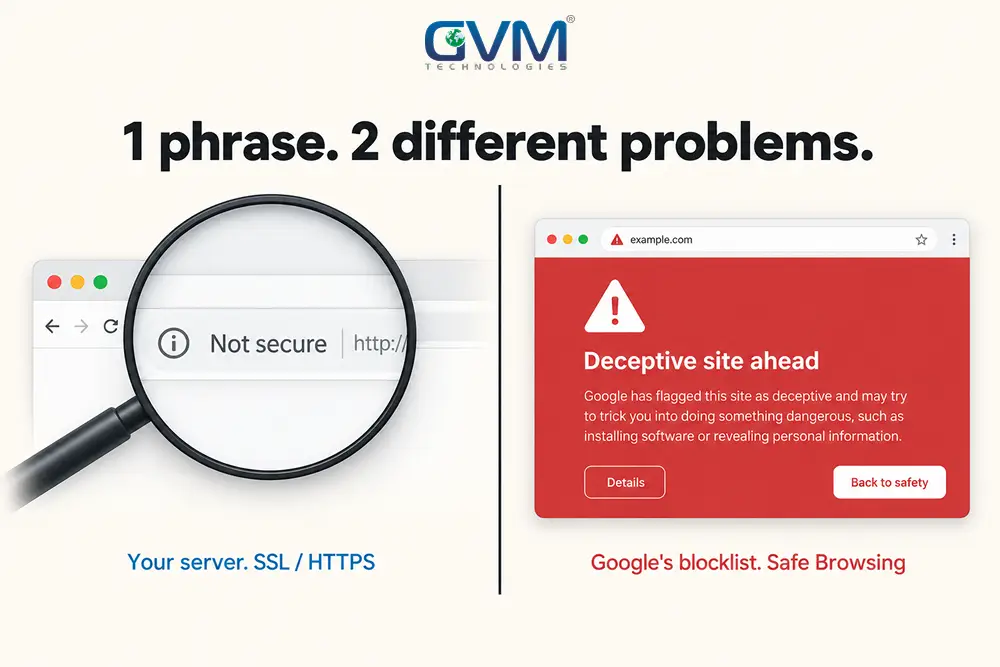
| Security threat | Warnings shown to visitors | Security issues report, deceptive site warnings |
| Spam violation | Pages demoted or removed | Manual actions report |
| Seasonality | Traffic dips but rankings hold | Google Trends |
| Site migration | Swings after URL changes | Redirect and index checks |
The 4-question Google penalty check
Run this Google penalty check before any fix:
- Date: did the drop start on a confirmed update date?
- Notice: does the Manual actions report show an action?
- Scope: is the loss site-wide, or limited to 1 page type such as blog posts?
- Health: is the site indexed, secure and online?
Practitioners add a fifth habit: compare brand and non-brand queries. When brand searches hold but blog and support pages fall, the problem sits in that content section, not the whole domain.
Give a sudden cliff 72 hours before big edits. One reported fall from page 1 to page 8 reversed within days, and the only fault found was a sitemap full of duplicate URLs.
Reading the drop pattern in Search Console
Google’s guidance turns the Google penalty check into a shape test. Use 16 months of data, then match your pattern:
- Rank 2 to 4 with stable impressions is normal noise, so no action
- Top 10 to position 29 across many keywords points to a content quality problem
- Stable impressions with falling clicks means weak titles or snippets
- A sharp site-wide fall suggests a technical fault
- A gradual page-level slide suggests a page-specific issue
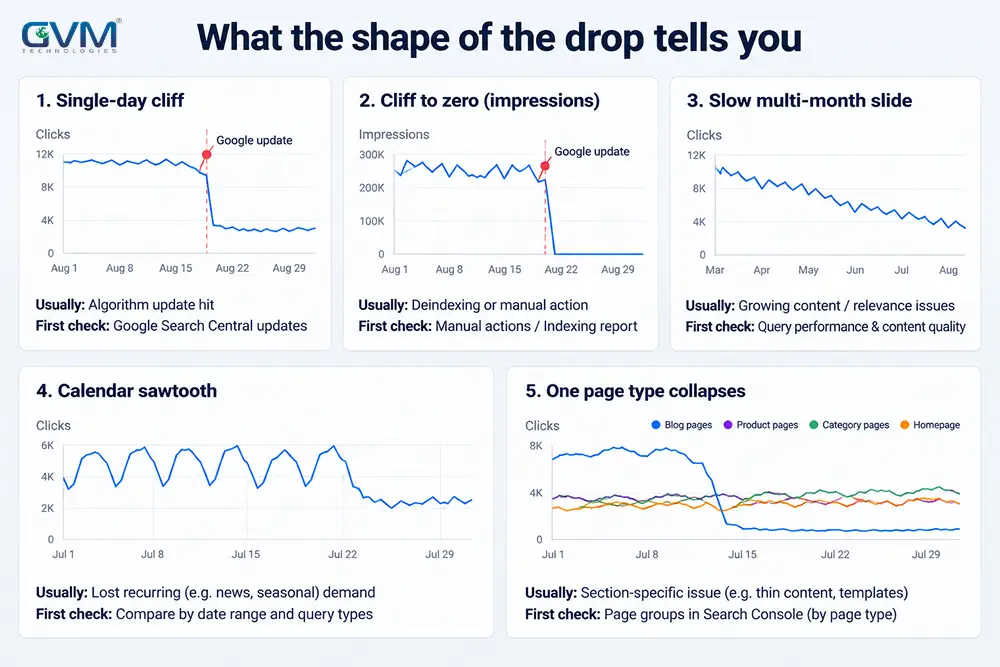
Not every “not indexed” page is a problem. CMS plugins create /feed/ URLs that sit in “Crawled, currently not indexed” forever, so check whether the pages are real, then read why pages are not indexed.
Google penalty recovery differs for manual actions and algorithm updates
A Google manual action is a human decision with a notice and a review request. An algorithmic hit is automatic, silent and has no request form. Your Google penalty recovery plan, proof and timeline depend on which one you have.
| Particulars | Google manual action | Algorithmic hit |
|---|---|---|
| How you find out | Notice in Manual actions report | No notice |
| Cause | Reviewer finds a spam policy breach | Ranking systems re-rate the site |
| Fix scope | Every affected page | Overall site quality |
| Request | Review request | None exists |
| Typical wait | Days to weeks, longer for links | Months |
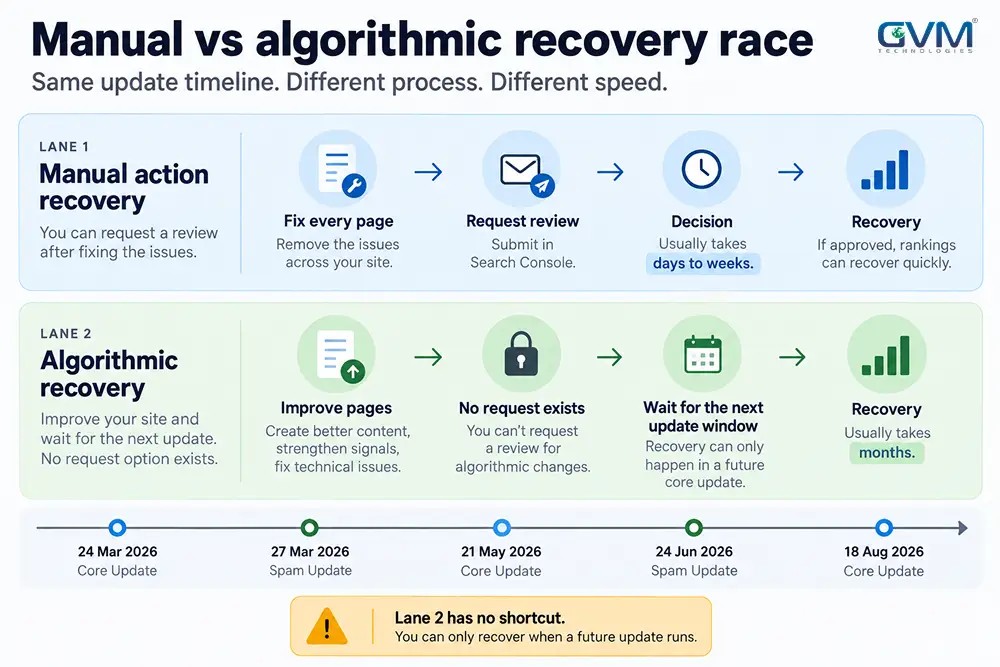
Google manual action: fix everything, then ask once
Google penalty removal follows the rules in Google’s Manual actions report guidance:
- Fix every affected page, because fixing some earns no partial return
- Make sure Google can crawl them, with no login, paywall or robots block
- Explain the issue, the steps taken and the outcome in the request
- Never resubmit before a decision arrives
- Content policy breaches for Discover and News can also appear as manual actions
Algorithm hits: dates, patterns and patience
Match your first bad day to 2026’s updates on the status dashboard:
| Update | Started | Ran for |
|---|---|---|
| March 2026 spam update | 24 March | 19 hours |
| March 2026 core update | 27 March | 12 days |
| May 2026 core update | 21 May | 12 days |
| June 2026 spam update | 24 June | 2 days |
| August 2026 spam update | 18 August | 2 days 16 hours |
Sites penalized by Google in the August update should read the reports, including GSQi’s case studies, which say it targeted scaled content abuse, programmatic pages, AI-written text at scale and thin affiliate pages. It did not target link spam.
Google penalty recovery took several months at minimum, about 5 months in documented cases. Sites also need to stay clean for a long stretch, so new pages may earn only a trickle of impressions meanwhile.
What each spam violation looks like and how to fix it
Google’s spam policies name 16 violation types, but small sites penalized by Google usually hit 3 groups: content at scale, manipulative links, and security or redirect abuse. Fix the group your notice or update date points to. That keeps Google penalty recovery focused.
1. Content violations: scaled, thin and affiliate pages
- Scaled content: many pages made mainly to rank. Google says AI-generated content is not banned, but mass pages without value can break policy
- Thin affiliate: copied merchant data. Add original testing or delete
- Doorway pages: near-identical city or keyword pages. Merge them into 1 useful page
- Site reputation abuse: third-party content hosted mainly to borrow your rankings. Remove it or separate it
A practitioner rule of thumb: review pages with under 30 to 50 clicks in 12 months, then merge, update or delete. Check backlinks before deleting anything.
2. Link violations: unnatural links to and from your site
- Links to you: bought, exchanged or automated links. For Google penalty removal, remove them first, document outreach, disavow last
- Links from you: sold links pass rankings. Remove them or mark them
rel="sponsored"
3. Security, cloaking and redirect violations
- Hacked content: injected spam pages. Search
site:yourdomain.complus spammy terms, clean, patch, then request review. Our hacked website guide notes malware reviews often clear in a day, while spam reviews take a week or more - Cloaking and sneaky redirects: different content for Googlebot and visitors. Test with URL Inspection
- User-generated spam: a marketplace had blank profile pages and spam profiles indexed. The fix was 410 for spam, then re-indexing only its best 10 to 20% of profiles
The 7-step Google penalty recovery plan
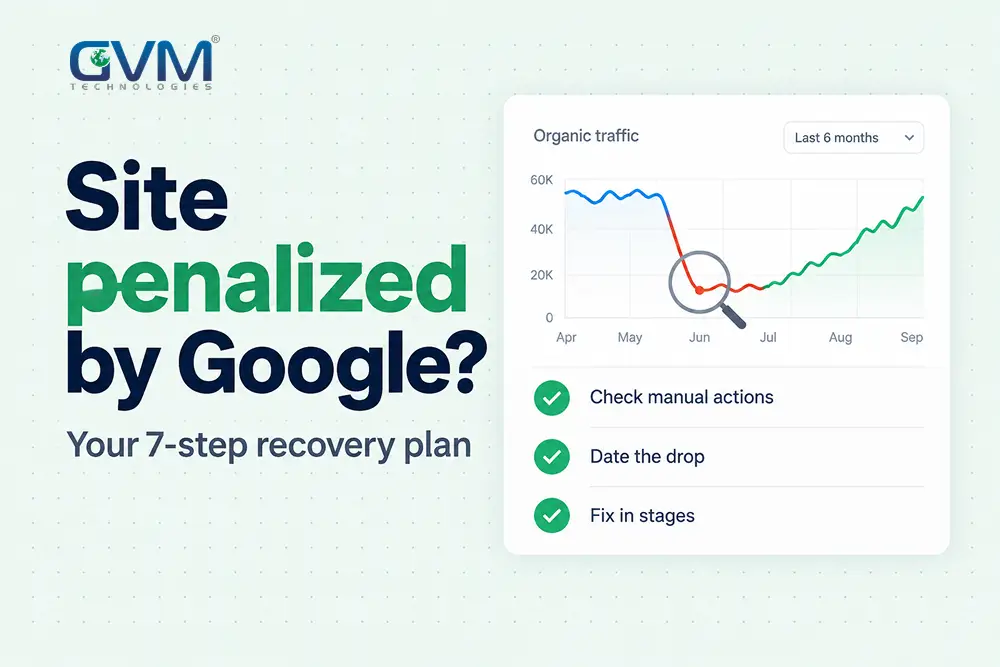
Google penalty recovery takes 7 steps: freeze changes and export data, check for a Google manual action, date the drop, segment the losers, fix in stages, request review or publish improvements, then monitor after each update. Skipping the order costs weeks.
- Freeze and export. Stop edits. Export 16 months of Search Console data and screenshot the Manual actions report.
- Run the Google penalty check. Read the notice pattern. A directory pattern means partial scope.
- Date the drop. Match the first bad day to update dates and your own release log.
- Segment the losers. Split brand vs non-brand, blog vs product pages, and sort by clicks difference.
- Fix in stages. Start with high-traffic pages. Hundreds of simultaneous changes hide what worked.
- Ask or publish. For Google penalty removal after a manual action, send the review request with evidence. Algorithmic: improve pages and keep them live.
- Monitor per update. Recheck about 4 weeks after each update window and log movement.
After rewriting a page, update its date honestly and earn a few links from relevant sites. Both signal that the page changed and that others vouch for it.
Rewrite for the intent behind the query, not the keyword alone. Keyword research best practices shows how to check that intent.
Disavow, 410 and 301: what to do with bad links and dead pages
In Google penalty recovery, Google says most sites do not need the disavow tool. Use it only when many spammy links caused, or will likely cause, a Google manual action. For dead spam pages, a 410 status tells Google the URL is gone for good.
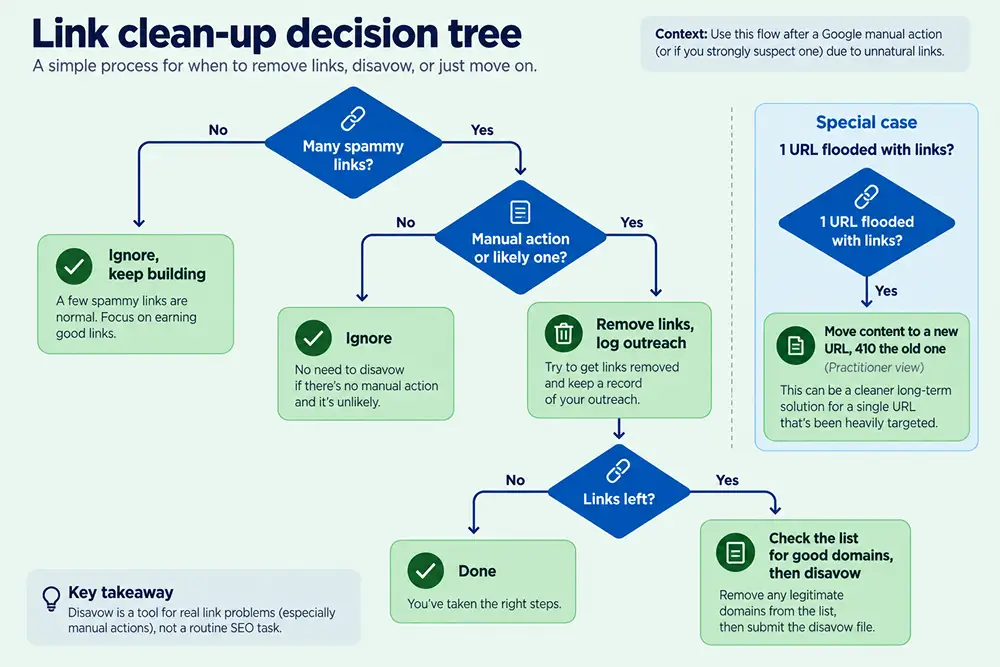
When a disavow file is justified
- Google’s disavow guidance asks for both a large spam link count and a Google manual action risk
- Google penalty removal for link cases starts with removal outreach, then the disavow file
- Remove links from the web first. Processing takes a few weeks
- Google’s Search Advocate has said a handful of disavowed links will not make a site drop out of search
The correlation trap: an owner lost the #3 spot 2 weeks after a disavow. It was also the week of the August 2026 spam update. During Google penalty recovery, check update dates before blaming the file, and remove valuable domains from it if you find them.
A single URL flooded with junk links
Some practitioners move the content to a new URL, return 410 on the old one, stop linking to it internally and avoid a 301 that carries the problem forward.
Views differ, since others say Google simply ignores such links.
Results are mixed. An owner with 120,000 links to a page did this and saw no quick return, which suggests links were not the only cause.
Mistakes that stretch Google penalty recovery
- Skipping the Google penalty check. Fixing before diagnosing wastes weeks.
- Requesting review too early. A failed request delays Google penalty removal by lengthening the queue for the next one.
- Fixing sample URLs only. Google expects every affected page fixed.
- Noindexing everything. It removes inventory that earned links and rankings.
- Disavowing whole spreadsheets. “Toxic” scores from tools are not Google’s view.
- Calling seasonality a penalty. If rankings hold and traffic dips, demand fell.
- Trusting “20-day recovery” stories. Google’s own guidance says algorithmic recovery takes months.
- Buying a guaranteed fix. No vendor controls Google’s systems. Use these questions to ask an SEO agency before you pay anyone.
- Expecting the old peak. A site penalized by Google regains what it earned legitimately, not the lift the violation gave it.
Where GVM Technologies shortens the recovery
Google penalty recovery mixes SEO judgment with development work, and GVM Technologies covers both. Our SEO service starts with an audit, competitor analysis and keyword strategy, then our developers fix the hosting, security and speed faults the audit finds.
- SEO service: technical, on-page, off-page and content fixes
- Website development: rebuild thin or slow templates on clean, SEO-optimized code
- DevOps and cloud hosting: infrastructure management and security
- Generative Engine Optimization: rebuild visibility in ChatGPT and Google’s AI results once the site is clean
In our GlobalRose SEO campaign, the same audit, technical, content and link sequence lifted domain authority from 12 to 28 in 6 months, per the case study. It was not a penalty case, but the method is the same.
If your site is penalized by Google and a review request just failed, or a hack keeps returning, a second pair of eyes saves weeks.
FAQs
1. Is my site penalized by Google or just outranked?
Run the Google penalty check above. If the Manual actions report says no issues, you have no Google manual action. Compare your drop date with update dates, and check whether rivals gained on the same queries.
2. How long does Google penalty recovery take?
Google penalty recovery after a manual action takes several days to weeks for review, longer for link cases. Algorithmic recovery takes months and often depends on the next update or system refresh.
3. Can Google penalty recovery happen without a reconsideration request?
Yes, for algorithmic hits. No request exists for them, so Google penalty removal means improving the pages, keep them live and wait for Google to reassess the site.
4. Should I run Google penalty removal steps like disavowing links?
Only with many spammy links and a Google manual action risk. Google says most sites do not need the tool, and mistakes can harm rankings.
5. Will deleting AI content fix a Google penalty?
Not automatically. Sites penalized by Google for scaled content should know Google does not ban AI content, but mass pages without value break its policy. Merge or improve what earns traffic, and delete what does not.
Conclusion: diagnose first, fix in stages, then wait with proof
Google penalty recovery is mostly diagnosis. Do the Google penalty check first, separate a Google manual action from an algorithm hit, fix the whole cause and keep records, because Google penalty removal needs proof.
Then give Google time to reassess. Most sites penalized by Google recover faster by fixing the right thing once, since reviews take weeks and algorithm recovery takes months.
Talk to GVM Technologies about your Google penalty recovery
If your site was penalized by Google, tell us what changed and when. We will tell you whether it is a Google manual action, an update or a fault, and what to fix first.