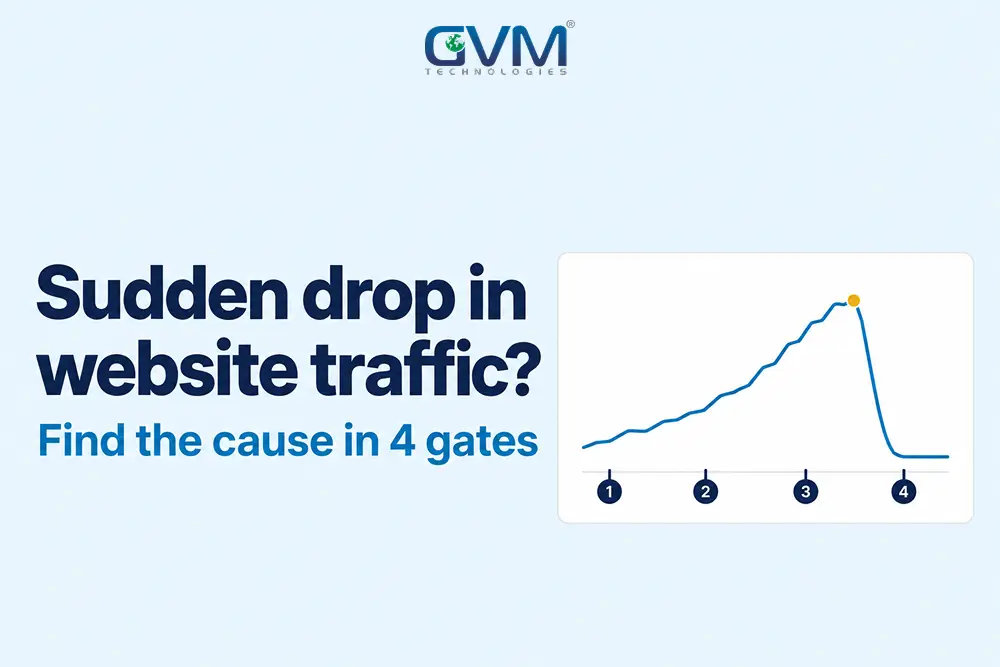
A traffic drop is a steep fall in visits over days, not a slow slide over months. You open the dashboard, the line hits the floor, and nobody can say why.
A sudden drop in website traffic has 4 usual suspects: broken tracking, blocked pages, a penalty or lost rankings. Check them in order, or start with our website down checklist if the site will not load.
Quick answer: A sudden drop in website traffic usually traces to 1 of 4 causes: analytics that stopped counting, pages Google cannot index, a penalty or spam update, or lost rankings. Confirm the numbers in Search Console, then match the start date to a site change or Google update.
Key takeaways
- Data first: a sudden drop in website traffic can be a removed tag, a wrong Search Console property or a Google logging error.
- Shape names the cause: a sudden drop in website traffic shaped as a cliff means a block, a slope lost rankings, a spike a reset.
- Clicks beat impressions: Google’s impression logging was inaccurate from May 13, 2025 to April 27, 2026, while clicks stayed accurate.
- Dates solve cases: note the first day and hour, then match it to deploys, DNS, SSL, plugin updates and Google updates.
- Hands off content: rewriting pages before the cause is known changes only what was never broken.
A sudden drop in website traffic clears 4 gates, in a fixed order
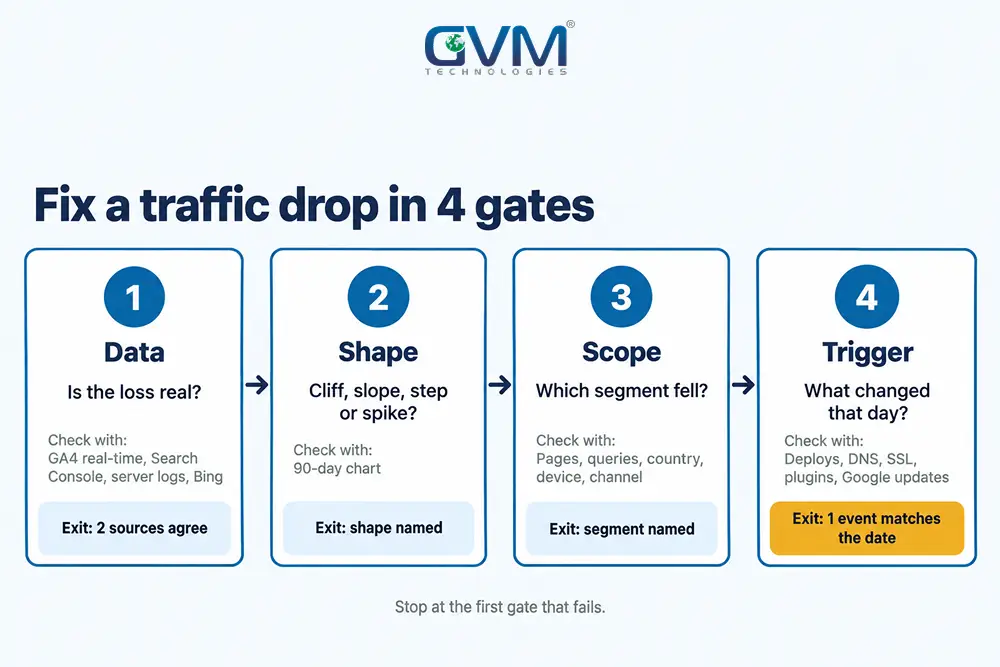
Work through 4 gates in order: confirm the data, read the drop’s shape, narrow its scope, then find the trigger. Each gate rules out a whole family of causes, so the guessing usually stops within about 30 minutes of checking.
The 4-Gate Drop Triage for a sudden drop in website traffic
The 4-Gate Drop Triage is a fixed order of 4 questions for any sudden drop in website traffic. Each gate has 1 exit test. A full technical SEO audit goes deeper on the same ground.
| Gate | Question | Where to look | Clears when |
|---|---|---|---|
| 1. Data | Is the loss real? | GA4 real-time, Search Console, server logs | 2 sources agree |
| 2. Shape | Cliff, slope, step or spike? | 90-day line chart | You can name the shape |
| 3. Scope | Which segment fell? | Pages, queries, country, device, channel | You can name the segment |
| 4. Trigger | What changed that day? | Deploy log, DNS, SSL, plugins, Google updates | 1 event matches the date |
Why the order matters when you diagnose a sudden drop in website traffic
Many website owners type “why is my website traffic dropping” and start at the last gate. A common mistake across SEO communities is rewriting content first, then finding a deleted tracking tag.
Write down the exact day and hour the line broke. Developers, hosts and Google’s own troubleshooting all start from that timestamp.
Gate 1: confirm a sudden drop in website traffic is real before touching anything
A sudden drop in website traffic is real only when 2 independent sources show it. Check that analytics still records visits, that Search Console shows the right property, and that server logs or Bing agree. Data faults cost nothing to fix and fake the scariest charts.
1. Analytics faults that fake a sudden drop in website traffic
- Missing tag: a theme change, redesign or plugin swap can strip the GA4 snippet from every page.
- Real-time test: open the site in a private window and watch GA4 real-time for your own visit.
- Consent banner: a stricter cookie banner hides visitors who decline, so sessions fall while real visits hold.
- New property: a fresh GA4 property or renamed events can restart totals at zero.
Our guide to the role of analytics in digital marketing explains which metrics to keep stable.
2. Search Console views that exaggerate a sudden drop in website traffic
- Wrong property: Google lists a property that does not match your site’s http, https or www version as its first cause, in its traffic drop guide.
- Logging errors: Google’s anomalies log shows skewed impressions and position from May 13, 2025 to April 27, 2026. Clicks held.
- The num=100 change: Google stopped serving 100 results per page in September 2025, and 319 sites studied mostly lost impressions.
Clicks and conversions are the cleaner signal. A falling impression line with steady clicks is a reporting shift, not a loss.
3. Cross-checks from 3 independent sources
- Server access logs: ask your host for requests per day, since logs do not depend on any script.
- Bing Webmaster Tools: steady Bing clicks beside a Google collapse mean the cause sits on Google’s side.
- Business signals: calls, form leads and orders, plus calls from a Google Business Profile listing. If these held, the lost visits were not buying.
Gates 2 and 3: read the shape of a sudden drop in website traffic, then narrow its scope
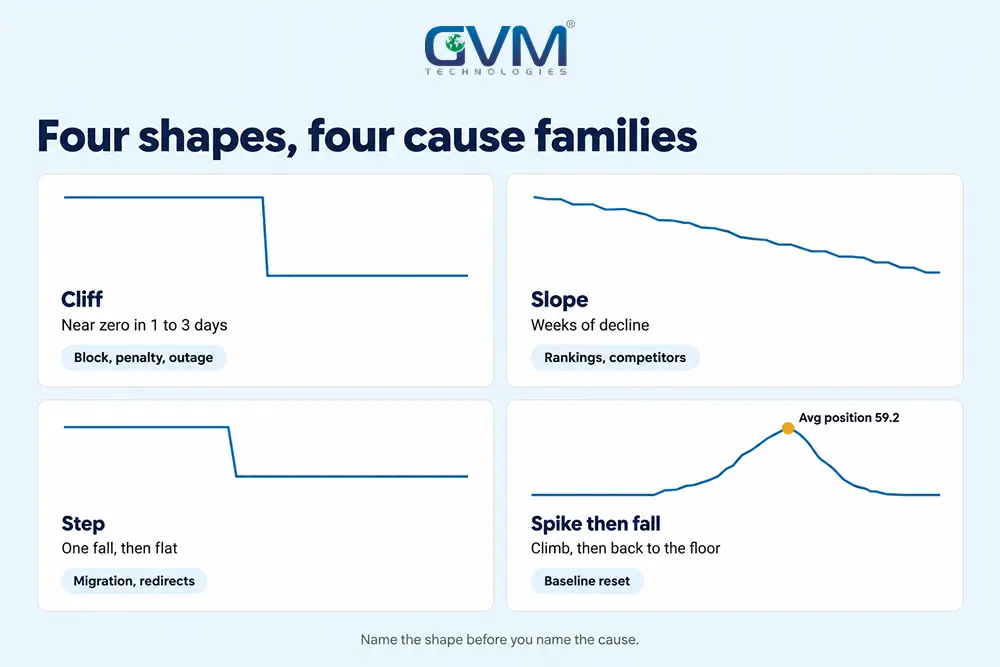
The shape of the line names the cause family. A cliff points to a block, penalty or outage, a slope to lost rankings, and a spike then fall to a reset. Scope then narrows it to 1 page group, country, device or channel.
1. 4 shapes of a sudden drop in website traffic and what each means
| Shape | What you see | Usual causes | First check |
|---|---|---|---|
| Cliff | Near zero within 1 to 3 days | noindex, robots.txt block, DNS or SSL failure, manual action, tag removed | Page Indexing, Manual actions, GA4 real-time |
| Slope | Steady decline over weeks | Lost rankings, new competitors, stale pages, AI answers | Compare 2 date ranges by query |
| Step | 1 fall, then flat | Migration, broken redirects, template change | Old URLs against the redirect map |
| Spike then fall | Impressions climb, then return to the floor | Baseline reset, scaled content, spam update | Average position, indexed page count |
2. A sudden drop in website traffic after a spike on a new site
Picture a 3-month Search Console view with 13.3K impressions, 34 clicks, 0.3% CTR and an average position of 59.2. That position sits around page 6, where almost nobody clicks.
Clicks peaked at 5 a day, so the traffic that vanished was never really traffic. The fall after the spike was a return to baseline, not a loss of customers.
If that is your chart, check Bing and your content depth before blaming a penalty.
3. Segments and the clicks versus impressions split
Split the loss first:
- Country and device: a mobile-only or 1-country fall points to rendering, localization or a weak mobile-first design.
- Channel: organic, direct, referral, paid and social, so a stopped ad budget does not pose as an SEO loss.
- Page group: blog, product, service or location pages, to expose a folder or template fault.
- Query type: brand versus non-brand, since a branded fall signals demand, not rankings.
Then read impressions and clicks together:
| Impressions | Clicks | Likely reading |
|---|---|---|
| Fell | Fell | Indexing loss, penalty or lost rankings |
| Held | Fell | SERP change, AI answer or weaker snippet |
| Fell | Held | Reporting shift or bot impressions |
| Held | Held, GA4 fell | Tracking fault |
Gate 4, technical triggers: 3 site changes behind a sudden drop in website traffic
When a site vanishes in a night, a change on your side is the likeliest cause. Look for noindex or robots.txt rules left from staging, broken redirects after a launch, and DNS, SSL, server or rendering failures that Googlebot meets first.
1. A noindex tag or robots.txt block left over from staging
A noindex tag asks Google to drop a page, while Disallow: / in robots.txt blocks crawling.
Open yoursite.com/robots.txt, view the page source for noindex, and run URL Inspection on 3 key pages. If pages show as excluded, our Search Console pages not indexed guide maps each status.
2. Migrations and redirects that cause a sudden drop in website traffic
A step-shaped fall after a redesign usually means old URLs now return 404 instead of a 301 redirect. Test the top landing pages from before launch against the new redirect map.
GVM Technologies rescues stalled or failing builds through code audits and repairs.
3. DNS, SSL, server and rendering failures
- DNS: a host move or lapsed registration can point your name at the wrong server.
- SSL: an expired SSL certificate throws browser warnings and crawl errors.
- Server errors: repeated 5xx responses make Googlebot slow its crawling, so read the logs.
- Rendering: URL Inspection’s rendered HTML shows what Googlebot sees. Missing content needs a developer.
GVM’s DevOps team runs real-time monitoring and CI/CD releases, so outages and bad deploys raise alerts instead of surprising you.
Gate 4, search-side triggers: penalties, spam updates and AI answers
If a sudden drop in organic traffic survives Gates 1 to 3, look at Google’s side. A manual action appears in Search Console, while a spam or core update shows only as a date match. AI answers add a third pattern: impressions hold and clicks fall.
1. Manual action versus algorithm update
Open the Manual actions report first. A listed action explains the loss, and Google says reconsideration reviews take several days or weeks.
Google sends no notice for algorithmic changes, so match your start date to the 2026 calendar on its Search Status Dashboard:
- March 24 to 25: spam update
- March 27 to April 8: core update
- May 21 to June 2: core update
- August 18 to 21: spam update
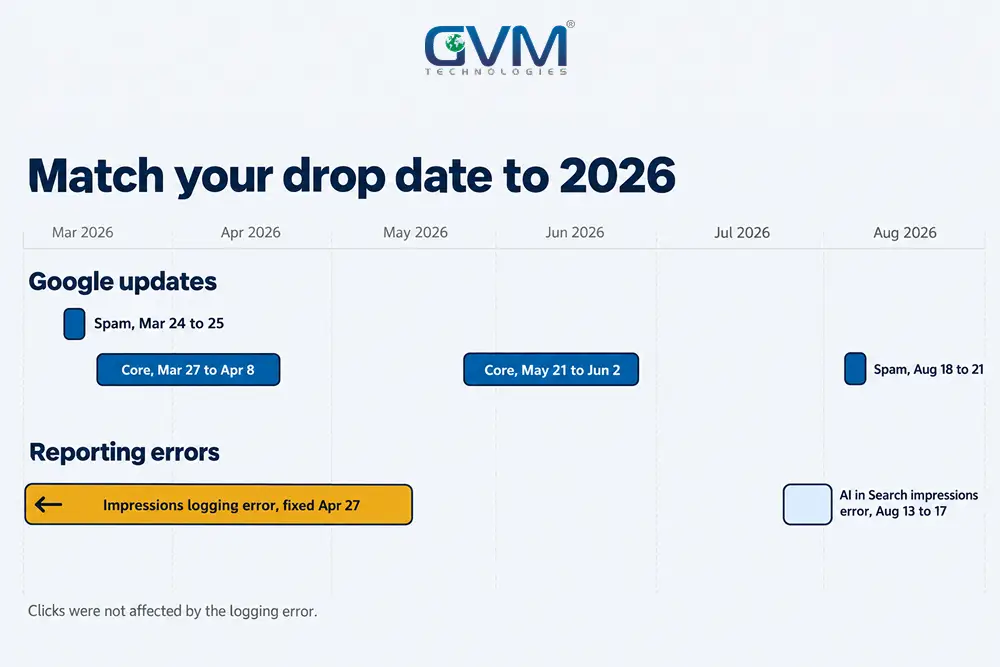
A date match is a clue, not proof. Core updates roll out over about 2 weeks, so changing pages mid-rollout muddies the result. Our Google penalty recovery plan covers the steps after.
2. Scaled or thin pages
Google’s spam policies name scaled content abuse: many pages made mainly to rank, however created. Dozens of near-duplicate pages in 1 month, then lost visibility, fit that pattern.
Merge or noindex thin pages, add original data, then wait. GVM’s SEO team runs technical audits covering crawlability and structured data before any content pruning.
3. AI answers and the clicks gap
When impressions hold and clicks fall, the page still ranks but fewer people click. AI answers explain part of that. Informational queries tend to lose clicks first, so compare them with commercial ones.
Short answer blocks, clear entities and schema help AI systems quote you. GVM’s Generative Engine Optimization service covers semantic structure, schema markup and AI search monitoring.
A 4-step recovery plan for a sudden drop in website traffic
Recovery runs in 4 steps: freeze the evidence, fix the cause, wait out the recrawl, then monitor by segment. Technical fixes show results only as Google recrawls, which it says can take a week or more, while manual actions and core updates run on Google’s own schedule.
1. Freeze the evidence in the first 24 hours
- Screenshot the Search Console and GA4 charts, and note the first day and hour of the drop.
- Confirm 2 sources agree, using Gate 1.
- Check Manual actions, Security issues and Page Indexing.
- List every release, plugin update, DNS or host change from the 7 days before.
2. Fix the cause of a sudden drop in website traffic, 1 change at a time
Log each change with a timestamp. Then match the fix to the cause:
- Tracking fault: reinstall the tag, and counts return the same day, though the missing history stays missing.
- noindex or robots block: remove the rule, then request a recrawl with URL Inspection.
- Broken redirects: map each old URL to its new page with a 301, and expect weeks.
- Bad plugin or theme update: roll back, as in our WordPress update broke my site guide.
- Manual action: fix every flagged issue, then submit 1 reconsideration request.
- Core or spam update: improve thin pages, since recovery often waits for a later update.
3. Wait out the recrawl before judging a sudden drop in website traffic
Google says a recrawl can take a week or more, and a manual action review takes several days or weeks.
Compare the same weekdays across 2 weeks, not today against yesterday. Pages edited during a core update rollout muddy the result, so hold content changes until it ends.
4. Monitor by segment and avoid mistakes that stretch the drop
GVM’s SEO reporting covers keyword rankings and traffic reports, so you can see whether a recovery is real. Then avoid these mistakes:
- Rewriting first: content changes before Gate 1 hide the real cause.
- Changing many things at once: nobody can tell which change worked.
- Disavowing blindly: a disavow file helps only when real link spam exists.
- Relying on 1 channel: an email list, Bing and referrals soften the next drop.
- Hiring blindly: vet any unsolicited audit offer with these questions to ask an SEO agency.
FAQs
1. Why is my website traffic dropping to zero overnight?
Zero in 1 night points to a block or a data fault: a noindex tag, a robots.txt rule, a DNS or SSL failure, a manual action, or a removed analytics tag. Check GA4 real-time first.
2. How long does traffic take to recover after a sudden drop in website traffic?
A removed block recovers within weeks, because Google needs a week or more to recrawl. Manual actions wait on Google’s review, and core update losses often need a later update.
3. Is a sudden drop in website traffic a Google penalty?
No. Manual actions show in Search Console, and most drops come from tracking faults, technical changes, algorithm updates or lost rankings.
4. Why are my impressions up but clicks down?
The page still appears, yet fewer people click. Common causes are AI answers, richer results and a weaker title.
5. Can a Google update cause a sudden drop in website traffic when nothing changed on my site?
Yes. Core and spam updates re-rank pages without any change on your side, so match the start date to the update calendar.
Conclusion: confirm the data, then match the date
A sudden drop in website traffic is 1 cause waiting for a timestamp. Confirm the data, read the shape, narrow the scope, then match the date.
Your checklist for today:
- Compare GA4 with Search Console clicks and 1 server or Bing source
- Write down the first day and hour of the sudden drop in website traffic
- Check Manual actions, Page Indexing, robots.txt and noindex
- List every release, plugin, DNS or host change from the 7 days before
With alerts and a monthly Gate 1 check in place, the next sudden drop in website traffic becomes a 30-minute job.
Talk to GVM Technologies about a sudden drop in website traffic
Traffic is gone, the cause is unclear and each day without a fix costs inquiries. GVM Technologies helps in 4 ways:
- Search engine optimization: technical SEO audits plus traffic and ranking reports
- DevOps and cloud hosting: real-time monitoring and CI/CD releases that catch bad deploys
- Project rescue: code audits and repairs for builds that stalled or broke after a launch
- Quality assurance testing: manual and automated tests before each release
We took a US trucking insurance agency to first-page rankings on numerous high-intent searches within 90 to 120 days, as this trucking insurance case study shows.
Send us your chart, the start date and what changed that week.