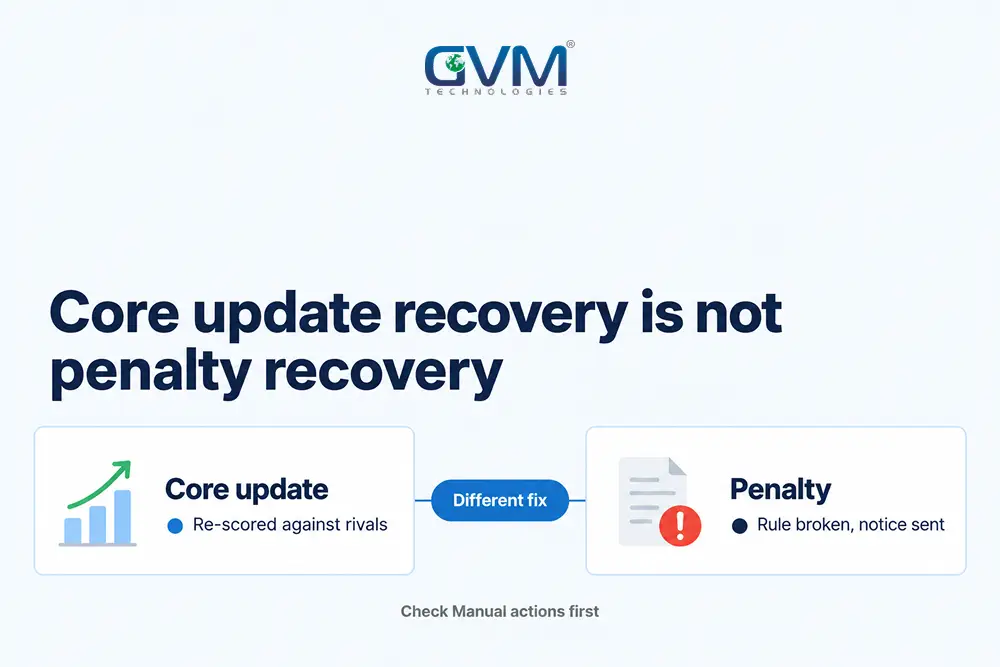
A core update is Google’s broad re-scoring of how pages rank. A penalty is a punishment for breaking its spam rules, and traffic can fall after either one.
Core update recovery means becoming the better answer, while penalty recovery means removing a violation. Run a traffic drop triage first, then pick the plan that fits.
Quick answer: Core update recovery is not penalty recovery. A core update re-ranks pages against rivals and sends no notice, so you build better answers. A manual action shows in Search Console and needs a fix plus a review, so check that report first.
Key takeaways
- 3 verdicts, not 2: a drop can come from a manual action, an automated spam demotion or a core update re-score.
- Notice test: only a manual action leaves a message in Search Console, and a core update penalty notice does not exist.
- Date test: 2026 core updates ran 27 Mar to 8 Apr and 21 May to 2 Jun, so match your first drop day to them.
- Clock test: each verdict has its own clock, from weeks after a review request to months of core update recovery.
- Shape test: a cliff that stays flat through 2 later updates points to a site-level cause, so waiting alone will not fix it.
What Is Core Update Recovery, and Why Penalty Rules Do Not Apply
Core update recovery is the work of regaining rankings after Google re-scored pages across the web. Google says core updates do not target specific sites, so no violation exists to remove. You win positions back by serving searchers better than the pages that passed you.
1. Why a core update penalty is a label and recovery differs
Google describes core updates as broad changes that do not target specific sites or pages. A site that slips is not necessarily bad, because other pages may now fit the query better.
That is why a core update penalty cannot be appealed. No rule was broken, so no form exists.
Many website owners struggle here because 1 chart gets 3 names. Forum threads, vendor blogs and AI answers all say “penalty”, so owners reach for the wrong tool.
Slow pages are a separate check, covered in page speed metrics.
2. Core update recovery vs penalty: the 3 verdicts compared
Most owners search for a core update penalty because 3 different events produce the same traffic chart. The table separates them.
| Verdict | Decided by | Notice | What it says about you | Fix |
|---|---|---|---|---|
| Manual action | A human reviewer | Manual actions report | You broke a rule | Fix all pages, request review |
| Spam demotion | Automated spam systems | None | You likely broke a rule | Remove the cause, wait |
| Core update re-score | Automated ranking systems | None | Rivals scored higher | Improve pages against rivals |
3. Where the two-way comparison misleads
Most guides compare only core updates with manual actions, so a core update penalty claim skips the spam bucket. An empty Manual actions report does not clear a site, since spam updates demote silently.
Google also said in March 2024 that its helpful content system joined core ranking. So “helpful content penalty” talk now sits under core re-scoring.
Diagnose Your Verdict Before Core Update Recovery Starts
Run 3 checks in order: the Manual actions report, your first drop date against Google’s dashboard, and the scope of the loss. Each check rules out 1 verdict. The full set takes about an hour, and no page needs editing.
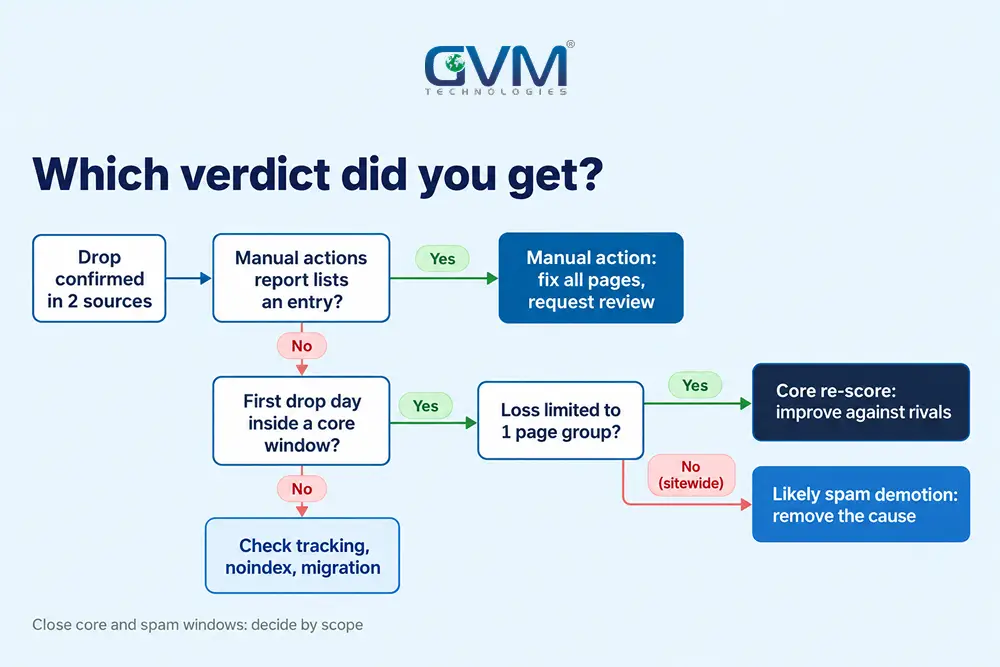
1. Start with the Manual actions and Security issues reports
Open both reports in Search Console. A listed manual action means a human applied it, and Google’s manual actions help page explains the review path.
Hunting for a core update penalty notice finds nothing, because Google sends none. Then rule out causes that only look like penalties:
- Tracking breaks: see analytics that stopped counting.
- Migrations: compare the date with a hosting move.
- Hacks: a hacked site can also trigger spam demotion.
GVM’s SEO audits cover the technical side of this check: crawlability, indexing and structured data.
2. Match your first drop day to the update windows
Note the first day the line fell, then check it against the official Search Status Dashboard. The windows below use its listed dates, and some end dates are approximate:
- 30 Jun to 17 Jul 2025: core update
- 11 to about 29 Dec 2025: core update
- 24 to 25 Mar 2026: spam update
- 27 Mar to 8 Apr 2026: core update
- 21 May to 2 Jun 2026: core update
- 24 to 26 Jun, 18 to 20 Aug and 24 Sep to about 7 Oct 2026: spam updates
As of 26 Oct 2026, no core update has been listed since 2 Jun. The newest ranking event is the September spam update.
3. Separate close windows by scope and signal
The March spam update ended 2 days before the March core update began. So the date alone cannot name the cause.
Use scope instead. A drop on 1 page group, where rivals now out-answer you, reads as a core re-score.
A sitewide fall with old keyword-heavy anchor links or scaled pages reads as spam, according to practitioners who audit local sites.
4. Match the line to 1 of 4 shapes
Open the 16-month view and match the line to a shape:
- Cliff, then flat: clicks fall from about 60 a day to roughly 10 or fewer and stay there for 10 months.
- Staircase: several smaller drops, each near a different update window.
- Notch and return: a dip during the rollout, then a rebound.
- Clicks fall, impressions hold: the URL keeps its spot, but a snippet or AI answer absorbs the click.
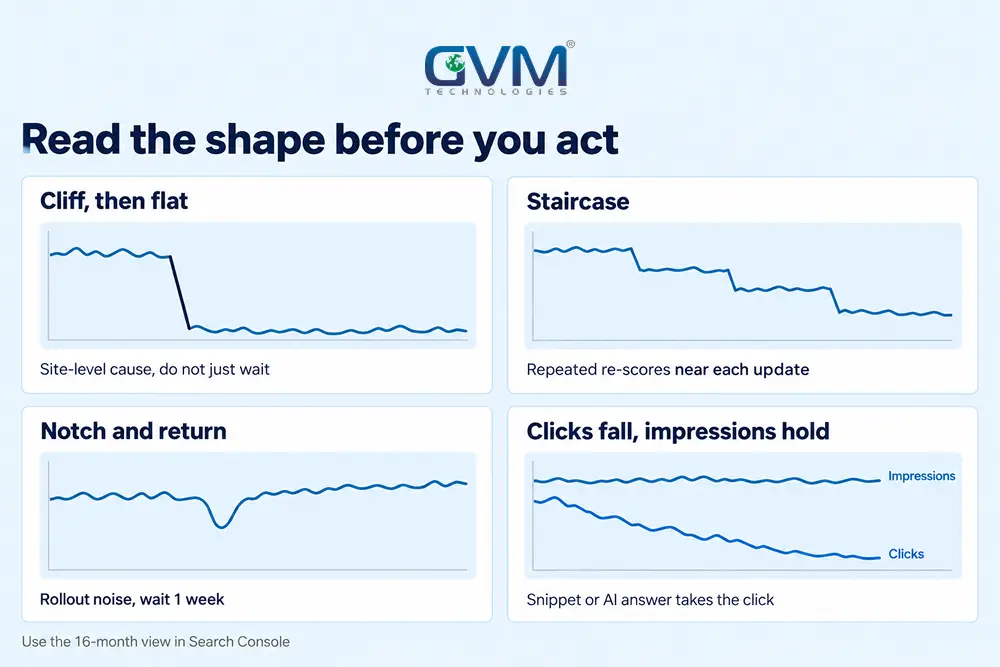
Take an illustration built from a typical 16-month chart, not a client result:
- Cliff: it lands inside the June 2025 core update window.
- Flat line: no response to the December 2025 or March 2026 updates.
- Reading: the step-down fits a re-score, but the silence does not, so check links, scaled pages and indexing statuses.
A volatility tool cannot name your verdict either. In one 30-day Semrush Sensor chart, all but about 2 days sat in the High or Very High band.
GVM’s analytics and reporting work tracks these shapes by page group, so a dip is read against its own baseline.
A Core Update Recovery Plan That Starts With the Search Results
Core update recovery starts after the rollout ends. Wait 1 full week, compare matched periods in Search Console, then read the results page for your top losing queries. The page that replaced you shows what Google now rewards, and so what to build.
1. Wait 1 week, then compare matched periods
Google advises waiting at least a full week after the rollout finishes. Then compare the week after with the week before, as the traffic drop debugging guide describes.
A move from position 2 to 4 needs no drastic action. A fall from position 4 to 29 across many queries calls for a deeper review, such as a technical SEO audit.
2. Name what replaced you in core update recovery
Open your 10 biggest losing queries and look at who sits above you now. The replacement type decides the response.
| Replacement | Signal in the results | Response |
|---|---|---|
| Specialist page | Named author, photos, original data | Add first-hand proof |
| Different format | Short answer, tool, forum thread | Match the format or drop the query |
| Stronger brand | Well-known entities fill the top | Target narrower queries |
| AI Overview or AI Mode | Impressions hold, clicks fall | Earn the citation, accept fewer clicks |
GVM’s competitor analysis runs this comparison for each losing query group.
3. Fix supporting pages first in core update recovery
Many owners rewrite the page that dropped. However, practitioners who audit recovered sites often report that supporting pages and internal links moved first.
Treat that as a pattern, not a proven mechanism.
In practice, 3 moves come up most:
- Consolidate: merge overlapping posts that compete for 1 intent.
- Link: point related pages that already earn traffic at the weak page.
- Prove: add a named author, sources and first-hand evidence, as Google’s helpful content questions ask.
GVM’s content optimization work follows this order, and its keyword research habits keep each page tied to 1 intent.
4. Leave these alone during core update recovery
Google calls deleting content a last resort. Also skip these:
- Disavow files: they address link violations, so they cannot lift a core update penalty that does not exist.
- Title and schema tweaks: neither changes which page answers better.
- 100 edits at once: you could not tell which one worked.
Penalty Recovery Is a Different Job: Manual Actions and Spam Demotions
A manual action ends with a review request, and a spam demotion ends when automated systems re-evaluate a clean site. Neither responds to content polish alone, so remove the violation on every affected page first. Only then does asking or waiting make sense.
Manual action: fix every page, then ask once
Google says a partial fix earns no partial return, and reviews take days or weeks. Do not resubmit while a request is pending.
Our 7-step penalty recovery plan covers the request itself.
Spam demotion: no form, so remove the cause
A manual action lists the affected URL patterns. A spam demotion lists nothing and offers no review button.
Check Google’s spam policies against scaled pages, link schemes and hacked content, then fix the cause. Security testing from GVM’s QA specialists can catch hacked content early.
How Long Core Update Recovery Takes: 3 Clocks
Google says some core update changes show in days, while confirming a site-wide quality shift can take months. A conference recap puts typical core update recovery at 3 to 6 months. Manual actions run faster, because a human reviews the request.
1. The 3 clocks side by side
| Verdict | Clock starts | Range | Source |
|---|---|---|---|
| Manual action | You submit the request | Days to weeks | Google help page |
| Core update re-score | Changes finished | Days to months; 6 to 12 at slowest | Google, plus unofficial recap |
| Spam demotion | Violation removed | No published timer | None |
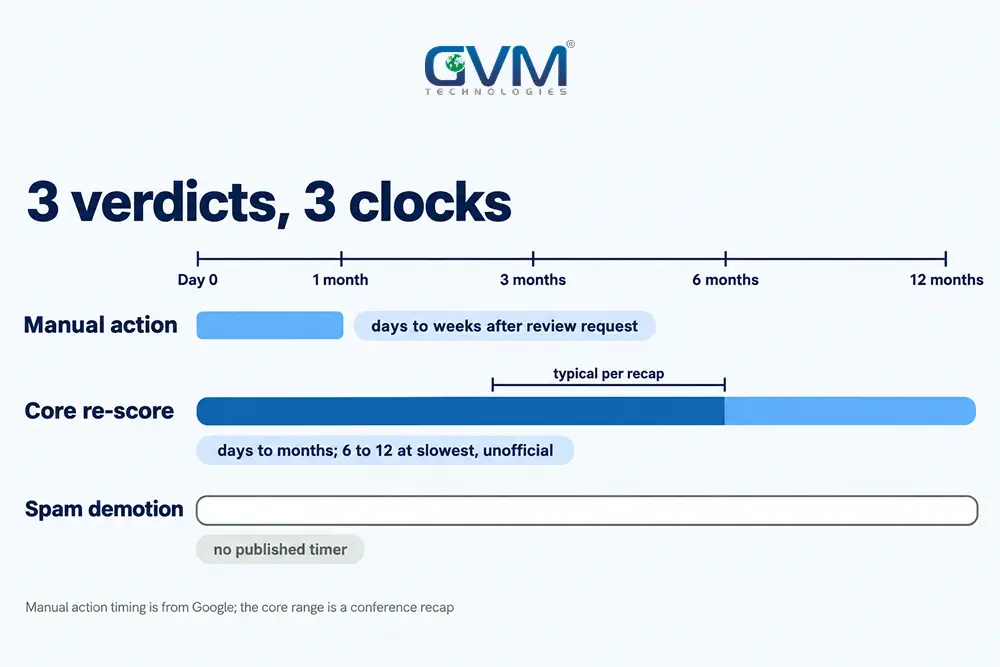
2. Will core update recovery wait on Google’s next release?
Not necessarily, because Google says smaller unannounced updates can lift pages. Yet if months pass with no change, the next core update may be the checkpoint.
As of 26 Oct 2026, the last core update ended nearly 5 months ago. Meanwhile, confirm the pages are indexed, starting with crawled but not indexed pages.
3. Checkpoints that keep core update recovery honest
- Week 1: log the drop day, the update window and the 10 worst queries.
- Weeks 2 to 4: ship 1 change set and note the date.
- Month 3: compare improved pages with untouched pages, using non-brand queries and matched weekdays.
- Next core update: judge the whole site, not single pages.
If both groups rise, the market moved. If only improved pages rise, the work is landing. GVM’s SEO team keeps monitoring and content updates running through this window.
Core Update Recovery Mistakes That Stretch the Wait
The costliest errors are treating the wrong verdict and changing too much at once. Owners who guess wrong spend months on a review request that does not exist, or on a content purge nobody needed. Both errors are avoidable with the checks above.
Mistakes in diagnosis
- Reconsideration for a core drop: the form exists only for manual actions.
- Volatility as proof: a high Sensor score means everyone moved, not you.
- Waiting on a core update penalty notice: Google sends none, and spam demotions arrive silently too.
- Blaming Google first: a broken tag can fake the whole drop.
Mistakes in the fix
- Mass deletion: owners who removed most of an archive report waits past 1 year, and redirect and 404 rules matter when you remove pages.
- A new domain as an escape: Google documents no such route, and reports are mixed.
- Rewriting without a SERP check: you cannot beat a format you have not read.
FAQs
1. Is a Google core update penalty real?
No. A core update is an automated re-score of pages, and Google says it does not target specific sites. A real penalty is a manual action: a person at Google decides, and Search Console tells you.
2. Does core update recovery need a reconsideration request?
No. A core update penalty does not exist, so the review request applies only to manual actions. After a core update, you improve the pages and wait for Google’s systems to re-evaluate.
3. How long does Google core update recovery take?
Google says some effects appear in days, while others take several months. A conference recap puts typical recovery at 3 to 6 months, though it is not official.
4. Is there a Google core update right now?
As of 26 Oct 2026, no core update is rolling out. The most recent one ended 2 Jun 2026,
5. Can a site have a manual action and a core update drop together?
Yes. They run independently, so check Manual actions even when your drop lines up with a core update window.
6. Should I delete old content during core update recovery?
Google calls deletion a last resort, so improve or merge pages first and remove only what cannot be salvaged.
Conclusion: Name the Verdict, Then Work the Right Clock
Core update recovery rewards better pages, while penalty recovery rewards a clean fix. A core update penalty needs no appeal, only a clear verdict and a better answer.
Today’s checklist:
- Open the Manual actions and Security issues reports.
- Log the first drop day against the dashboard windows.
- Note which rivals now sit above your 10 biggest losing queries.
- Pick 1 change set, and leave the rest of the site alone.
Then give the changes a full recrawl cycle before you judge them. If you hire help, these questions to put to an SEO partner keep the quote honest.
Talk to GVM Technologies about core update recovery
A wrong verdict costs months, because the wrong fix runs on the wrong clock. GVM’s team can sort the drop and build the plan. The work covers:
- SEO audits that separate a manual action, a spam demotion and a core re-score
- Content marketing built around the pages that replaced you
- AI search optimization so answer engines can cite the improved pages
- Website development to rebuild slow or broken templates
GVM’s trucking insurance case study reached page 1 for 3 target phrases in roughly 3 to 4 months.