A website accessibility lawsuit is a claim, usually under the Americans with Disabilities Act (ADA), that a disabled visitor could not use a business site. It often starts as a demand letter.
If a website accessibility lawsuit threatens your shop, save the papers, call an ADA defense lawyer and fix with dated proof before paying. Our website accessibility basics cover the fixes.
Quick answer: A website accessibility lawsuit starts a clock, so save every document, check for court dates and hire an ADA defense lawyer before replying. Federal law lets private plaintiffs seek a court order and attorney fees, not damages, while state laws can add money.
Website accessibility lawsuit basics: what the law lets a plaintiff win
Under federal ADA Title III, a private plaintiff can ask a court to order fixes and to award attorney fees, but not damages. State laws can add money. So the same inaccessible checkout can cost very different amounts depending on where the plaintiff lives and sues.
1. Federal remedies in a website accessibility lawsuit
Title III reaches shops, restaurants, clinics and other firms that serve the public. Under the federal remedies statute, a private plaintiff gets an injunction, not money damages.
- Injunction: a court order to fix named barriers, sometimes with monitoring afterward.
- Attorney fees: a winning plaintiff recovers legal costs, which drive much of any settlement figure.
No federal rule sets technical standards for private websites. Courts and settlements usually borrow the Web Content Accessibility Guidelines (WCAG) 2.1 Level AA.
2. Whether your site is covered at all
Courts disagree on whether a website alone is a place of public accommodation. Commentators say the 3rd, 6th and 9th Circuits want a physical-location link, while the 1st and 7th read the law more broadly.
- Store plus website: the strongest coverage case, as in Robles v. Domino’s (9th Cir. 2019).
- Online-only seller: it depends on the circuit, yet plaintiffs sue these shops anyway.
- Brochure site: lower risk, not zero, and a Shopify store or a custom build faces the same claims.
3. State laws that add damages
State and city laws sit on top of the ADA, and some pay money. A plaintiff may plead both.
| Law | What a plaintiff can seek | Effect on the bill |
|---|---|---|
| Federal ADA Title III | Injunction and attorney fees | Sets the fix list and fee exposure |
| California Unruh Act | At least $4,000 per violation in statutory damages | Adds a fixed dollar floor |
| New York State and City human rights laws | Compensatory damages; punitive damages under the city law | Can lift settlements above fee-only levels |
Laws change, so ask counsel which state claims fit your sales and your plaintiff.
ADA demand letter, complaint or scare: sort your situation first
An ADA demand letter is a private request to pay or fix, while a complaint is a court filing with a deadline. Sorting which one you hold sets your clock. Many owners lose weeks treating a served complaint like a letter.
If an agency built the site, check whether your development contract made it answerable for accessibility defects.
| What you hold | What it is | Clock | First move |
|---|---|---|---|
| ADA demand letter | A private request before suit, often with a price | Sender’s date, often 2 to 4 weeks | Save it, call counsel first |
| Summons and complaint | A filed lawsuit | Usually 21 days after service in federal court; states differ | Give it to counsel today |
| Waiver of service request | Paperwork asking you to skip formal service | 60 days if you sign, in federal court | Let counsel decide first |
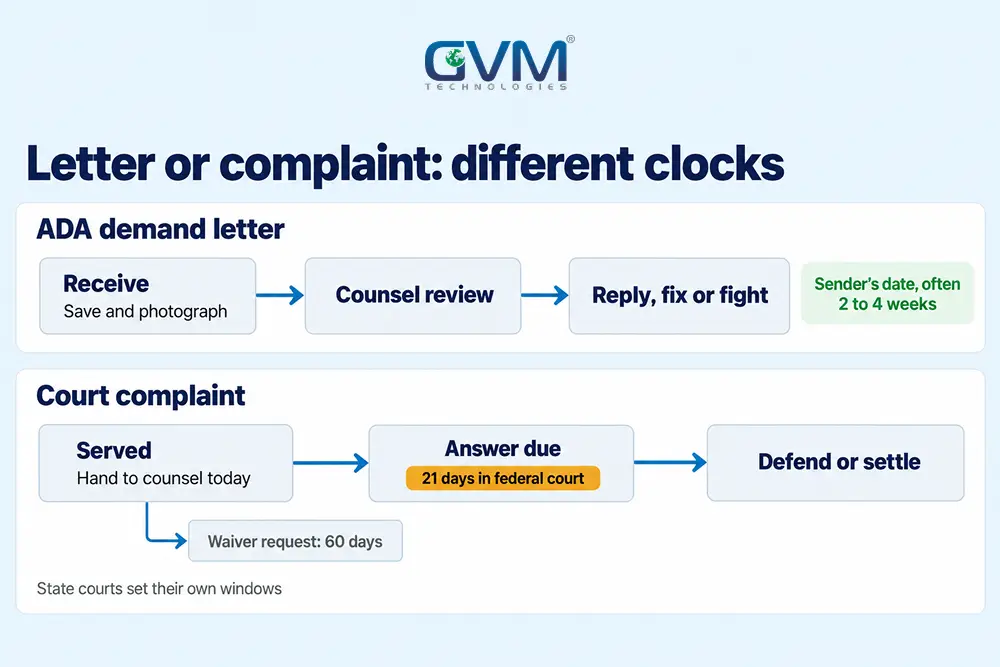
What an ADA demand letter proves, and where its claims stop
An ADA demand letter names pages and WCAG criteria, but it proves nothing in court. Some firms skip the letter and file directly.
Signs of a volume template:
- Vague citations: WCAG criteria with no page, element or screenshot.
- No visit details: no date, device or screen reader, and no purchase attempt.
- Distant plaintiff: someone far from anywhere you sell.
- Repeat filer: dozens of similar cases under the firm’s name in PACER, the federal court records system, or CourtListener.
What changes once a court complaint arrives
- Deadline: unlike an ADA demand letter, the clock runs from valid service, and a missed date can end in default judgment.
- Service questions: papers taped to a door may not count as service, but the plaintiff can serve again, so counsel decides.
- Venue: suits often get filed where the plaintiff lives, so counsel tests whether that court has jurisdiction over you.
Who files a website accessibility lawsuit in 2026, and what changed this year
Federal courts saw 3,117 website accessibility lawsuit filings in 2025, up from 2,452 in 2024, per Seyfarth Shaw. New York, Florida and Illinois led, and online stores drew most claims. Small shops with checkout pages are the usual target.
1. 2025 filing counts and where they cluster
- All federal website filings: 3,117, about 36% of 8,667 Title III suits, per Seyfarth Shaw’s count.
- New York: 1,021 filings, the most of any state.
- Florida: 961, nearly double its 470 in 2024.
- Illinois: 585 filings.
- California: only 4 federal filings, probably because Unruh Act claims run through state court.
Seyfarth warns its method can miss cases, and state courts add more, so treat these counts as a floor.
2. Why small shops get picked for a website accessibility lawsuit
- Cheap to find: a scanner flags missing alt text and unlabeled fields in minutes.
- Clear harm story: “I could not buy this item” reads simply, even for a small purchase.
- Quick builds: pages from AI code tools often ship without labels or alt text.
- Rational settlements: defense bills can top the demand, so many owners pay.
- Tester plaintiffs: the Supreme Court left tester standing open when it dismissed Acheson Hotels v. Laufer as moot in 2023.
Both things can be true. A template ADA demand letter can still point at a real barrier, since blind users report that many checkouts fail with a screen reader.
3. What changed in 2026
- Missouri: SB 907, effective Aug 28, 2026, offers a 90-day fix window after notice, with a presumption against abusive claims.
- Federal law: still no cure period for private websites, so Missouri’s law does not stop a federal suit.
- Title II dates: DOJ moved government-site deadlines to Apr 26, 2027 and 2028, which do not reach private businesses.
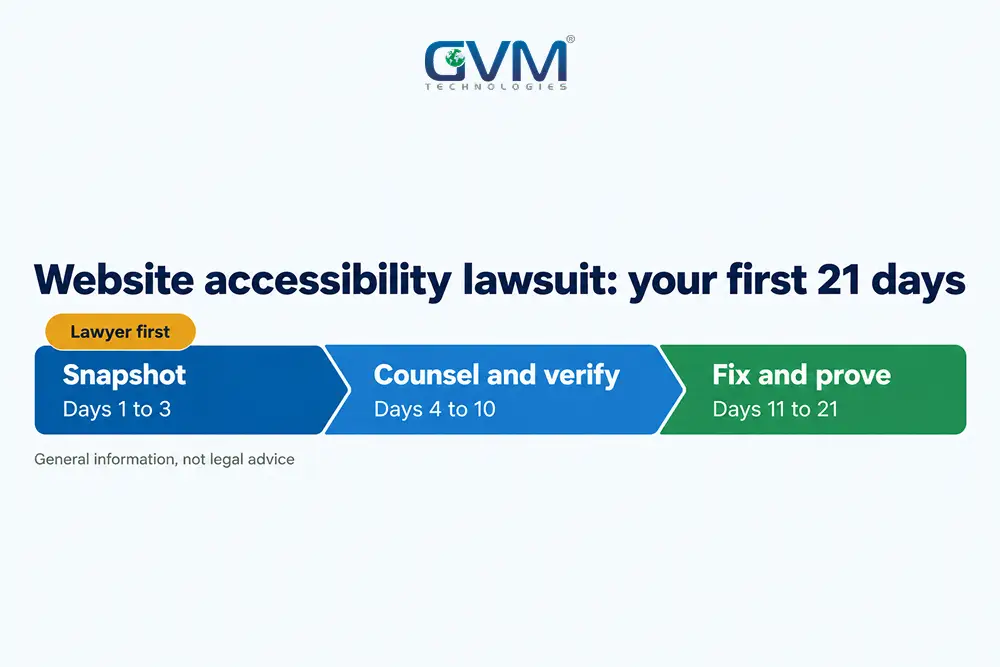
A 21-day plan for a website accessibility lawsuit: snapshot, fix, proof
Use 3 moves in order: snapshot the site as it stands, fix the journeys the claim cites, then prove the fix with dated retests. Fixing first can erase evidence your lawyer needs. Counsel still comes first, since replies are their call.
Treat this as background reading, not a legal opinion.
1. Days 1 to 3: preserve and read the papers
- Save the ADA demand letter or summons, the envelope and any emails, and note who received them and when.
- Hold off on replies, calls and site edits until counsel has seen a snapshot.
- Capture the site: dated full-page screenshots, a full backup of the theme and a plugin list with versions.
- Tell your insurance broker in writing and ask what the policy covers.
- Search the sender in PACER or CourtListener to see their filing history.
2. Days 4 to 10: counsel, verification and scope
- Counsel: hire a lawyer who defends ADA website cases, and ask about a flat-fee first review.
- Verify each claim: repeat every cited barrier on the snapshot, using a keyboard and a screen reader such as NVDA or VoiceOver.
- Map to WCAG: tie each real barrier to a WCAG 2.1 AA criterion, and mark claims that fail on facts.
- Widen the test: check checkout, forms and booking too, since the next ADA demand letter will cite them.
3. Days 11 to 21 and after: fix, retest and record
- Fix in code: work one journey at a time, and log the ticket, commit and date.
- Retest: run keyboard and screen reader passes, and save dated reports.
- Publish a statement: add an accessibility page with a working contact, once counsel agrees.
Evidence of a fix can end a case. In Jones v. Moscot.com, a federal court in New York dismissed a claim as moot after the retailer filed audit evidence and the plaintiff filed nothing to rebut it.
Such rulings can be narrow, so ask counsel whether refiling or state claims remain.
Teams without in-house testers can add manual QA. GVM Technologies runs manual and cross-platform testing, which suits repeat keyboard and device passes between releases.
What a website accessibility lawsuit costs
Third-party estimates put settlements of filed cases from about $5,000 up to $25,000, ahead of defense costs. Flat-fee counsel runs near $2,000 to $8,500, and contested cases pass $15,000 in fees. Those are vendor and defense-firm figures, not court data.
Settlement, defense and fix costs in ranges
- Settlement of a filed case: about $5,000 up to $25,000, and far more where state-law damages apply.
- Flat-fee first review: about $2,000 to $8,500 per matter.
- Contested litigation: $15,000 and up, billed hourly.
- Remediation you owe either way: days for a brochure site, weeks for a custom store.
Owners who have faced a website accessibility lawsuit describe the same pattern: a legal fee and a settlement of similar size, then a separate bill for fixes.
Fixing first costs less than settling, yet a fix alone does not close an open claim.
GVM Technologies scopes remediation on a call, since platform and theme drive the work. For build-side ranges, see the website development costs breakdown.
Insurance and a tax credit owners overlook
- Insurance: some policies cover customer discrimination claims, yet many exclude website claims. Ask your broker in writing.
- Disabled Access Credit: IRS Form 8826 offers eligible small businesses up to $5,000 a year. Ask a tax adviser whether website fixes qualify.
Why overlays and one-time fixes fail to stop a second website accessibility lawsuit
An overlay patches the page in the browser after it loads, so the source code stays as built. A one-time fix also decays whenever themes, plugins or content change. That is why a fixed site still draws a second website accessibility lawsuit.
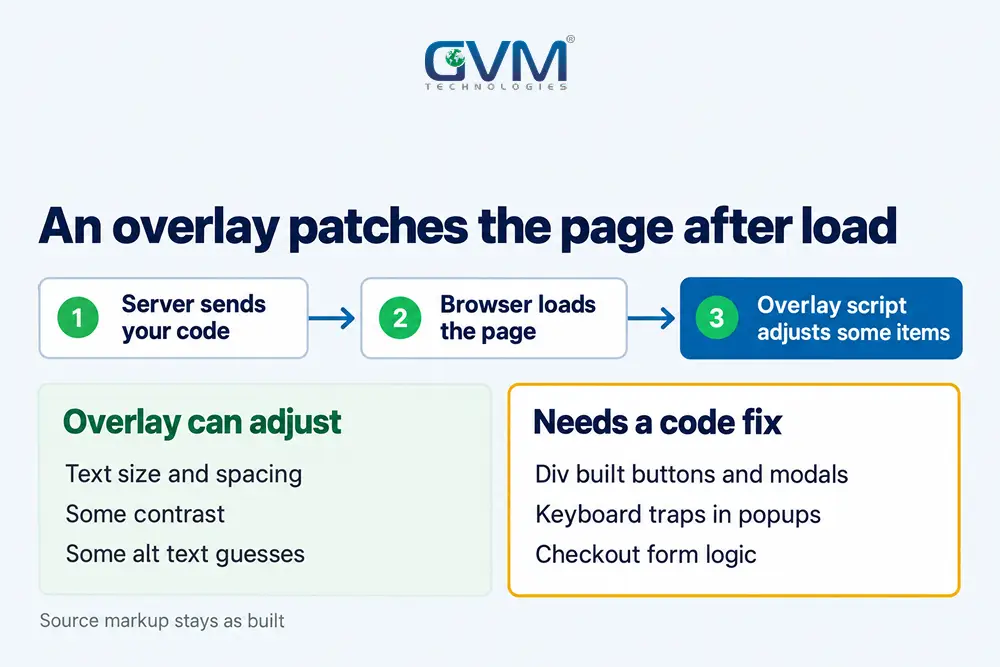
What an overlay changes and what stays broken
- Runtime patches: a script alters the page after load, and the markup underneath is unchanged.
- Custom parts: a div-built button, modal or date picker needs a real code fix.
- Regulator view: the FTC’s April 2025 order bars accessiBe from claiming its automated tools make sites WCAG-compliant without evidence.
Why a fixed site gets sued again
- Updates: a theme or WordPress plugin update can replace fixed markup.
- New popups: chat widgets and cookie banners can trap keyboard focus.
- Content edits: new images arrive without alt text, and videos without captions.
- Third-party tools: booking, payment and review widgets sit outside your code.
Fix this with a schedule: retest after each release, and write the duty into an SLA checklist for founders with your agency. GVM’s post-launch maintenance and support exist for this drift.
The journeys behind a website accessibility lawsuit: homepage to checkout
Plaintiff testers follow a buyer’s path, not your site map. They land on a page, open a product, add it to the cart and try to pay with a keyboard or screen reader. The step that fails becomes the claim, so test in that order.
| Journey step | Typical failure | WCAG criterion | Quick test |
|---|---|---|---|
| Landing and cookie banner | Banner traps keyboard focus | 2.1.2 No Keyboard Trap | Tab in, then close with Escape |
| Product page | Missing alt text, unlabeled size swatches | 1.1.1 Non-text Content | Listen to each option read aloud |
| Checkout form | Fields without labels, errors shown only in red | 3.3.1 Error Identification; 3.3.2 Labels | Submit an empty form |
| Pay button | Low-contrast text on a brand color | 1.4.3 Contrast (Minimum) | Test text contrast; aim for 4.5:1 |
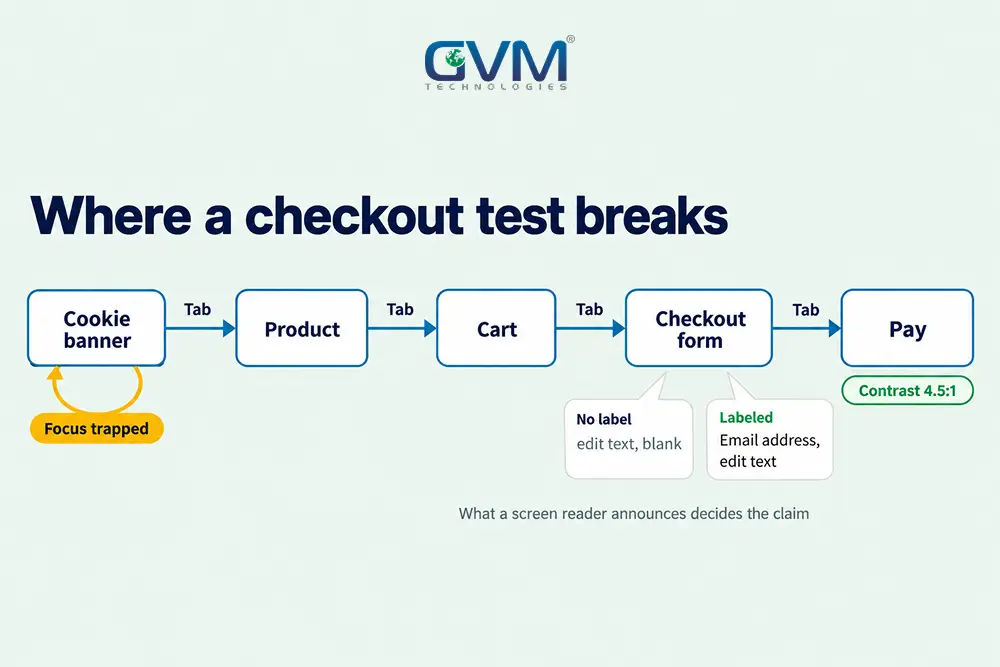
The 10-minute checkout test
- Unplug the mouse and press Tab from the homepage to a product.
- Add the item to the cart and open checkout.
- Switch on NVDA, which is free, or VoiceOver.
- Submit the form with errors on purpose.
- Finish a test purchase using the keyboard alone.
GVM Technologies builds WooCommerce checkouts with payment gateway integration, so this test belongs in every launch.
What a scanner misses and who should test
Scanners catch missing labels and low contrast. They miss keyboard traps, focus order, poor alt text and confusing error flow, so people must test those.
Design helps early. GVM’s UI/UX team designs with usability and accessibility in mind, before code exists.
Then run one pass inside a planned technical SEO audit, since alt text and headings help search too.
FAQs
1. Can I ignore an ADA demand letter?
Ignoring an ADA demand letter risks a filed suit and a default judgment. Instead, save it, note the sender’s deadline and talk to counsel.
2. How long do I have to respond to a website accessibility lawsuit?
Usually 21 days after valid service in federal court, or 60 days if you sign a waiver. State courts set their own windows, so read the summons on day 1.
3. Is a website accessibility lawsuit a scam?
The suits are legal, and many come from volume filers using template letters. However, the barriers they cite are often real, so verify the claim first.
4. Will fixing my website end a website accessibility lawsuit?
Not automatically. Fixes can moot a claim for a court order, as in Jones v. Moscot.com, yet attorney fees and state damages may remain.
5. Can an online-only shop face a website accessibility lawsuit?
Yes. It depends on the circuit, because courts disagree on sites without a physical location, and plaintiffs still sue online-only sellers.
Conclusion: sort the papers first, then fix with proof
A website accessibility lawsuit is a clock plus a fix list, and the money depends on state law as much as code. Calm, ordered moves beat fast, undocumented ones.
Today, do these:
- Identify whether you hold an ADA demand letter, a summons or a waiver request.
- Save the papers and snapshot the site before editing.
- Call an ADA defense lawyer and your insurance broker.
- Test checkout by keyboard and screen reader, and log each fix with a date.
Once the claim closes, retest after each release so the next ADA demand letter finds nothing new.
Talk to GVM Technologies about website accessibility lawsuit risk
A letter with a 3-week clock leaves little time to find a team, scope the work and retest checkout. GVM Technologies covers the build and test side:
- UI/UX design: wireframes and prototypes focused on usability and accessibility.
- Manual and cross-platform QA: repeatable testing across browsers and devices.
- Website development: custom, WordPress and e-commerce builds with ongoing support.
- WooCommerce development: online stores, including payment gateway setup and plugin upkeep.
GVM has delivered production sites since 2013 under ISO 27001 and ISO 9001 certified processes, and built the national Crash Champions site for a network of 600+ repair centers.