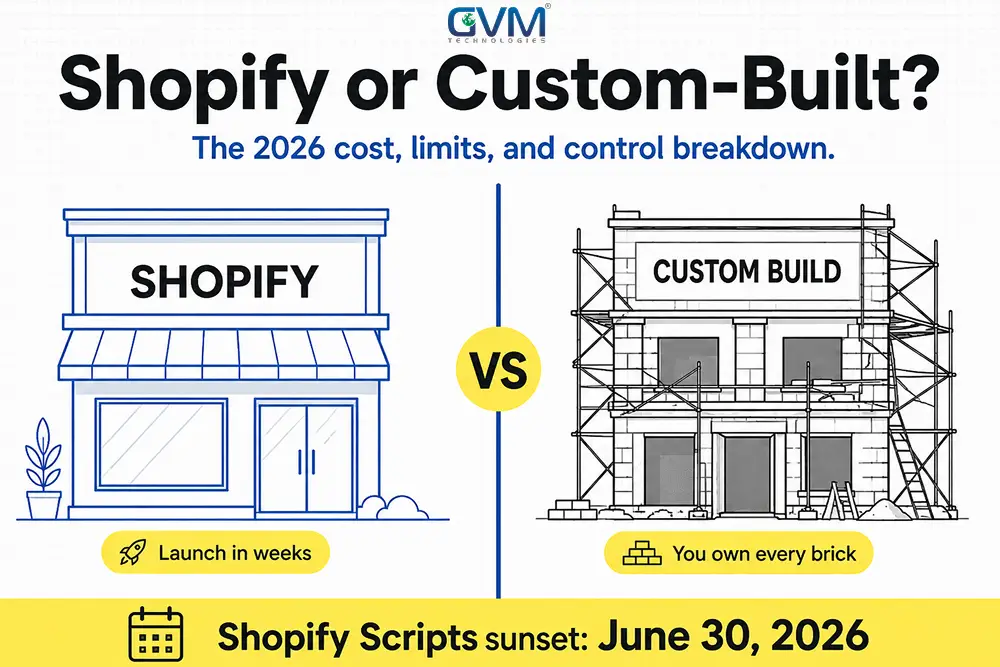
Quick Answer: Start on Shopify unless you can name one specific requirement it cannot meet.
Custom ecommerce development earns its cost when your checkout logic, catalog scale, or payout structure breaks a platform’s published limits, not because “custom” sounds more serious than “rented.” Most stores never hit that line.
A smaller, real group hits it immediately, because their business was never a standard storefront to begin with. This guide shows you exactly where that line sits in 2026, using current platform limits, not guesswork.
Key Takeaways
- Shopify’s plans run $39 to $399 a month before apps. Shopify Plus starts near $2,300 a month.
- Custom builds typically run $8,000 to $500,000+, depending on complexity, plus $12,000 to $50,000 a year to maintain.
- Shopify Scripts, used for years to run custom discount and shipping logic, was fully sunset on June 30, 2026. Anything still relying on it stopped working on July 1.
- Non-Plus stores hit a hard 50,000-variant ceiling, throttled to 1,000 new variants per 24 hours past that point.
- The Storefront API that powers headless Shopify works on every plan, including Basic. Plus is a checkout-customization and scale requirement, not a headless-access requirement.
- Real crossover point: businesses clearing roughly $500,000 to $1M in annual revenue, or running a checkout that was never linear, are where custom or headless starts paying for itself.
What Shopify and Custom Ecommerce Development Actually Mean
“Shopify vs. custom” gets confusing fast because both sides hide sub-categories. Sort those out first, or the rest of this decision won’t hold up.
1. What Shopify Gives You Out of the Box
Shopify is a hosted commerce platform. You rent infrastructure, checkout, PCI compliance, uptime, and security patching, and build inside its rules using Liquid themes, apps, and its APIs.
You never touch a server. You also never get to touch one, which is the entire trade this decision hinges on.
| Plan | Monthly Cost | What Changes | Best Fit |
|---|---|---|---|
| Basic | $39 ($29 annual) | Full storefront, Storefront API access | New stores, single founder |
| Grow | $105 ($79 annual) | More staff accounts, better reporting | Growing catalog, small team |
| Advanced | $399 ($299 annual) | Advanced reporting, lower card rates | $1M+ revenue, multi-staff ops |
| Plus | From ~$2,300 | Checkout UI Extensions, custom Functions, no variant cap | Non-linear checkout, 50K+ variants |
That plan fee is the floor, not the total. Apps for reviews, upsells, and inventory sync typically add $10 to $30 each a month, which is why a “$39 store” running 8 to 10 apps often lands closer to $200 to $300 before a single ad dollar is spent.
2. What Custom Ecommerce Development Actually Means
Custom ecommerce development means an engineering team writes your storefront, cart, and checkout logic in code you own outright, typically a headless frontend calling your own backend or an open-source commerce engine.
You own the repository. You own the database. You own every decision Shopify would otherwise make for you, and every consequence of a decision made badly.
3. The Three Builds Hiding Under “Custom”
Founders lump these together constantly. They carry very different cost and risk profiles.
- Fully custom, in-house stack. Your own backend and payment integration, built on frameworks like React or Next.js. Reserved for businesses whose commerce logic is their actual differentiator.
- Open-source commerce engine. WooCommerce, Medusa.js, or Saleor give you owned code with no licensing fee. You still host, patch, and secure it yourself.
- Headless on a hosted backend. Shopify or BigCommerce power the backend while your team owns the frontend. This is the middle path most people reaching for “custom” actually mean.
The trade nobody prices in advance: Developers who haven’t shipped a store before often assume ecommerce is CRUD with extra steps. Tax logic across jurisdictions, PCI scope, promotion stacking, and abandoned-cart recovery each carry their own edge cases, and none of them are visible from the outside until you’ve built one.
Where Each Approach Actually Wins
Real brand examples settle this faster than theory. Both sides of this comparison have proof at scale.
1. When Shopify Is the Right Call
Shopify is the correct default for most stores, and the businesses proving it aren’t small. Gymshark, Allbirds, Fashion Nova, and Kylie Cosmetics all run on Shopify Plus, not because they lack engineering budget, but because a standard catalog-and-checkout model doesn’t benefit from rebuilding infrastructure Shopify already runs at global scale.
Choose Shopify when:
- Your catalog is standard: fixed SKUs, normal variants, standard shipping rules
- You’re still validating the business model, not scaling a proven one
- Your team would rather fund marketing and merchandising than backend maintenance
- You’d rather not own PCI compliance, uptime, and fraud screening yourself
2. When Custom-Built Earns Its Cost
Chewy, Zappos, and Best Buy run custom platforms because real-time inventory across warehouses, subscription logic, and marketplace listings exceed what a templated system was built for.
Louis Vuitton runs on Oracle Commerce and Gucci runs a Powerfront/SAP Commerce Cloud stack, deliberately, because the checkout experience is part of the product.
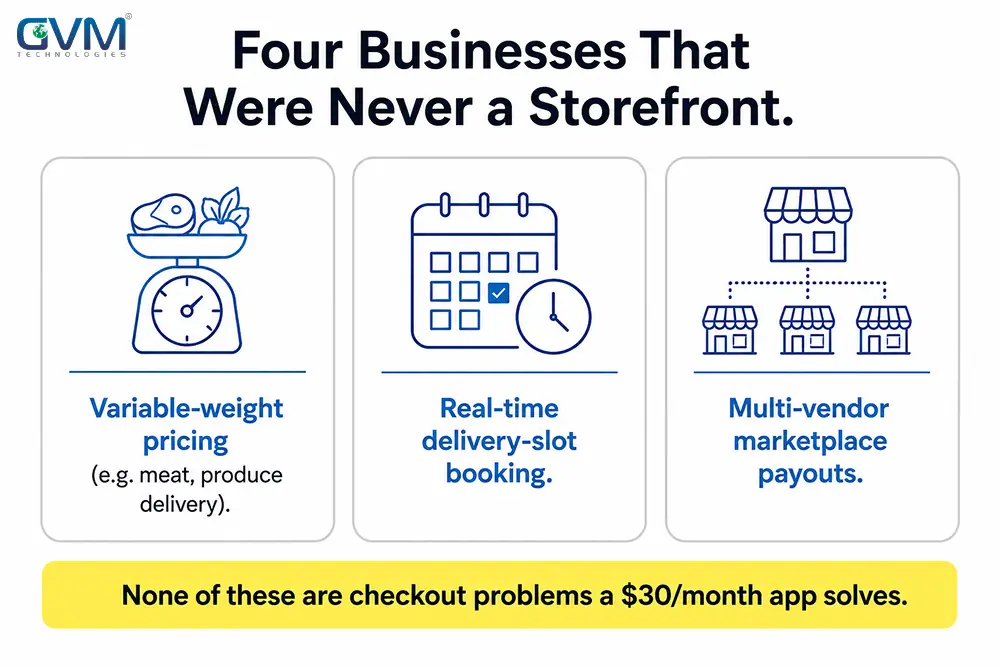
Four business models keep showing up wherever a template genuinely fails, and none of them are exotic:
- A meat or grocery delivery brand that sells by weight, where a 1 kg order ships as 1.05 kg and the price has to adjust after packing, not before checkout.
- A service that qualifies a buyer through a year/make/model or SMS-verification lookup before showing a price, not a product grid.
- A retailer offering real-time delivery-slot booking that has to lock inventory the moment a slot fills, across dozens of physical locations.
- A marketplace paying out multiple vendors per order, each on a different commission rate.
None of these are checkout problems a $30/month app solves. Each is a data-model problem, and data-model problems are exactly what custom development is for.
3. What It Actually Costs to Get This Wrong
One widely discussed case: a two-year, roughly $2 million internal ecommerce build, scrapped because it never reached the reliability of the platforms it was meant to replace.
That’s not a rare story. It’s the predictable outcome of funding a full engineering team before validating that the business needed one.
What Custom Ecommerce Development Actually Costs
Sticker price is the wrong number on either side. What decides this call is cost by build tier, matched against a realistic timeline.
| Build Tier | Typical Cost | Typical Timeline | What It Actually Covers |
|---|---|---|---|
| Basic custom storefront | $8,000–$25,000 | 6–10 weeks | Single catalog, standard cart, one payment gateway |
| Mid-complexity build | $40,000–$120,000 | 3–5 months | Custom checkout logic, ERP/CRM integration, multi-currency |
| Enterprise or marketplace | $150,000–$500,000+ | 6–12 months | Multi-vendor payouts, real-time inventory, B2B contract pricing |
Maintenance sits on top of every tier: $12,000 to $50,000 a year for bug fixes, security patching, and PCI re-certification. Our full cost breakdown shows how those ranges get assembled line by line for custom software generally.
1. Why the Same “Custom Store” Quote Varies by 5x
Two agencies quoting the same brief can land $40,000 apart, and it’s rarely padding. The gap is almost always integration count: how many payment gateways, warehouses, tax jurisdictions, and legacy systems the build has to talk to.
2. What’s Never Included in the Initial Quote
Three costs almost never appear in the year-one number:
- Year-two maintenance and bug fixes
- Annual PCI re-certification
- An on-call engineer for when checkout breaks mid-sale
Ask for the 3-year total before signing off on the 1-year total.
The 2026 Shopify Reality Most Comparison Guides Haven’t Caught Up To
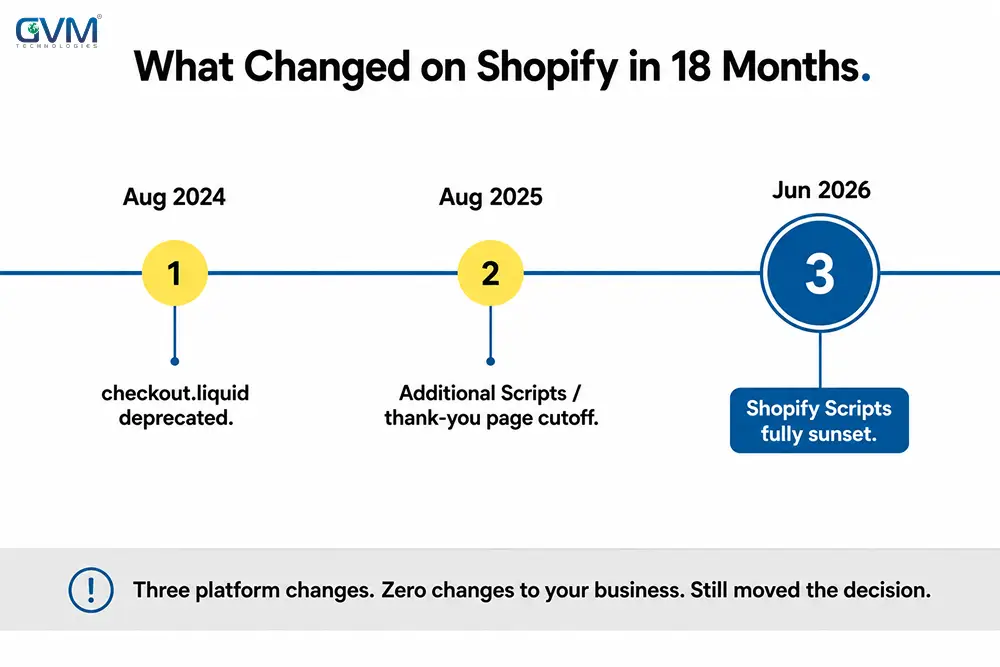
This is the part most “Shopify vs. custom” articles get wrong: they compare a 2022 version of Shopify. Three changes shipped in the last 18 months materially move where the line between “use Shopify” and “go custom” actually sits.
1. Shopify Scripts Officially Sunset on June 30, 2026
Shopify Scripts ran custom logic entirely server-side, free on Plus, for years. Timeline: new Script editing stopped April 15, 2026. Every remaining Script stopped executing June 30, 2026.
What actually ran on Scripts, and stopped working July 1 for anyone who didn’t migrate:
- Custom discount stacking and combination rules
- Tiered or conditional shipping rates
- B2B-specific negotiated pricing logic
The replacement is Shopify Functions. Ruby-based Scripts have to be rewritten in JavaScript or Rust and deployed as an app, a real rebuild running 4 to 8 weeks with a dedicated engineer who’s done it before.
2. The 50,000-Variant Ceiling Almost Nobody Writes About
Once a non-Plus store crosses 50,000 total variants, Shopify throttles new variant creation to 1,000 per 24-hour period.
That ceiling is real for:
- High-SKU catalogs with fast-changing pricing
- Apparel brands running heavy size/color matrices
- B2B distributors carrying tens of thousands of parts
Shopify’s Bulk Operations API fixes reads and updates on existing records, not the cap itself. It processes tens of millions of rows asynchronously, but 50,000 variants stays the ceiling on anything below Plus.
3. Checkout Extensibility Closed the Old Workaround
Before August 2024, merchants customized checkout with checkout.liquid and Additional Scripts, injecting tracking pixels and upsell logic straight into the page.
That path is gone. Shopify deprecated it in phases through August 2025 and replaced it with Checkout Extensibility, a sandboxed, app-based model with real upside: roughly 4x faster checkout rendering and an average 1%+ conversion lift.
The trade-off: ad hoc checkout scripting, the thing agencies used to bolt on for a client in an afternoon, no longer exists. It’s an app now, or Plus-only Checkout UI Extensions.
Why this section exists: Most comparison content treats Shopify’s limits as static. They aren’t. Three platform-level changes in 18 months moved real businesses from “Shopify is fine” to “we need Functions, or we need custom,” without those businesses changing anything about their own operations.
Shopify vs. Custom-Built E-commerce: Full Comparison
| Factor | Shopify (Standard) | Headless / Hybrid | Fully Custom-Built |
|---|---|---|---|
| Time to first sale | 1–4 weeks | 8–16 weeks | 16–40+ weeks |
| Code ownership | None, you rent it | Frontend yes, backend depends | Full |
| PCI/security burden | Shopify’s problem | Shared, mostly Shopify’s | Entirely yours |
| Checkout customization | App-based, Plus for full control | Plus tier or self-built | Unlimited |
| Catalog/variant ceiling | 50,000 (non-Plus), throttled past that | Higher, engineered | No inherent ceiling |
| Discount/shipping logic | Shopify Functions (post-Scripts) | Functions or custom | Fully custom |
| Traffic spike resilience | Handled by Shopify’s infra | Depends on your build | Entirely your responsibility |
| Exit cost | Export data, rebuild storefront | Rebuild frontend or backend | Zero, already yours |
| Typical annual maintenance | Plan fee + apps ($500–$5K) | $15K–$60K | $12K–$50K+ |
1. Where the Comparison Breaks Down
Every row above assumes a standard retail model. The moment your checkout isn’t linear (a delivery slot, a configurable price, a multi-vendor payout) this table stops applying, and the decision moves to the four models above instead.
Not sure which side you’re on? A short scoping conversation before either quote gets requested usually settles it, since the answer changes the entire brief.
2. The Row That Decides Most Cases
Look at exit cost. A Shopify store you outgrow costs you a rebuild, not a write-off, since product data, customers, and order history export cleanly.
A custom build you abandon costs you the entire investment. That asymmetry is why “build custom to be safe” is backwards advice before a business model is validated.
The Middle Path: Headless Commerce Without the Plus-Tier Myth
The framing “Shopify vs. custom” hides a third option most businesses actually want: headless Shopify, where Shopify’s backend still handles products, payments, and PCI compliance while your team owns a fully custom frontend, typically built with Hydrogen or a standard React stack calling the Storefront API.
1. Clearing Up the Storefront API Myth
A lot of founders assume headless requires Shopify Plus at roughly $2,300 a month. Not true: the Storefront API is on every plan, including Basic at $39 a month.
If your build reads products, manages a cart, and hands off to Shopify’s standard checkout unmodified, Basic or Grow is enough. Plus becomes necessary only when:
- You need to customize checkout itself through Checkout UI Extensions
- You’re running multiple storefronts from one backend
- You need API limits high enough for very large catalogs
2. Where Shopify Functions Fits
Public, App Store-distributed Function apps work on any Shopify plan. Custom Function apps, the kind built specifically for one merchant’s pricing logic, require Plus.
That’s the real dividing line post-Scripts: standard logic can stay on a lower plan through a public app, genuinely custom logic needs either Plus or a fully owned backend.
7 Mistakes That Turn a Cheap Store Into an Expensive One
- Treating “custom” as a control upgrade, not a cost decision. Wanting control is normal. Funding a full engineering team to get it before validating the model is how founders burn six figures on a store that could have launched for $39 a month.
- Underestimating what checkout involves. Tax logic, fraud screening, cart soft-locks, payment retries, and country-specific invoicing each look small alone. Together, they’re most of a platform’s value and most of a custom build’s hidden cost.
- Stacking apps until “cheap” stops being true. Ten $20-a-month apps is $200 before a single ad dollar is spent. At that point, comparing raw plan price to custom cost compares the wrong numbers.
- Assuming headless requires the top-tier plan. It doesn’t. The myth pushes founders toward an unnecessary $2,300-a-month commitment, or an unnecessary full-custom build, when a $39–$105 plan with a custom frontend covers most real needs.
- Migrating a Shopify Scripts store without a Functions plan. Stores that treated the June 2026 deadline as optional lost live discount and shipping logic overnight. This was scheduled, published, and still caught most Plus merchants late.
- Skipping the 301 redirect map during any platform move. URL structures differ between platforms. Skipping redirects resets months of organic rankings, a completely avoidable mistake.
- Picking the platform before defining the operations model. Delivery slots, variable pricing, and multi-vendor payouts should shape the platform decision, not surface as blockers after months of development.
The thread through all seven: the decision fails when it’s made on instinct instead of a specific operational requirement the current platform can’t meet, the same discipline behind any build-vs-buy software decision.
The 5-Signal Platform Test
Run these five questions before pricing a single build.
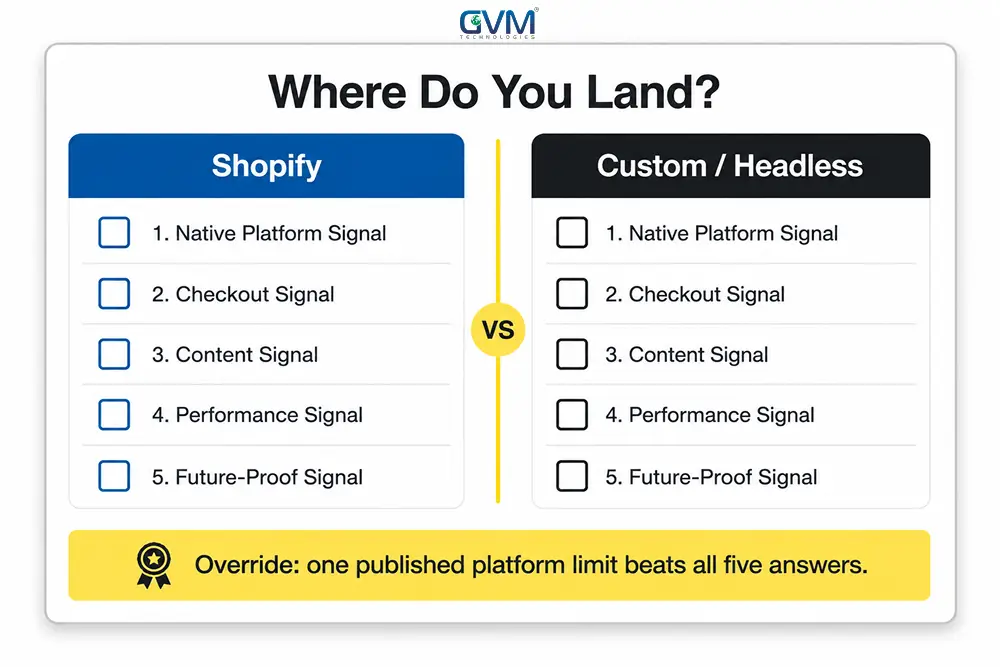
- Is your checkout linear, add to cart, pay, ship? Yes points to Shopify. No, slots, configurators, contract pricing, points to custom or headless.
- Are you selling one catalog from one entity, or multiple vendors with separate payouts? One entity points to Shopify. Multi-vendor points to custom.
- Is your SKU or variant count approaching 50,000 on a non-Plus plan? No points to Shopify. Yes means price Plus or custom before you hit the throttle, not after.
- Can your team fund ongoing backend engineering? No points to Shopify. Yes points to headless or custom, since the option only pays off if someone maintains it.
- Is your frontend experience genuinely part of your product’s value, beyond a nice theme? No points to Shopify. Yes points to headless.
1. Reading Your Score
- 4–5 favoring Shopify: launch there, revisit at your next real revenue milestone.
- 4–5 favoring custom: your model likely never fit a template. Scope it as a proper MVP instead of discovering gaps mid-launch.
- A near-even split: the common case. Start on Shopify and let real order volume trigger the move.
2. The Override That Beats All Five Answers
One condition outranks the whole test. If a published platform limit, the 50,000-variant cap, the loss of Scripts, a hard API rate limit, sits between you and your 24-month forecast, treat a platform build as a prototype with an expiry date, not a permanent home.
Migration Isn’t the Trap People Think It Is
A common objection to starting on Shopify is fear of lock-in. In practice, leaving Shopify later is far more reversible than abandoning a custom stack that failed.
1. Why Leaving Shopify Is Cheaper Than Leaving Custom
Product data, customer records, and order history export in standard formats. Patching a struggling custom build back toward a managed platform is the expensive direction, because it usually means rebuilding, not exporting.
2. The One Step Everyone Skips
What actually breaks rankings and revenue during a move isn’t the platform switch. It’s skipping the 301 redirect mapping from every old URL to its new equivalent, a step our QA and testing process treats as a launch blocker, not a nice-to-have.
FAQs
1. Is Shopify or custom ecommerce development cheaper?
Shopify is cheaper for the first three years in nearly every standard-catalog scenario, typically $15,000 to $40,000 total versus $80,000 to $300,000+ for custom over the same window. Custom only closes that gap at high volume or with a checkout that was never linear.
2. Do I need Shopify Plus to build a headless store?
No. The Storefront API is available starting on the Basic plan at $39 a month. Plus, from roughly $2,300 a month, is required only for checkout customization, multiple storefronts, or higher API limits at large scale.
3. What happened to Shopify Scripts, and does it affect me?
Shopify Scripts stopped executing entirely on June 30, 2026. If your store used Scripts for discounts, tiered shipping, or B2B pricing and didn’t migrate to Shopify Functions, that logic is currently not running.
4. How many product variants can Shopify handle?
Non-Plus stores hit a hard cap of 50,000 variants, throttled to 1,000 new variants per 24 hours once reached. Shopify Plus removes this ceiling entirely.
5. How much does custom ecommerce website development cost?
Mid-complexity builds typically run $40,000 to $120,000 upfront, with $12,000 to $50,000 a year in maintenance. Marketplace or multi-vendor builds regularly clear $250,000 and can exceed $1 million.
6. Can I switch from Shopify to custom-built later without losing SEO rankings?
Yes, if the migration includes a full 301 redirect map from every existing URL to its new equivalent. Rankings drop when redirects are skipped, not because the platform changed.
7. What’s the clearest sign my business has outgrown Shopify?
A non-linear checkout requirement, delivery-slot booking, configurable pricing, multi-vendor payouts, or B2B contract pricing, is the clearest signal. High order volume alone rarely forces a move; unusual business logic does.
8. Is WooCommerce a middle ground between Shopify and fully custom?
It’s a different trade-off, not strictly a middle ground. WooCommerce gives you owned code with no licensing fee, but you still handle hosting, security patching, and plugin conflicts, the maintenance burden of custom development without full custom flexibility.
9. Should a startup with a simple product build custom from day one?
Almost never. Validate the model on Shopify first. Moving to custom before you know real order volume and checkout requirements risks funding the same store twice: once to learn what you need, once to build it correctly.
Conclusion: What to Decide This Week
Shopify vs. custom-built e-commerce isn’t a quality question. It’s whether your checkout, catalog, and payout structure are standard enough for a rented platform to run well, or specific enough that renting one costs more.
Most businesses are the first case. Before requesting a quote either direction:
- Run the 5-Signal Platform Test against your actual operations, not your ideal ones.
- Price your current Shopify app stack honestly, not just the plan fee.
- Name the one requirement a standard platform can’t meet. If you can’t, the decision is already made.
Weighing a build that doesn’t fit neatly into either column, a marketplace, a delivery-slot model, or a catalog closing in on Shopify’s variant cap?
GVM Technologies has scoped both platform and custom ecommerce projects for businesses on both sides of this line since 2012, and reviews your specific requirements before recommending either path.
Book a platform-fit assessment with GVM Technologies and see how similar builds were scoped in our portfolio.