You’ve narrowed your vendor shortlist to one, and there’s a single line item left to settle before work starts: how you’ll pay for it. That choice matters as much as any contract clause around it, since it decides who absorbs the cost once your project stops going exactly to plan.
Neither model removes risk, it only decides who carries it and when. This guide fixed price vs time and materials contract covers where that risk lands, a 2017 study on real projects by contract type, why time-and-materials and cost-plus aren’t the same thing, and a 5-question test to score your own project before you sign.
Quick answer: Fixed-price contracts protect your budget on short, well-scoped, stable projects, but that protection is priced in. Vendors build a 15-30% contingency buffer into the quote, and quality is usually the first thing cut once that buffer runs out.
Time-and-materials contracts protect your outcome on projects with real unknowns, since you only pay for work actually done, but they need a not-to-exceed cap and weekly reporting to avoid runaway spending.
A study of real software projects found fixed-price contracts carry a higher failure risk than time-and-materials contracts, across 2 separate datasets.
Most experienced buyers use a hybrid: time-and-materials for discovery, then a fixed-price or capped rate once scope is locked.
Key takeaways
- Fixed-price doesn’t eliminate risk, it moves it into a buffer. You pay for that 15-30% contingency margin whether the risk it covers ever shows up or not.
- A peer-reviewed study of real software projects found fixed-price contracts carry a higher failure risk than time-and-materials contracts, across 2 datasets, one international and one Norwegian public-sector.
- “Blank check” is the wrong fear for time-and-materials. The real risk is an open-ended contract with no cap and no reporting cadence, which a not-to-exceed clause solves directly.
- Time-and-materials and cost-plus aren’t the same model, even though buyers and vendors use the terms interchangeably. The difference decides whether you ever see the vendor’s real costs.
- Scope certainty, not project size, decides the right fit. A small project with unclear requirements is a worse fit for fixed-price than a large one with a locked spec.
- The hybrid model wins most often in practice: time-and-materials for discovery, then a fixed-price or capped rate once scope is real.
How a fixed-price contract works, and where its protection ends
A fixed-price contract sets 1 number for a defined scope, agreed before development starts. You know the total cost on day 1. The vendor carries the overrun risk, at least until a change order shifts it back to you.
That certainty has a price built into it before you ever sign.
What’s baked into a fixed-price quote
Vendors don’t quote the exact hours a project will take. They quote the hours plus a contingency margin, typically 15-30%, to cover unknowns they can’t price from a proposal alone. You pay for that buffer whether the risk it covers ever happens.
This is also why fixed-price quotes for the same brief vary so widely between vendors. A vendor who’s built something similar prices a smaller buffer than one seeing your requirements for the first time.
Where “fixed” breaks down once work starts
Almost every fixed-price contract still has a change-order process, since almost no spec survives contact with real users unchanged. The only truly fixed number is the price for the scope defined at signing, not whatever the project becomes 6 weeks in.
When a vendor’s margin gets squeezed by an underestimate, the same 3 things tend to happen, in order:
- Testing gets compressed
- Senior staff get reassigned to better-paying work
- Edge cases get quietly deprioritized
None of that shows up as a line item. It surfaces after launch, in the problems that appear once real users hit the app.
How a time-and-materials contract works, and why “blank check” is the wrong fear
A time-and-materials contract bills actual hours and materials, at rates agreed in advance. There’s no single locked total. You can redirect the work at any point without renegotiating the whole contract.
That flexibility is also where most of the fear about this model comes from, and most of it is solvable.
What you’re really paying for with T&M
Every sprint, you get a real answer to where the money went, not a milestone update that could mean almost anything. You’re not just buying developer hours, you’re buying the ability to redirect them the moment priorities change.
This is the same structure behind hiring dedicated development resources instead of a fixed-scope build. You’re paying for capacity and direction, which fits an agile process better than a locked scope ever could.
T&M vs. cost-plus: the mix-up almost nobody explains
These 2 models get used interchangeably, and the difference decides whether you ever see what you’re really paying for:
- Time-and-materials bills a pre-agreed hourly rate. The rate is already fixed and disclosed, so you don’t need to see internal costs to know what you owe.
- Cost-plus bills actual costs plus a disclosed fee on top. You’re entitled to see receipts, timesheets, and what any subcontracted work cost before markup.
Under an undisclosed cost-plus deal, a vendor can send work to a subcontractor, mark it up before it reaches your invoice, then add their own fee on top of that marked-up number. You end up paying a markup on a markup, with no line that says so.
A contract that requires competitive bids, or ties the vendor’s fee to the lowest of 3 sub quotes rather than whichever one they picked, closes that gap directly.
Fixed-price vs. time-and-materials, side by side
| Particulars | Fixed-price | Time-and-materials |
|---|---|---|
| Total cost | Locked upfront, includes a 15-30% risk buffer | Variable, tracks actual work done |
| Who carries scope risk | The vendor, until a change order shifts it to you | You, managed through sprint priorities |
| Best fit | Small, well-defined, short-timeline projects | Evolving products, unclear scope, long-term builds |
| Change requests | Trigger a formal, often slow, renegotiation | Absorbed into the next sprint |
| Budget predictability | High at signing, lower once change orders start | Low without a cap, high with a not-to-exceed clause |
| Vendor incentive | Finish fast, minimize hours spent | Keep delivering value, sprint after sprint |
| Your involvement required | Heavy upfront during spec, light during build | Light upfront, continuous throughout |
| Quality risk | Rises if the estimate was too tight | Stays stable, since hours reflect real effort |
The risk transfer map: where each risk really lands
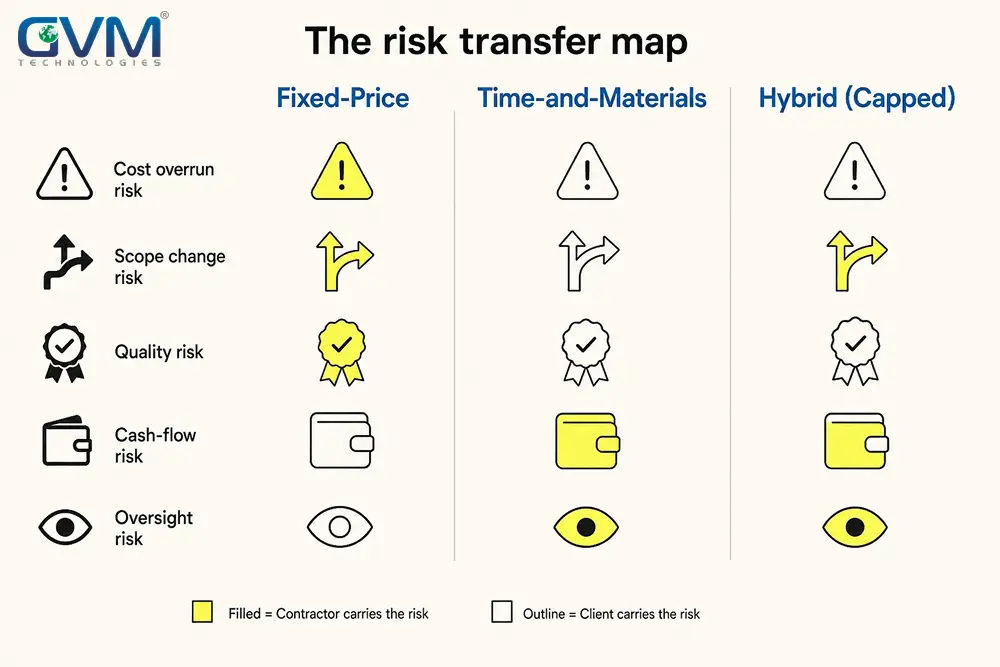
The most common mistake is treating a contract type as a way to make risk disappear. It doesn’t.
A fixed price that looks safe on paper can still expose you if scope was never nailed down, and an uncapped time-and-materials contract can expose you the opposite way.
Reading the risk transfer table
| Risk | Fixed-price | Time-and-materials | Hybrid (capped T&M) |
|---|---|---|---|
| Cost overrun | Vendor, until a change order shifts it to you | You, without a cap | Vendor, once the cap is hit |
| Requirements changing mid-project | You, via a change-order fee | Absorbed into ongoing sprints | Absorbed until the cap, then re-scoped |
| Quality erosion under margin pressure | You, silently, post-launch | Low, since hours reflect real effort | Low, same as T&M |
| Vendor’s cash-flow risk | Vendor, upfront | Minimal, paid as work happens | Minimal |
| Your oversight burden | Low during build, high during spec | High, ongoing | Moderate, front-loaded |
Why carrying the risk isn’t the same as avoiding the cost
A fixed-price vendor technically carrying overrun risk still recovers it somehow. They typically get it back 1 of 3 ways:
- A change order
- A shorter warranty period
- A build that’s slightly thinner than what you assumed you bought
A developer or agency going dark mid-project is a risk under either model. Milestone-based code access and a named backup developer protect you there, similar to a construction retainage clause holding back payment until testing passes, not the pricing structure itself.
What the research shows about contract type and project outcomes
This isn’t just opinion between 2 reasonable options. It’s been studied directly, and the indirect data backs it up.
The direct evidence: contract type and project failure
A 2017 study by Jørgensen, Mohagheghi, and Grimstad, published in the International Journal of Project Management, tracked real software projects by contract type across 2 separate datasets: an international set of outsourced projects, and Norwegian public-sector projects.
Both found the same result: fixed-price contracts carry a higher risk of project failure than time-and-materials contracts.
The indirect evidence: why so many projects miss budget anyway
| Source | Finding |
|---|---|
| PMI Pulse of the Profession | 52% of projects had scope creep in the past 12 months, up from 43% five years earlier |
| BCG (2024), 1,000+ companies | Two-thirds of large-scale tech programs miss timeline, budget, or scope |
| McKinsey / Oxford BT Centre, 5,400+ IT projects | 66% of large software projects run over budget; each extra year adds roughly 15% more overrun |
| Standish Group CHAOS data | Agile-delivered projects succeed roughly 3x as often as waterfall, 42% vs. 13% |
Time-and-materials is the contract structure agile delivery runs on, which is why that last row matters here. None of this makes fixed-price a bad model. It makes fixed-price a bad fit when scope isn’t fixed yet.
The Scope Certainty Score: a 5-question test to pick your contract
Contract type isn’t really a preference. It’s a direct output of how well-defined your project is before work starts. Answer these 5 questions honestly and count your “yes” answers.
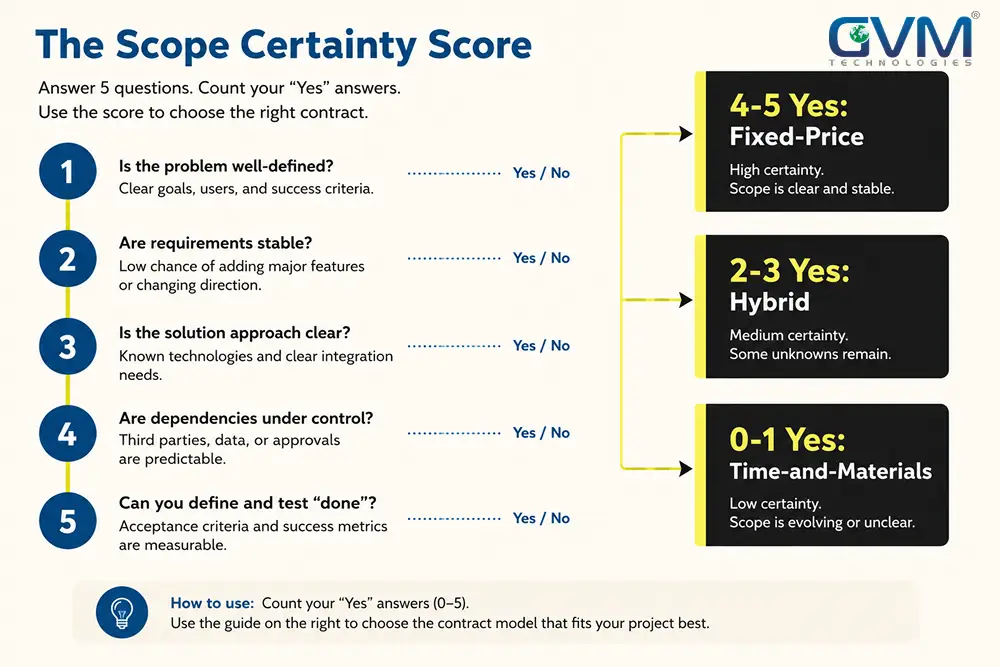
Score the 5 questions
- Do you have a written spec, wireframes, or a detailed brief for every screen and feature?
- Is this a rebuild, clone, or close variant of something that already exists, rather than something genuinely new?
- Will the project realistically finish in under 8-10 weeks?
- Is your budget fixed and non-negotiable, with no room to move once work starts?
- Do you expect to make close to zero changes once development begins?
What your score means
- 4-5 “yes” answers: Fixed-price is a strong fit. Your scope is stable enough for the vendor to price it accurately, so the contingency buffer should stay small.
- 2-3 “yes” answers: A hybrid, not-to-exceed structure fits better. You have enough certainty to set a cap, but enough unknowns that pure fixed-price triggers change orders fast.
- 0-1 “yes” answers: Time-and-materials, run in sprints with weekly reporting, is the honest choice. Forcing an undefined project into a fixed price just moves the uncertainty into change-order disputes later, over a build that may already run longer than you’re expecting.
The hybrid model: not-to-exceed, GMP, and fixed-fee-plus-costs
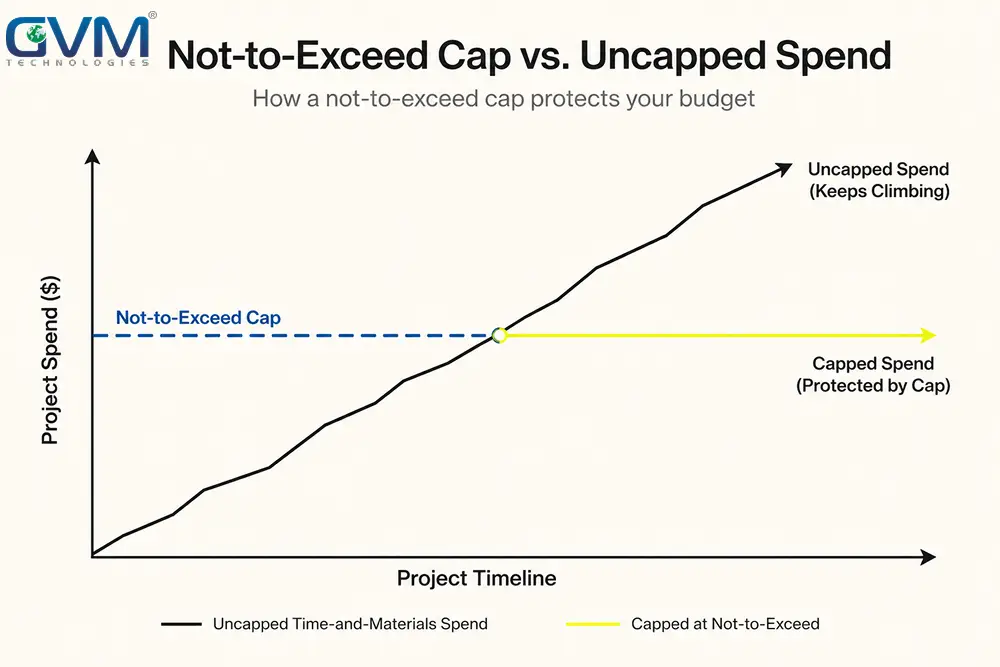
Most experienced buyers don’t pick 1 pure model. They combine time-and-materials where scope is unknown with a fixed rate or cap where it isn’t.
| Structure | How it bills | If the project finishes under budget |
|---|---|---|
| Not-to-exceed (NTE) | Hourly, capped at a ceiling | You simply pay less |
| Guaranteed Maximum Price (GMP) | Hourly, capped at a ceiling | Savings often split 50/50 |
| Fixed-fee-plus-costs | Flat fee, plus costs at cost | Vendor’s fee stays the same either way |
1. How a not-to-exceed cap works in practice
An NTE contract bills hourly against actual work, capped at an agreed ceiling. If the vendor runs over, they absorb the difference, not you. It removes 2 fears at once: unlimited spending on your side, and an underscoped loss on theirs.
2. Guaranteed Maximum Price and the savings split
A GMP works the same way but usually splits any savings under the ceiling, often 50/50. That turns the vendor’s incentive from protecting their own margin into finishing efficiently, since coming in under budget benefits both sides.
3. Fixed-fee-plus-costs: removing the markup incentive
Here the vendor charges a flat management fee on a set schedule, with actual costs reimbursed separately at cost. Since the fee doesn’t scale with spend, there’s no financial reason to let costs run higher, unlike a percentage-based cost-plus deal.
It’s rarer in software than construction, but worth asking about on a long-running SaaS engagement rather than a single deliverable.
Common misconceptions that quietly cost buyers money
- “Fixed price means no risk for me.” The risk is priced into the buffer, then shows up as quality erosion once that buffer runs out.
- “Time-and-materials is a blank check.” An uncapped contract with no reporting is. A not-to-exceed structure with weekly logs isn’t riskier than fixed-price, and it keeps the flexibility.
- “Open-book billing means full transparency.” Not automatically. It usually shows the vendor’s own labor costs, not what a subcontractor was paid before markup. Ask directly.
- “A fixed number in the contract can’t change.” It’s fixed for the scope at signing. Nearly every fixed-price contract still has a change-order clause, which is exactly where the overruns happen.
- “Asking for a cost breakdown on a fixed-price project is a red flag.” It’s usually the opposite signal: it means you want T&M-level visibility. Say so upfront, and structure the contract that way instead.
- “Contract type alone determines success.” It shapes how risk shows up, not whether it exists. An undefined “done” sinks projects under either model.
Questions to ask, and clauses to add, before you sign
Questions that apply to either contract type
- What exactly counts as “in scope,” and what triggers a change order? Get this in writing, tied to specific deliverables.
- If this is time-and-materials, is there a not-to-exceed cap, and who absorbs cost above it?
- How often will you receive itemized time and expense reports? Weekly, not monthly, is the standard.
- What happens to unused contingency if the project finishes under budget? Most vendors don’t credit it back unless asked.
- If work is subcontracted, is it billed at cost or with a disclosed markup, and can you see the invoice?
Clauses worth adding regardless of which model you pick
- A fallback hourly rate for out-of-scope work, written into the fixed-price contract itself, so “that’s not in scope” doesn’t become a separate negotiation every time.
- A rate-escalation clause for engagements running past 6-9 months, naming exactly how and when a vendor’s rates can change, instead of a surprise increase mid-project.
- A milestone-based code custody clause, giving you real access to each paid milestone’s code as you go, not just a promise at final handover.
These sit alongside the broader contract red flags to check before you sign anything: who owns the code, what liability covers, and your exit rights if the relationship doesn’t work out.
One nuance for government buyers: FAR Part 12 generally blocks federal agencies from using cost-reimbursement contracts for commercial products or services, which is why public-sector software work skews toward fixed-price and time-and-materials in the first place.
How GVM Technologies structures fixed-price and time-and-materials engagements
GVM Technologies runs both models and recommends whichever fits your project, not whichever is easiest to sell. A tightly scoped build with a locked spec gets a fixed-price quote. A product still being defined, or one needing ongoing development capacity, gets time-and-materials with weekly reporting and a not-to-exceed cap built in.
Website development, MVP builds, and project rescue work each sit at a different point on that spectrum. GVM’s past project work includes both models in practice, including projects where scope shifted mid-build without a dispute.
FAQs
1. Which contract is cheaper in the long run, fixed price or time and materials?
Time-and-materials is usually cheaper on projects with real unknowns, since you’re not paying a contingency buffer for risks that never happen. Fixed-price is usually cheaper on short, well-defined projects, with no ongoing management overhead to price in.
2. Is a time-and-materials contract just a blank check for the vendor?
Only if it has no cap and no reporting cadence. A not-to-exceed clause, weekly time logs, and sprint-based approval turn it into a controlled, transparent model.
3. What is a not-to-exceed (NTE) time-and-materials contract?
It bills hourly like standard time-and-materials but sets a ceiling on total spend. You pay actual costs up to that ceiling, and the vendor absorbs anything beyond it.
4. What’s the actual difference between time-and-materials and cost-plus billing?
Time-and-materials bills a pre-agreed hourly rate, already fixed and disclosed. Cost-plus bills actual costs plus a fee, which means you’re entitled to see the underlying receipts, including what subcontracted work cost before markup.
5. Can you start with time and materials and switch to fixed price later?
Yes, and it’s a common structure. A short T&M discovery phase defines the real scope, then a fixed-price or capped quote covers the build phase once requirements are known.
6. Why do fixed-price quotes for the same project vary so much between vendors?
Each vendor prices their own uncertainty, not just your requirements. A vendor who’s built something similar prices a smaller contingency buffer than one seeing your spec for the first time.
7. Is fixed price or time and materials better for an MVP or startup project?
Time-and-materials, or a capped hybrid, usually fits better. MVP scope shifts as you learn from early users, and a pure fixed-price contract turns every learning into a change-order negotiation.
8. What is a Guaranteed Maximum Price (GMP) contract, and how does it differ from an NTE cap?
Both cap total spend at a ceiling. A GMP typically adds a savings split, often 50/50, if the final cost lands under that ceiling, giving the vendor a direct reason to finish efficiently.
9. Does the contract type determine whether my project succeeds?
Research shows a real correlation, but it isn’t the whole story. What consistently causes failure under either model is an undefined “done,” with no clear owner for scope decisions.
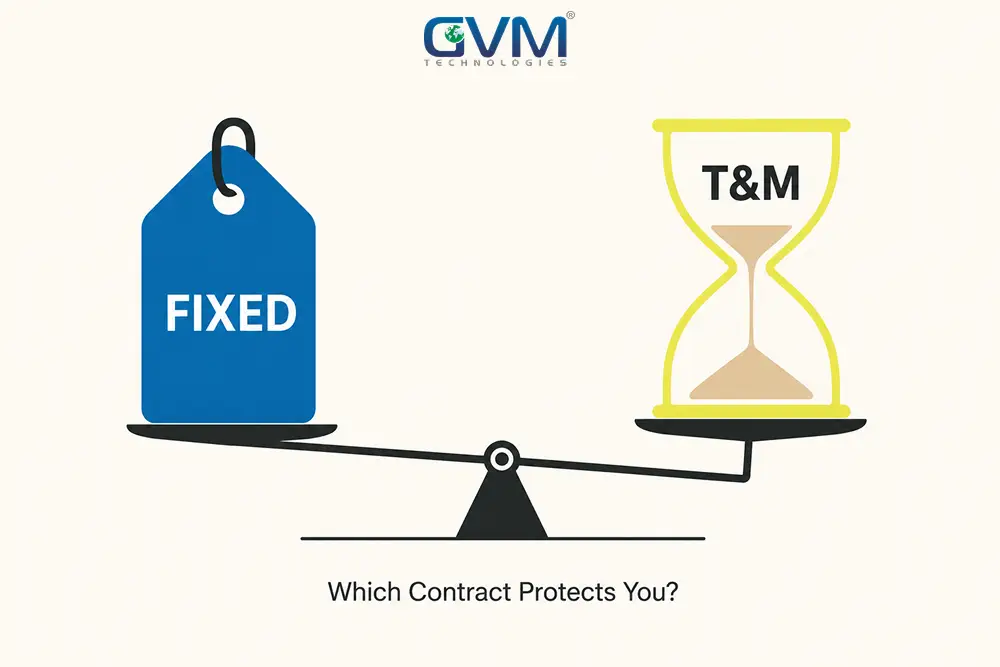
Which contract protects you
Neither contract type is inherently safer. Fixed-price protects your budget when scope genuinely won’t move. Time-and-materials protects your outcome when it will, as long as it has a cap and real reporting.
Most real projects sit between those 2 extremes, which is why the hybrid, time-and-materials for discovery and a capped rate for the build, has become the default among experienced buyers rather than the exception.
Before you sign anything, get a second opinion on which structure fits your project.
Book a meeting with GVM Technologies to walk through your brief. You’ll get an honest read on whether fixed-price, time-and-materials, or a capped hybrid fits what you’re building, even when that means recommending the option with the smaller number upfront.