Most custom software projects take 3 to 9 months from kickoff to launch. The real range runs from 8 weeks for a lean MVP to 18 months for an enterprise system with dozens of integrations.
If you’re comparing quotes from a custom software development company and getting wildly different numbers for the same project, that gap says more about the vendor’s process than about your idea.
This guide covers realistic timelines by project type, the 5 phases that consume the time, and why 2 vendors can quote 1 month and 6 months for the same spec.
Key Takeaways
- A simple MVP typically ships in 8 to 16 weeks. A mid-size platform needs 6 to 9 months. Enterprise systems run 9 to 18 months.
- McKinsey and Oxford studied over 5,400 IT projects. Large ones run 45% over budget on average.
- Requirements clarity, not team size, is the biggest predictor of a blown timeline.
- A trustworthy vendor gives you a phase-by-phase breakdown with a named buffer, not a single number in the first call.
- An AI-generated “working demo” and a production-ready application are 2 different finish lines.
- Your contract type (fixed price vs time and materials) changes your timeline risk as much as the developers do.
Custom Software Project Timelines by Type
Project type sets the floor for your timeline before a developer touches a keyboard. A single-screen internal tool and a multi-role SaaS platform aren’t the same conversation.
Both get called a “custom software project” on a sales call. A portfolio of past builds is a faster way to see where yours actually sits.
| Project type | Typical timeline | Common examples |
|---|---|---|
| MVP / proof of concept | 8 to 16 weeks | Single user role, 5 to 15 screens, minimal integrations |
| Small business application | 3 to 6 months | Booking systems, internal CRMs, customer portals |
| Mid-size platform | 6 to 9 months | Multi-role SaaS, payment processing, 3rd-party integrations |
| Enterprise-grade system | 9 to 18 months | Regulatory compliance, legacy migrations, embedded AI |
1. MVP and proof-of-concept timelines
A minimum viable product with 1 user role and no heavy integrations usually lands in 8 to 16 weeks. Add payment processing or 2 to 3 external APIs, and it stretches to 12 to 20 weeks.
Founders often confuse an MVP with a finished product. A working demo can now appear in a single day using tools like GitHub Copilot, Cursor, or Claude Code.
A demo on a developer’s laptop and a web application safe for paying users are 2 different deliverables. That gap is covered in detail later in this guide.
3 things stretch an MVP timeline past 16 weeks, most common first:
- The founder adds “just 1 more” screen or role mid-build
- Payment processing or a 3rd-party API needs an approval or compliance review
- User testing surfaces a core workflow that needs rebuilding, not patching
2. Small business application timelines
A booking system, an internal CRM, or a customer portal typically needs 3 to 6 months. Most of that time goes into the working relationship between the vendor and whoever owns requirements internally, not raw coding hours.
Businesses replacing an aging system move faster here. Migrating from spreadsheets or a rigid tool means requirements are already proven by years of real use.
3. Mid-size platform and multi-integration timelines
Multi-role platforms with payment processing and several 3rd-party integrations need 6 to 9 months as a realistic floor.
SaaS solution development at this scale usually needs a discovery phase alone that runs 3 to 6 weeks. Getting the data model and role permissions wrong here is expensive to unwind after launch.
4. Enterprise-grade system timelines
Regulatory compliance, legacy data migrations, and embedded AI capabilities push a system to 9 to 18 months. These projects rarely stall over coding speed. They stall over:
- Approval chains across multiple departments
- Compliance sign-off before launch
- Integration with systems nobody fully documented the first time
The 5 Phases Inside Every Software Timeline
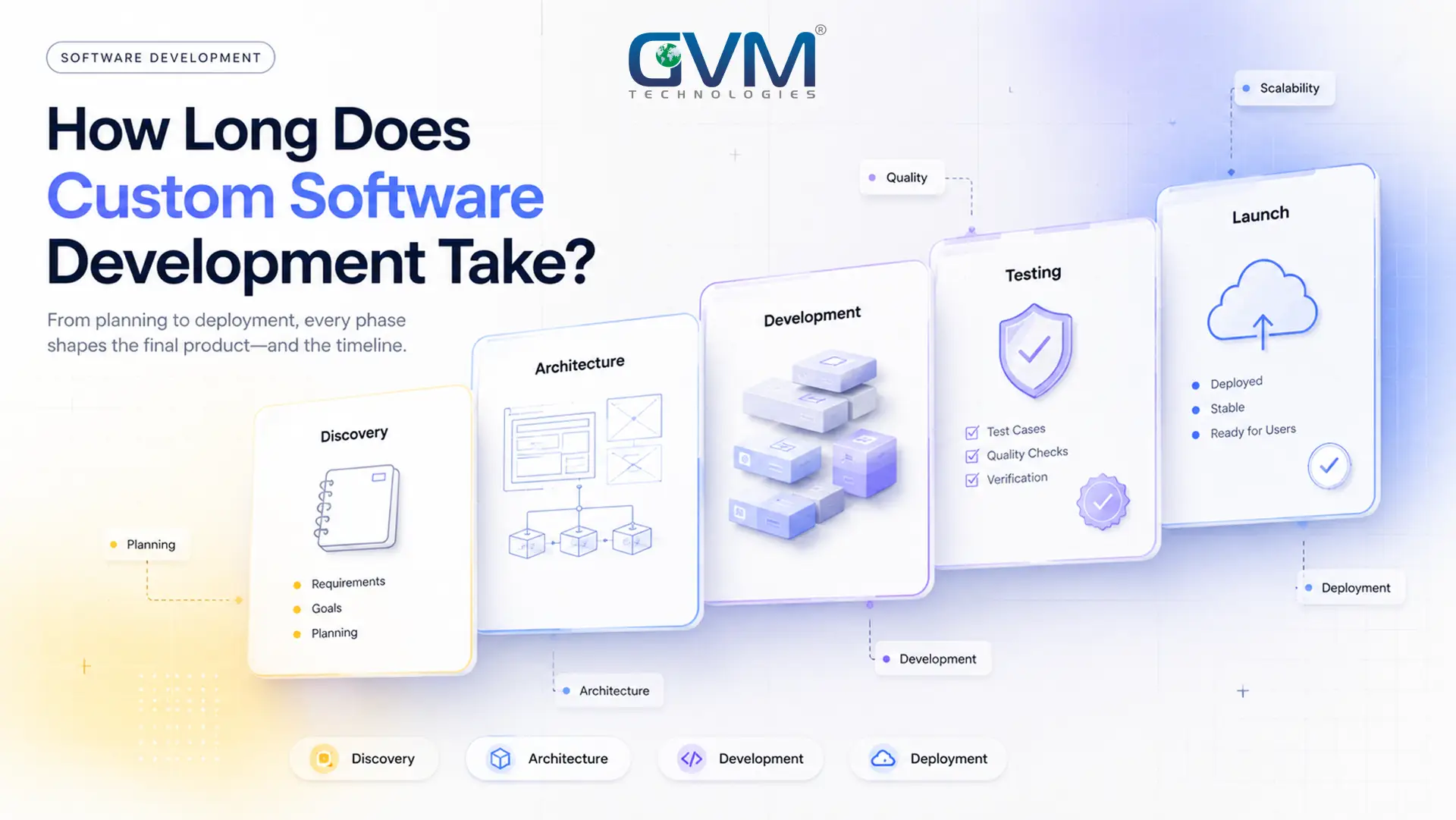
Every legitimate custom software project timeline breaks into 5 phases. Knowing what happens in each one is the fastest way to spot a padded estimate versus a planned one.
1. Discovery and requirements gathering
This phase runs 2 to 4 weeks on a small project, up to 6 weeks on a complex one. A vendor documents features, user roles, data flow, and integration points before writing any code.
Most business owners want to skip this phase. It’s also the one that determines whether the rest of the timeline holds.
Projects that shortcut discovery discover their real requirements mid-development instead. That costs far more to fix.
2. Design and architecture
Design and technical architecture typically take 3 to 6 weeks:
- Wireframes and UI/UX design
- Database structure
- Framework and hosting decisions, which are painful to reverse once development starts
Firms that also handle UI/UX design and prototyping in-house tend to compress this phase. There’s no handoff delay between the design team and the developers building against their work.
3. Development sprints
Actual coding runs 3 to 6 months for most business applications, delivered in 2-week sprints with visible progress at the end of each one. This is the phase clients picture, but it’s rarely where projects go off schedule.
4 things determine how fast sprints actually move:
- Team specialization: a team with dedicated frontend, backend, and QA roles outpaces 1 or 2 generalists
- Stack familiarity: a team on its 50th React and Node.js build moves faster than a team learning that stack on your project
- Sprint visibility: weekly demos catch misalignment in days, not months
- Dependency sequencing: features that block other features, like authentication before user profiles, have to be built in order
4. QA and testing
Dedicated testing typically runs 3 to 6 weeks, running alongside later sprints rather than only at the end. This phase covers:
- Functional testing
- Security testing
- Load testing
- User acceptance testing (UAT), where real stakeholders confirm the software does what the spec said it would
Skipping or compressing quality assurance testing is the fastest way to hit a deadline and still ship something that breaks in production.
5. Deployment and stabilization
Launch and stabilization run 1 to 3 weeks. This covers final DevOps and cloud hosting setup, monitoring, and a standby window for issues real traffic surfaces.
Most realistic timelines build in a 20% to 30% buffer across all 5 phases. Unknowns turn up in every one of them.
Why the Same Project Gets Wildly Different Quotes
The exact same specification can get a 1-month quote from 1 vendor and a 6-month quote from another. The gap rarely comes down to price-gouging. It comes down to 4 variables that rarely surface in a sales conversation.
1. Team experience is the biggest hidden variable
A senior developer who has built the same login flow or payment integration dozens of times can finish it in a fraction of the time a junior developer needs.
This variance is rarely discussed openly. It's often the single largest factor in how a project performs against its estimate.
Across the projects GVM Technologies (localhost/gvm-technologies-new/) scopes each year, the estimates that hold share 1 trait. A senior engineer, not a salesperson, sat through discovery.
That engineer can tell a 2-hour task apart from a 2-week rabbit hole. A salesperson can't, and that gap shows up later as a blown deadline.
2. Solo developer vs development agency
Both paths are legitimate, and each carries a real tradeoff, including bus factor risk (how badly a project stalls if 1 key person becomes unavailable).
| Factor | Solo developer | Development agency |
|---|---|---|
| Speed on simple projects | Often faster, no coordination overhead | Slightly slower start, faster at scale |
| Bus factor risk | High, project stalls if they’re unavailable | Low, knowledge shared across a team |
| Specialized skills | Limited to their own stack | QA, DevOps, and design available in-house |
| Long-term maintenance | Depends on continued availability | Documented handoff and support process |
| Best fit | Small MVPs, tight budgets | Compliance, integrations, or scale needs |
A solo developer building a simple internal tool can beat an agency on speed and cost. A multi-role platform with compliance requirements is a different calculation.
That’s also where staff augmentation can bridge the gap for a team with the roadmap but not the headcount to execute it.
3. What AI coding tools actually change
AI coding assistants have measurably compressed how fast experienced developers produce working code. What they haven’t compressed is requirements clarity, security review, or deployment work.
- Sped up: first-draft UI components, boilerplate CRUD endpoints, unit test scaffolding
- Not sped up: architecture decisions, edge-case handling, security review, load testing, stakeholder sign-off
A senior engineer using these tools well can prototype in hours what used to take days. That same engineer still spends roughly the same time on the polish that separates a demo from a shippable product.
4. Fixed-price vs time-and-materials contracts
Your contract structure changes timeline risk as much as who’s writing the code.
Fixed price:
- Puts financial risk on the vendor
- Vendors typically build a 15% to 30% risk buffer into the quote before you sign
- If requirements shift, a vendor may protect margin by cutting QA time instead of extending the timeline
Time and materials:
- Puts more schedule risk on you
- Lets the team change direction fast, without every idea stuck in a change-request process
- A “not-to-exceed” clause caps the budget while keeping that flexibility
Compare both against a detailed website development cost breakdown before picking a contract type.
The Real Reasons Software Projects Run Late
The research on this is blunt:
- McKinsey and the University of Oxford studied over 5,400 IT projects. Large ones run 45% over budget and 7% over schedule on average, delivering 56% less value than promised
- The Standish Group’s CHAOS Report tells a similar story: only about 31% of software projects finish on time, on budget, and with the originally agreed feature set
3 causes show up consistently across that research and real project retrospectives.
1. Scope creep and feature creep
A single “just 1 more feature” rarely derails a project by itself. The damage is cumulative. A 20% increase in scope routinely adds closer to 40% to the total timeline.
- Each added feature touches at least 1 already-built feature, which needs re-testing
- Approvals for “small” additions often skip the scrutiny the original scope got
- A defined change-request process, with a timeline and cost attached to every addition, is the actual fix
2. Vague or shifting requirements
Incomplete requirements are the single most cited cause of project failure in the Standish Group’s own research. That’s ahead of budget or team size.
“Add a login screen” sounds simple, until the second round of feedback adds a password policy nobody mentioned the first time.
A complete requirement documents 4 things, not just a feature name:
- Who uses this feature and under what conditions
- What happens on every error case, not only the happy path
- What data it reads or writes, and where that data lives
- How the team will know it’s done (the acceptance criteria)
3. Unknown technical risk
Every project carries some genuine unknown. That could be an undocumented legacy system, a 3rd-party API with documentation gaps, or an AI feature whose edge cases only show up under real data.
This is why AI services integration work specifically budgets extra discovery time. A capable team’s first 2 to 3 weeks on any complex project go toward surfacing these unknowns on purpose.
Watch for 3 warning signs during a project:
- Sprint demos stop showing new functionality and start showing “the same thing, but fixed”
- The team can’t answer “what’s left” without a lengthy explanation
- Requirements documents get revised more than once every 2 weeks
How to Get an Estimate You Can Actually Trust
A single confident number, delivered in the first sales call before any real discovery, is close to worthless for planning a custom software project. A trustworthy estimate looks structurally different.
Ask any vendor these 3 questions, and judge the answers, not just the number:
- Can you break that number down by phase? A vendor who shows discovery, design, development, QA, and deployment as separate line items has thought about the work
- What assumptions is that estimate built on? A real estimate names them, like “assumes 1 payment provider”
- What questions do you still need answered before that number firms up? Sharp questions about your requirements mean the vendor is doing the discovery work that protects your timeline
An early number should never be treated as final, and that isn’t vendor dishonesty. Software engineering researcher Barry Boehm formalized why decades ago in what’s now called the Cone of Uncertainty.
| Project stage | Estimate accuracy range | What narrows it |
|---|---|---|
| Initial concept, no requirements doc | 0.25x to 4x the eventual actual | Nothing yet, this is a guess |
| Requirements defined | 0.5x to 2x the eventual actual | Discovery phase completed |
| Architecture and design locked | 0.8x to 1.25x the eventual actual | Design decisions finalized |
| Detailed sprint plan in place | 0.9x to 1.15x the eventual actual | Development underway, scope frozen |
A number given before requirements exist is, by definition, a placeholder. A vendor presenting it as a firm commitment is skipping a step Boehm’s own research says can’t be skipped.
A vendor offering a fixed, sprint-level number before discovery has either done that discovery unusually fast, or skipped it entirely. Ask which one, directly, before you sign.
A documented ISO-certified process doesn’t guarantee good faith on its own. It does make shortcuts like this harder for a vendor to quietly take.
5 phrases should slow you down in a scoping call:
- “We can start coding this week,” before requirements are written down anywhere
- A single number with no phase breakdown, delivered in the first call
- No questions about your existing systems, users, or data
- “Don’t worry about the details, we’ll figure it out as we go”
- A quote that stays identical after you add 2 new requirements mid-conversation
MVP-Ready vs Production-Ready: 2 Different Finish Lines
“It works” and “it’s done” describe 2 different projects. Confusing them is where realistic timeline planning goes wrong most often, especially now that AI-assisted development makes early prototypes fast to produce.
What a working prototype skips
A prototype built to prove a concept typically skips:
- Authentication hardening beyond a basic login check
- Input validation on every field, not just the obvious ones
- Error handling for edge cases the happy-path demo never hits
- Load testing under real traffic instead of a single test user
- A deployment pipeline that can roll back safely if something breaks
None of that is visible in a demo. All of it becomes visible the first week real users touch the product.
What production-ready actually requires
Getting from “it works on my machine” to “it’s safe to launch” typically adds 30% to 50% more time on top of the initial build. That covers:
- Security review
- Testing across real-world scenarios, not just the happy path
- Deployment infrastructure built for actual traffic, not a local test environment
Teams that combine development, QA, and DevOps under 1 roof close that gap faster than teams that hand the build off between separate vendors at each stage. There’s no re-learning the codebase at every handoff.
This is the stretch GVM Technologies budgets for explicitly in every quote, rather than folding it into “final touches.” Clients who skip it on a previous build are usually the ones calling about project rescue.
If a project is already underway and the timeline has quietly doubled, that’s a signal worth acting on early. Project rescue services exist for exactly this.
A build that stalled, or a previous vendor’s estimate that came apart, is fixable. Catching it at month 3 is far cheaper than catching it at month 9.
FAQ
1. How long does it take to build an MVP?
A focused MVP with 1 user role and minimal integrations typically takes 8 to 16 weeks. Add payment processing or more than 1 user role, and 12 to 20 weeks is more realistic.
2. Why do software development quotes vary so much for the same project?
Quotes for the same custom software project vary because of team experience, requirement detail, and whether the vendor ran a real discovery process or used a template.
Skill variance alone can turn a feature into a 30-minute task for 1 developer, and a 3-day task for another. It’s worth asking who’s actually on the engineering team before comparing numbers.
3. Can custom software really be built in a few weeks?
A working prototype can be built in days with modern tools. A secure, tested, production-ready application almost never is. The gap between the 2 is usually 30% to 50% more time, visible across the case studies of real client builds.
4. How much time should I add as a buffer to a development estimate?
Most experienced teams build in a 20% to 30% buffer on top of the core estimate. That buffer widens for projects with more unknowns.
A vendor who refuses to discuss a buffer at all is a bigger concern than one who quotes a longer timeline upfront.
5. What’s the difference between fixed price and time and materials for timeline risk?
Fixed price puts budget risk on the vendor, but often includes a built-in buffer and less flexibility. Time and materials shifts more schedule risk to you, but allows faster changes in direction, especially with a not-to-exceed clause.
6. Does hiring a bigger development team make a project finish faster?
Not proportionally, and sometimes not at all. Coordination overhead grows with team size, and dependent features still need to be built in sequence. A smaller, experienced team frequently outperforms a larger, less coordinated one.
Conclusion
There’s no single honest number for how long a custom software project takes. There is an honest range once you know what you’re building:
- 8 to 16 weeks for a lean MVP
- 3 to 6 months for a small business application
- 6 to 9 months for a mid-size platform
- 9 to 18 months for an enterprise system
The variable that moves that range more than any other is how clearly your requirements are defined before development starts.
The next time a vendor hands you a timeline, run it through the 3 estimate questions above.
A team that breaks its number down by phase, names its assumptions, and asks sharp questions is telling you more than the number itself ever could.
GVM Technologies has built custom software since 2012 across offices in Miami and Surat. Every project runs against an ISO-certified process (27001:2022, 20000-1:2018, 9001:2015), so discovery, development, QA, and deployment happen under 1 accountable team.
Start with an MVP build if you’re still validating the idea.
Talk to GVM About Your Software Timeline and get a phase-by-phase estimate built from an actual discovery conversation, not a template.