A custom software development company designs, builds and maintains software made for 1 business. The hard part is that every shortlist looks alike, yet quotes for the same idea differ by 5 times.
This guide shows how to choose a custom software development company by cutting vendors on risk before comparing price. Still weighing a solo developer? Read our agency vs freelancer cost comparison first.
Quick answer: Choose a custom software development company by elimination. Shortlist firms that shipped and still maintain a product like yours, send all of them the same 1-page brief, meet the engineers who will build it, and pay for a short discovery. Sign once code, accounts and IP sit in your name.
Choosing a custom software development company in 6 elimination rounds
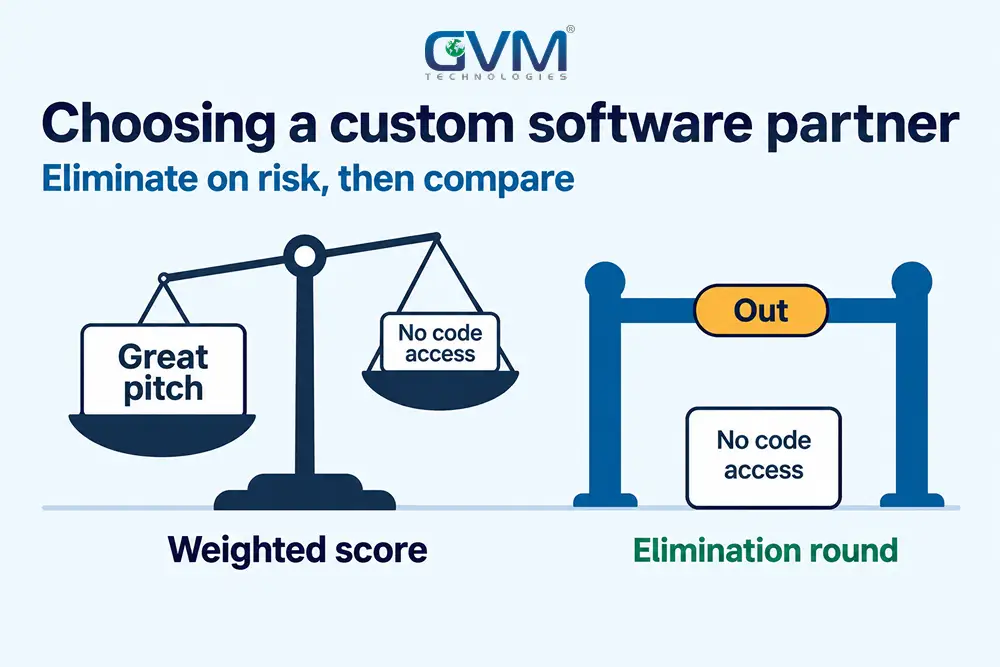
Most buyers score vendors on a weighted sheet, which lets a polished sales pitch offset a fatal flaw. Elimination works better: each round has 1 kill signal, and a firm that trips it is out. Only the survivors get compared on price and fit.
| Round | What you test | Kill signal | Time |
|---|---|---|---|
| 1. Need | Custom build vs SaaS, team type | An off-the-shelf tool covers 80% or more | 1 to 2 days |
| 2. Shortlist | Shipped and maintained work | No product like yours still live after 12 months | 2 to 3 days |
| 3. Same brief | How each firm questions scope | A firm quotes without asking questions | 1 week |
| 4. Builders | The engineers and past clients | You cannot meet the people who will code | 1 week |
| 5. Discovery | A small paid piece of real work | Estimates or demos slip inside 2 to 4 weeks | 2 to 4 weeks |
| 6. Contract | Ownership, team and exit terms | Code, accounts or IP stay with the vendor | 1 week |
Round 1: Decide whether you need a custom software development company at all
The cheapest custom software development company is the one you do not hire. Before shortlisting anyone, check that a configured SaaS tool or low-code platform cannot do the job, then pick the team type that fits the size and lifespan of the product.
Signs a custom build is the right call
A common pattern we see is that companies go custom when the workarounds cost more than building. Our low-code vs custom development guide covers the middle ground. The usual triggers:
- Duct-taped tools: 3 or more SaaS apps joined by exports and a spreadsheet that became load-bearing.
- The process is the product: your pricing, routing or scheduling rules are why customers pay you.
- Data control: compliance or privacy rules make sharing customer data with another vendor a problem.
- A legacy core: an old ERP you cannot replace yet needs modern apps built around it.
Scalability is the reason people give, yet it is rarely the real one. Off-the-shelf software usually scales fine; it just does not fit.
Agency, freelancer, staff augmentation or in-house team
Good and bad code exist in every model. What really differs is continuity: who still knows the system when 1 person leaves.
| Model | Best for | Main risk | Who manages the work |
|---|---|---|---|
| Freelancer | A defined v1 with 1 codebase | Single point of failure | You |
| Agency (5 to 50 people) | Products needing design, QA and DevOps | Sales team differs from delivery team | The agency, with you as product owner |
| Staff augmentation | Adding hands to an existing team | You still own architecture and delivery | Your tech lead |
| In-house team | Software that is your core business | Slow, costly hiring before you ship | Your CTO |
For a tight first version, a small agency or a focused MVP development team is often the safer middle. GVM scopes MVPs this way for founders who need design, code and testing at once.
Round 2: Build a shortlist from shipped work, not rankings
Start with 8 to 10 names and cut to 3 or 4. Directories such as Clutch and referrals from founders in your industry are good sources, but list placement can be paid. Judge each custom software development company on work that is live and still maintained today.
Where to find candidates worth a call
- Referrals: ask founders who launched a similar product which firm still supports it.
- Directories: read reviews for project size, stack and what went wrong, not the star average.
- Your stack: if your product runs on Rails or .NET, look for firms showing it in real projects.
Filters that cut a long list to 4 serious candidates
- Shipped and maintained: a product like yours, live for at least 12 months, not just launched.
- In-house or subcontracted: ask who employs the developers. Each subcontracting layer adds a handoff.
- Size fit: a 20-person firm gives a small project senior attention; a 5,000-person firm may not.
- Working-hours overlap: at least 3 to 4 shared hours a day for calls and quick decisions.
Round 3: Send every custom software development company the same 1-page brief
Quotes for the same idea vary because each firm guesses at a different scope. Send every shortlisted firm the same short brief and compare how they respond. The strongest custom software development company usually asks the most uncomfortable questions before naming any number.
What goes in the 1-page brief
- The problem: who uses the software, what they do today and what that costs you.
- Must-haves for v1: 5 to 10 features, ranked, plus what can wait.
- Integrations: payment, CRM, ERP or any API the system must talk to.
- Constraints: budget range, launch window and any compliance rules.
Our guide to a software development RFP that produces comparable quotes has a fuller template.
Read the questions each firm asks, not only the price
Many owners compare the bottom line and miss the better signal. A firm that pushes back on your spec or asks what happens when a payment fails is already thinking about your product.
A fixed number sent within 24 hours of a 1-page brief prices the firm’s own assumptions, not your project. That quote tends to grow through change orders later.
Round 4: Meet the people who will write the code
Sales calls are often led by senior people who will not touch your project. Before you sign with a custom software development company, meet the delivery lead and 1 assigned developer, then call past clients. GVM puts its engineers on these calls so buyers hear trade-offs directly.
1. Interview questions with strong and weak answers
| Question | Strong answer | Weak answer |
|---|---|---|
| Who will work on this, and for how long? | Named people, with a plan if 1 leaves | “Our best team” with no names |
| Can I see the repo and issue tracker from day 1? | Yes, in your accounts | You get the code at the end |
| How do you handle a scope change mid-build? | Written estimate of cost and time, then your approval | “We are flexible” |
| How often will I see working software? | A demo every 1 or 2 weeks | Status reports only |
| What would you not build in v1, and why? | A clear cut list with reasons | “We can build anything” |
| Tell me about a project that went wrong. | What broke, how they told the client, what changed | Another success story |
Also ask how they test. A firm that treats QA as a final phase usually ships bugs; see our QA testing guide for startups for a sound setup.
2. Reference calls that show how a custom software development company handles trouble
Ask each finalist for 2 references: 1 project that ran into problems and 1 client supported for over a year. Then ask each reference:
- What slipped, and how early did the firm tell you?
- Who handled fixes 6 months after launch, and how fast?
- Could another team deploy and maintain the code from the documentation?
- Would you hire them again for a product that is your whole business?
3. When a non-technical founder needs a technical reviewer
If nobody on your side reads code, pay an independent senior engineer for a few hours to interview each finalist’s tech lead. Smooth calls can hide a weak backend developer until mid-project.
Round 5: Pay for a short discovery before the full build
A paid discovery of 2 to 4 weeks is the cheapest way to test a custom software development company on real work. You get a usable scope and see whether estimates, demos and communication hold up before committing the full budget.
What a 2 to 4 week discovery should hand you
- Clickable prototype of the main screens, so users can react before code exists.
- Data model and architecture diagram with the reasoning behind the stack.
- Ranked backlog split into v1 and later, with an estimate per feature.
- Risk list: integrations, unknowns and what could move the timeline.
All 4 deliverables belong to you, even if you take them elsewhere. A good discovery also gives you a realistic custom software project timeline instead of a guess.
How discovery exposes a bad fit early
Watch 3 things: whether weekly demos happen on time, whether the person from Round 4 does the work, and whether estimates change without reason. Any of those is cheaper to spot now than in month 4.
Round 6: Sign a contract you could walk away from
The best contract lets you leave a custom software development company without losing your product. Code, accounts and IP should sit with you from the first commit, the named team should be written in, and payments should follow accepted demos rather than dates.
Our list of software development contract red flags covers the wording to avoid.
1. Why “work made for hire” does not cover your software
This confusion usually happens because buyers assume paying for code means owning it. Under 17 U.S.C. 101, commissioned work is “made for hire” only in 9 listed categories, and software is not 1 of them.
So the contract needs a written copyright assignment, signed as 17 U.S.C. 204 requires. It should also list any agency-owned components you only license.
We explain the clauses in who owns the IP when you hire an agency. This is US law, so check local rules with your lawyer.
2. Accounts in your name from day 1
- Code repository in your organization, with the vendor added as a member.
- Cloud, domain and app store accounts owned by you; give the vendor admin roles, not root.
- Third-party keys such as payment and email services registered to your business.
A repository can be moved later, as GitHub’s transfer documentation shows. That still depends on the vendor cooperating at the moment you need it least.
3. Named team, subcontracting and key-person terms
Write the delivery lead and senior developers into the contract, with your right to approve replacements. Require written consent before any subcontracting, and extend the IP assignment to subcontractors.
4. Payments, warranty and the exit clause
- Milestones tied to accepted demos. Our fixed price vs time and materials guide shows which model suits which scope.
- A warranty period of 30 to 90 days in which launch bugs are fixed at no cost.
- Support terms with response times; our SLA checklist for founders lists what to define.
- A handover clause: documentation, credentials and a transition period if either side ends the deal.
GVM’s project rescue team mostly sees projects where this clause was missing and the code lived on a vendor’s account.
What a custom software development company costs, and what quotes hide
What a custom software development company charges depends more on scope, integrations and team model than on hourly rate. Rates vary widely by region and seniority, so compare quotes built on the same brief, and budget for maintenance after launch.
Estimates drift most on big builds. A McKinsey and University of Oxford study of 5,400+ IT projects found large ones ran 45% over budget and delivered 56% less value than predicted.
What usually separates a low quote from a realistic one:
- Testing: automated tests and a QA pass, or none at all.
- Integrations: priced per API, or assumed simple. See our note on third-party API integration hidden costs.
- Hosting and DevOps: CI/CD, backups and monitoring, or a manual deploy only 1 person understands.
- Post-launch support: included for a period, or billed hourly from day 1.
Ask every custom software development company on your list to price these 4 items separately so the real gap shows.
FAQs
1. How many custom software development companies should I talk to?
Start with 8 to 10, send the brief to 4 or 5, and interview 2 or 3. More than that rarely improves the choice and adds weeks.
2. Is a freelancer cheaper than a custom software development company?
Per hour, usually yes. Over 2 to 3 years, a freelancer can cost more if they leave and a new developer must relearn undocumented code. A freelancer suits a small, defined v1.
3. Should I choose a fixed-price contract?
Fixed price works when scope is clear and stable, often after a paid discovery. For evolving products, time and materials with a monthly cap and demo-based reviews gives more control.
4. How do I check a custom software development company’s reviews are real?
Call the reviewer instead of only reading the review. Ask for your own references too, including 1 project that hit problems.
5. How long does it take to choose a development partner?
Plan on 5 to 8 weeks: about 2 for shortlisting and briefs, 1 for interviews and references, 2 to 4 for a paid discovery, and 1 for the contract.
6. Do I need an NDA before sharing my idea with a custom software development company?
A short NDA is reasonable before you share detailed specs or data. Few firms want to steal an idea; ownership of the code and accounts matters far more.
Conclusion: eliminate on risk, then choose on fit
Choosing a custom software development company gets easier once you ask which firms fail a round, not which firm is best. Same brief, real builders, paid discovery and an exit-ready contract remove most bad fits early.
The survivors are close on quality. Pick the custom software development company whose questions about your business were sharpest and whose people you would trust in month 8, when something breaks.
Talk to GVM Technologies about building your custom software
We are a custom software development company too, so run us through the same 6 rounds. A wrong pick can cost a rebuild and a missed launch window.
GVM Technologies has built software since 2013 under ISO 27001, 20000-1 and 9001 certified processes:
- SaaS solution development with multi-tenant architecture and API work.
- Quality assurance and security testing, manual and automated.
- DevOps and cloud hosting with CI/CD, monitoring and backups.
- Dedicated developers when you want a named team extension.
For a sense of scale, see the national collision-repair platform we built for Crash Champions across 600+ locations.