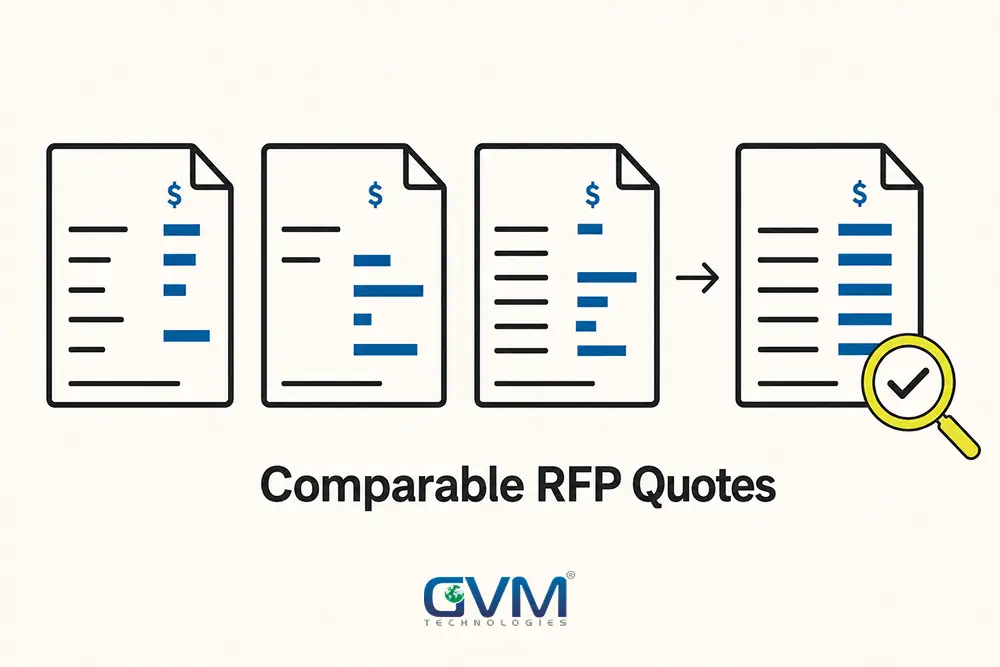
You send the same brief to 4 development shops. You get back 4 numbers that look nothing alike: one priced per screen, one billed hourly with no cap, one bundled into a single fee.
Nothing tells you whether you’re comparing 4 solutions, or 4 different projects that share a name. That gap traces back to how the RFP was written, not the vendors who answered it.
The same blind spot shows up when founders are choosing between an agency and a freelancer: without a shared format, “cheaper” and “better” are both guesses.
A software development RFP that gets comparable quotes does 5 things:
- Fixes scope in countable terms, not “as needed”
- Locks every vendor into 1 response format
- Closes assumptions with a written Q&A round
- Discloses how bids get scored, before they arrive
- Enforces that format instead of accepting whatever comes back
Quick answer: Comparable quotes come from a locked line-item pricing template every vendor fills in the same way, a published scoring matrix, 1 written Q&A round with answers sent to every bidder, and a stated budget range instead of an exact number.
A budget disclosed as a figure becomes the price you pay. A budget disclosed as a range filters out the wrong vendors without setting a target for anyone to hit.
Key takeaways
- Mismatched quotes usually aren’t dishonest vendors. They’re a symptom of an RFP that left pricing units, inclusions, and format open to interpretation.
- A locked response template does more than a longer scope document. It’s the single change that stops bundle pricing and free-form proposal PDFs.
- An exact budget number backfires more often than it helps. It anchors every bid toward that figure, whether scope justifies it or not.
- Disclosed evaluation weights produce sharper bids. Vendors stop guessing what you value and start writing to it.
- A 30-45 minute call with 1-2 trusted vendors before you finalize scope catches the technical gaps a first draft usually misses.
- A non-compliant proposal is data, not an inconvenience. Decide upfront whether that means disqualification or a resubmission window.
RFP vs RFQ vs RFI: pick the right document first
These 3 documents get used interchangeably, and that mix-up is often where comparability problems start.
| Document | What it asks for | Fits a software or web project when |
|---|---|---|
| RFI (Request for Information) | General capability, experience, rough approach | Scope is still forming and you want to see who exists in the market |
| RFP (Request for Proposal) | A full solution: approach, team, timeline, and price for a defined problem | Scope is defined enough that vendors can propose how to solve it |
| RFQ (Request for Quotation) | A price only, for a scope you’ve already specified | You already know exactly what gets built and just need a number |
1. The dollar threshold that decides if you need a formal RFP
Skip the formal process below roughly $25,000-$30,000, where a scoped MVP build conversation beats a 6-week RFP on speed.
Run the full process above that range, or wherever a wrong vendor choice is hard to reverse.
2. What a real RFP has to state, by the federal standard
FAR 15.203 sets the government-procurement bar for a Request for Proposal.
A compliant RFP states 3 things:
- The requirement itself, in specific terms
- The contract terms that will govern the work
- Exactly what the vendor’s response must contain
Skip any of the 3, and the document is a project description with a deadline, not a finished RFP.
Why vendor quotes stop being comparable
4 repeatable causes account for most comparability failures, not vendor dishonesty:
- Bundle pricing vs line items: a lump sum against a full breakdown, impossible to weigh against each other.
- Mismatched units: per-screen, per-hour, and per-module pricing each answer a different question.
- Free-form proposals: a branded PDF with the real number buried on page 30.
- Undisclosed scoring: vendors guess what matters, so you compare gut feelings instead of numbers.
The FRAME framework: 5 checks that force comparable quotes
1. The 5 checks
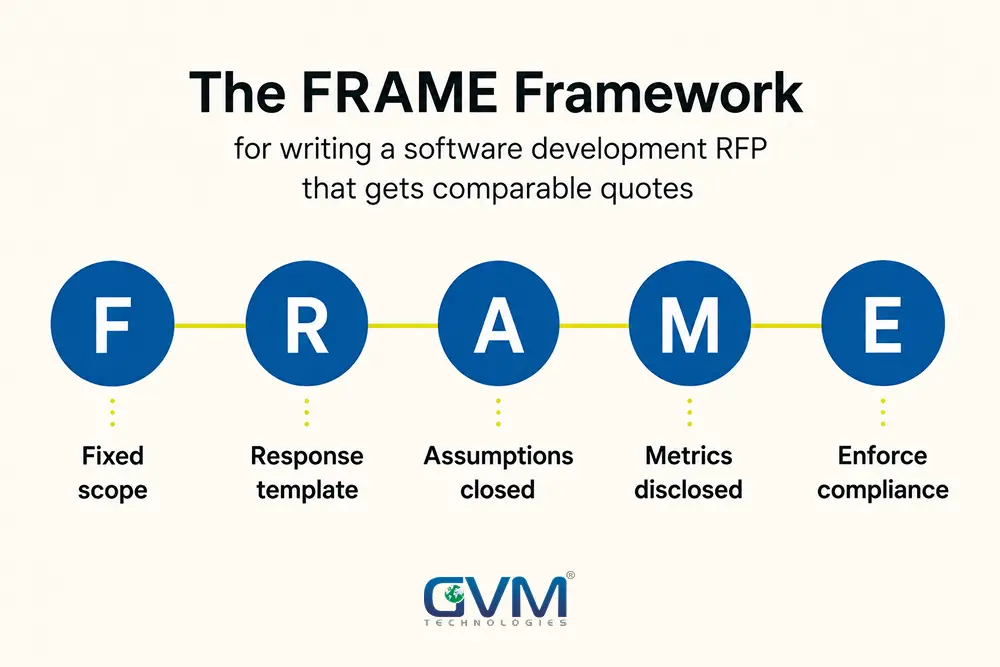
- Fixed scope: every deliverable stated as a number, a named artifact, or a list, never “as needed.”
- Response template: a locked worksheet every vendor fills in, not “attach your standard proposal.”
- Assumptions closed: 1 written Q&A round, answers sent to every bidder.
- Metrics disclosed: a weighted scoring matrix vendors see before they bid.
- Enforce compliance: a stated policy for a proposal that ignores your format.
2. The 2 checks almost every RFP guide skips
Most guides cover scope, timeline, and criteria in depth. Few address what happens once proposals land.
1 vendor returns a clean template. Another returns a 40-page PDF with the number buried inside.
Response template and enforcement decide whether that proposal gets converted by hand, ignored, or scored with a gap in your comparison.
The same discipline shows up later in a clean software development contract.
Locking scope so 2 vendors can’t read it differently
“Testing and deployment as needed” tells every vendor something different, since none know what “needed” means.
Replace it with a checklist:
- Discovery and requirements documentation
- UI/UX design, by screen or flow count
- Frontend and backend/API development
- Third-party integrations, listed by name, not “standard integrations”
- QA and testing, with coverage stated explicitly
- Deployment, go-live, and hosting ownership
- Project management and post-launch support window
1. Name every integration, not just “integration work”
Each third-party API integration hides cost surprises: rate limits, paid tiers, authentication work. List every one by name, priced separately.
2. Ask for fixed-price and time-and-materials on the same scope
Some vendors default to fixed-price, others to hourly, and that gap alone breaks comparability.
Ask every vendor for both:
- A fixed-price total for the full scope
- An hourly, not-to-exceed estimate for the same scope
The gap between the 2 numbers shows how confident that vendor really is. Our fixed-price vs time-and-materials guide covers which model fits which project.
The pricing template that kills brochure responses
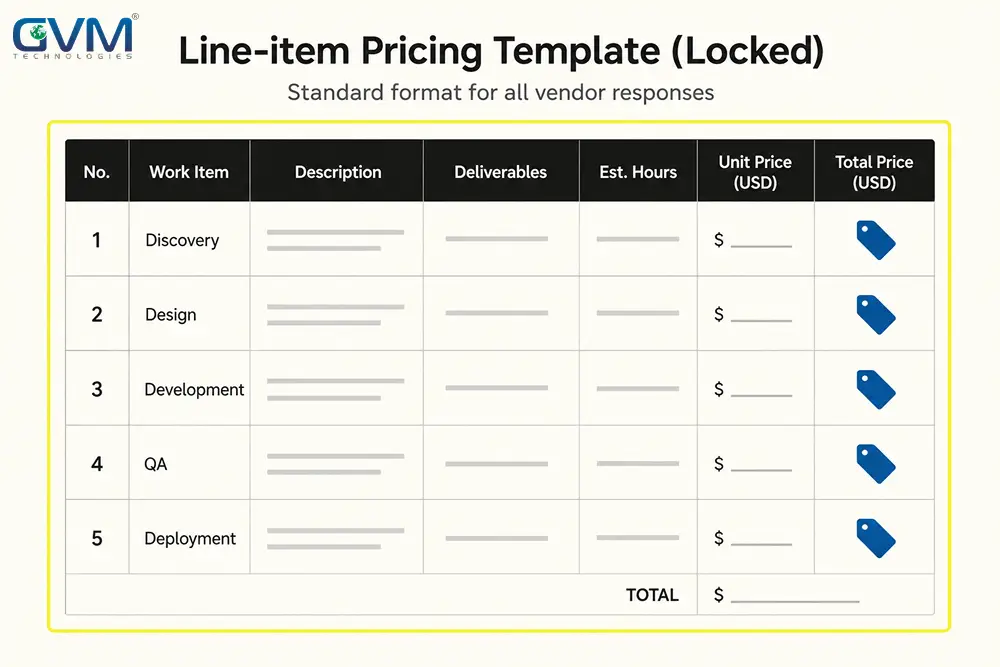
A locked pricing grid, attached as a required deliverable, forces the same information out of every bidder. State plainly that free-form PDFs replacing it are scored as non-compliant.
| Line item | Fixed or hourly | Estimate | Rate | Subtotal | Included? |
|---|---|---|---|---|---|
| Discovery and requirements | Fixed | – | – | $ | Y/N |
| UI/UX design | Fixed | # screens | $/screen | $ | Y/N |
| Frontend development | Hourly | # hours | $/hr | $ | Y/N |
| Backend and API development | Hourly | # hours | $/hr | $ | Y/N |
| Named integrations | Hourly | # hours | $/hr | $ | Y/N |
| QA and testing | Fixed or hourly | # hours | $/hr | $ | Y/N |
| Deployment and go-live | Fixed | – | – | $ | Y/N |
| Project management | % of build | – | – | $ | Y/N |
| Post-launch support (30 days) | Included or hourly | # hours | $/hr | $ | Y/N |
A vendor who leaves rows blank, or swaps the table for a lump sum, has told you something about how they scope work.
Should you disclose your budget? A range beats a figure
RFP guides split on this: some recommend an exact number, others a range. The 2 approaches don’t produce the same result.
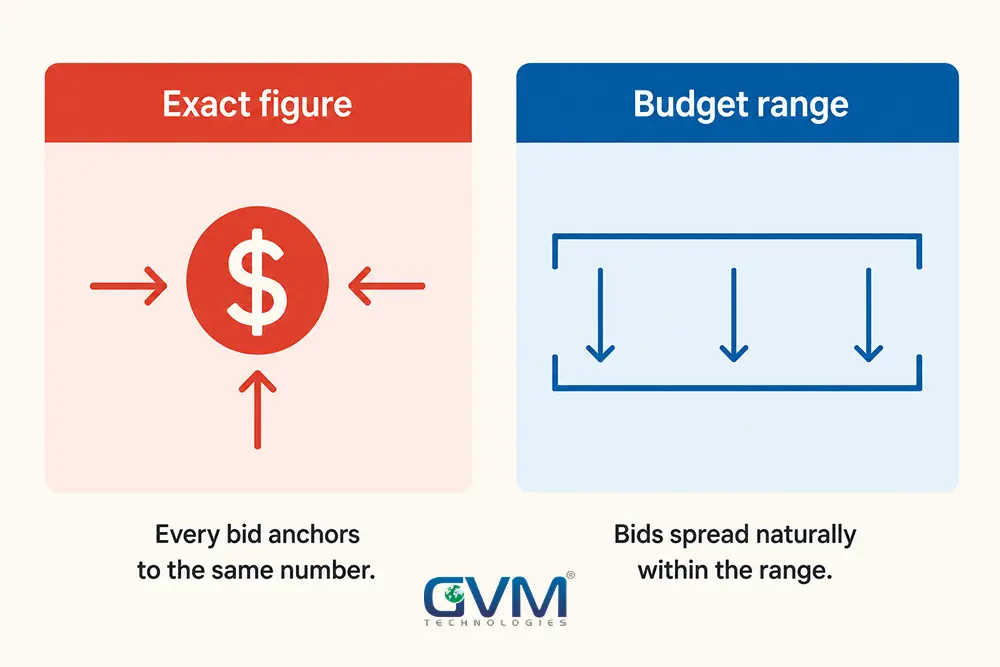
| Budget disclosure | What vendors do with it | Result |
|---|---|---|
| Exact figure (“$52,000”) | Anchor every proposal within a few percent of that number | Price stops reflecting real scope; you overpay for small projects and get corners cut on big ones |
| Range (“$40,000-$60,000”) | Self-select in or out based on fit, not a target | Mismatched vendors drop out before writing a proposal; the number stays a ceiling, not a target |
1. What happens when vendors see an exact number
An exact figure stops being a ceiling once vendors see it. It becomes a target, a pricing-psychology effect, not a sign of dishonesty.
2. The range that filters without anchoring
Disclose a band instead: “this needs to land in the $40,000-$60,000 range,” not “our budget is $52,000.” A range stops an enterprise agency spending a week on a project 5 times too small.
Prefer sharing nothing at all? Ask each vendor which of 3 bands your scope typically falls into, without naming a target.
Scoring bids with a weighted evaluation matrix
Comparable quotes still need a comparable way to judge them, or the guesswork moves from pricing to gut feeling.
| Criterion | Weight | What you’re actually scoring |
|---|---|---|
| Price and pricing clarity | 25-30% | Line-item completeness, not just the total |
| Relevant technical experience | 25% | Matching stack, matching industry, verifiable cases |
| Approach and timeline realism | 20% | Does the plan match your scope, or a template |
| Team and communication | 15% | A named, dedicated team, 1 point of contact |
| References and reliability | 10-15% | What went wrong on a past project, and how it was handled |
Publish the weights in the RFP itself. Vendors who know price counts for 30%, not 60%, stop shaving corners just to win on the number alone.
Closing the assumption gap: Q&A and non-compliant proposals
1. One written Q&A round, published to everyone
Run a single clarification window with these 3 rules:
- 5-7 business days, with a hard cutoff
- Every answer published in 1 numbered, dated addendum
- The addendum sent to every bidder, including the ones who didn’t ask anything
A question answered privately to 1 vendor gives them an edge, and quietly breaks the comparison you’re building.
2. What happens to a proposal that ignores your template
Pick a policy before the RFP goes out, and state it in the document itself.
| Policy | What it means | Use it when |
|---|---|---|
| Automatic disqualification | Non-compliant proposals are removed from the comparison | You have 4+ compliant bidders already |
| 48-hour resubmission window | 1 chance to refile in the correct format | The vendor is otherwise strong and worth keeping in the pool |
| Manual conversion | Your team rebuilds the vendor’s numbers into your template | Reserved for a vendor with no realistic alternative |
A vendor who knows the rule upfront is more likely to follow it.
Vetting vendors before you compare a single price
1. The reference-check question that actually works
Most buyers ask “were you happy,” which gets a polite yes. Ask “what went wrong, and how did they handle it” instead, since that answer shows how a vendor behaves under pressure.
2. What a same-day quote and a steep discount usually mean
A full timeline and price in a single first call comes from a template, not your requirements. Ask what changed between a vendor’s first estimate and final number on their last 2 projects.
Cross-check the answer against portfolio work and case studies.
Comparable-quotes checklist: red flag vs green flag wording
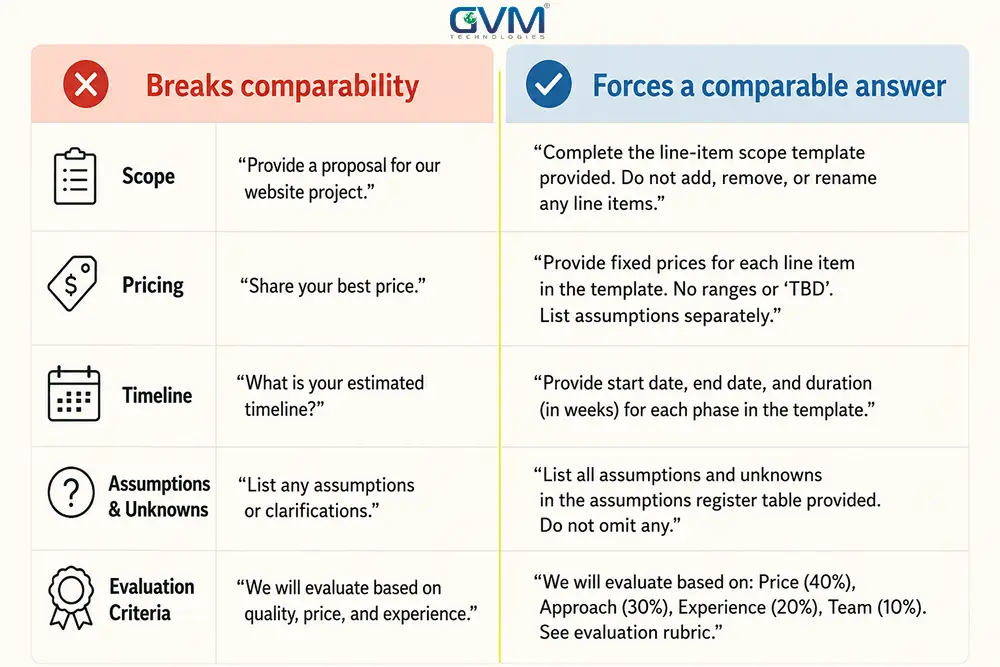
| Area | Breaks comparability | Forces a comparable answer |
|---|---|---|
| Scope | “Build something similar to X” | “8 screens, listed in Appendix A” |
| Pricing | “Provide your best quote” | “Complete the attached table; blank rows are non-compliant” |
| Timeline | “ASAP” or “flexible” | “Kickoff, MVP, and launch dates named” |
| Evaluation | Not stated anywhere | “Price 30%, experience 25%, approach 20%, team 15%, references 10%” |
| Security | “Secure coding practices” | Named against a pre-launch security checklist |
| Format | “Send us your proposal” | “Submit via the template; free-form PDFs are non-compliant” |
How long the process should realistically take
| Week | What happens |
|---|---|
| Week 1 | Finalize scope, template, and evaluation weights internally |
| Week 1-2 | Distribute the RFP to 4-6 shortlisted vendors |
| Week 2-3 | Q&A window open; answers published within 48 hours |
| Week 3-4 | Submission deadline; proposals scored against the matrix |
| Week 4-5 | 2-3 finalists shortlisted for a live walkthrough |
| Week 5-6 | Reference checks, negotiation, contract and timeline review |
A smaller build compresses to 2-3 weeks. A project needing board sign-off often runs longer.
FAQs
1. What’s the difference between an RFP, an RFQ, and an RFI?
An RFI asks for general capability while scope is forming. An RFP asks for a full solution once the problem is defined. An RFQ asks for a price only, on an already-specified scope.
2. Should I tell vendors my exact budget in an RFP?
Not as a figure. A disclosed range filters out mismatched vendors without setting a number every bid gravitates toward.
3. How many vendors should get a software development RFP?
4-6. More bidders rarely improves the comparison; it mostly adds review time.
4. How long should a software development RFP process take?
5-6 weeks for a mid-size project. Smaller projects compress to 2-3 weeks.
5. What’s the single biggest mistake that makes quotes impossible to compare?
Letting every vendor use its own proposal format. A locked pricing template fixes this fastest.
6. Do I need a lawyer to write a software development RFP?
Usually not for the RFP itself. It’s worth it once you review the resulting contract, especially IP ownership terms.
7. Should vendors be allowed to submit their own proposal format?
No, if comparability is the goal. A vendor’s own format highlights their strengths, not the answers you need.
8. Every quote came back wildly different. What now?
Check whether every vendor answered the same scope and pricing model, using your template. Most spreads trace back to 1 vendor assuming a different scope.
What to do before you send your next RFP
Most RFPs that produce unusable quotes fail on 2 checks: no locked response template, and no enforced policy for a vendor who ignores it. Fix those 2, and the rest of FRAME falls into place.
GVM Technologies reviews RFP scope and response templates as part of every new engagement:
- Custom software and web development
- MVP builds scoped for a first release
- A dedicated team extending one you already have
Last vendor search went sideways? Our guide to recovering when a developer disappears mid-project covers what to check before signing the next one.
Book a free RFP review with GVM Technologies before your document goes out. We’ll flag the gaps that would make your quotes incomparable, at no cost.