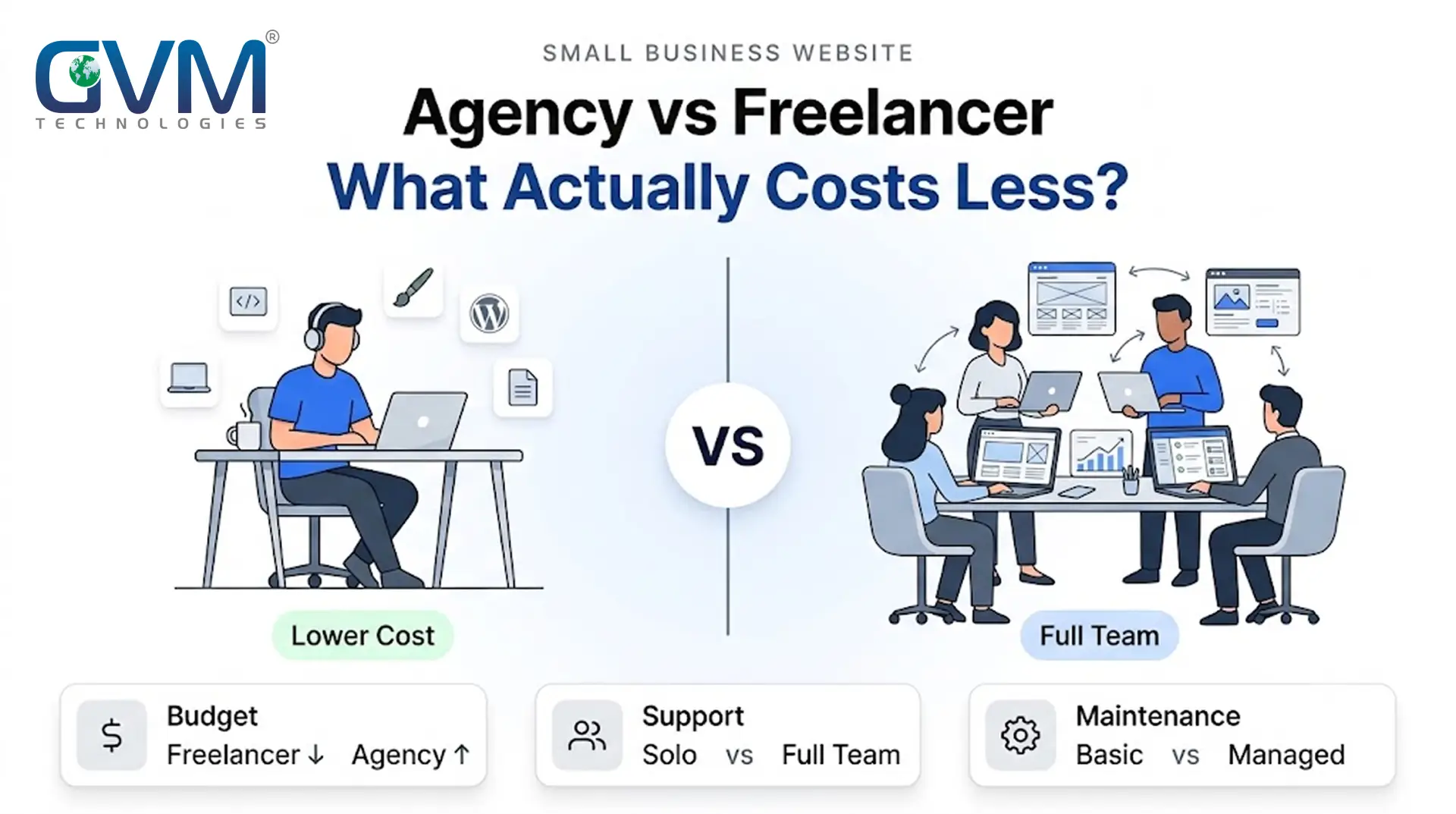
Quick answer: Weighing agency vs freelancer cost for a small business website comes down to what you’re actually buying, not just a price tag. A freelancer is one person, priced lower upfront, taking on some of the work.
An agency is a coordinated team, priced higher, taking on all of it. The gap between them isn’t really about talent; it’s about who absorbs the cost of coordinating design, code, copy, and SEO into one working site.
Get a custom quote from GVM Technologies for numbers specific to your project.
Key takeaways
The agency vs freelancer decision comes down to these five points:
- Freelancers win on upfront price and direct communication. Agencies win on continuity and accountability.
- Your own available time decides the better deal, not the invoice total.
- Hidden costs (copywriting, photography, SEO setup, your own oversight hours) close the price gap fast.
- A small, boutique agency often prices close to a senior freelancer, despite the “agency” label.
- Choosing wrong costs more than choosing slow. A botched freelancer build often gets redone by an agency anyway, adding a second cost on top of the first.
Why a freelancer quote and an agency quote cover different work
Most agency vs freelancer comparisons stop at “freelancers are cheaper, agencies cost more.” That’s true in general terms. It hides the real driver of the price gap.
A full website development project today spans five or six disciplines, and rarely fits inside just one lane:
- Design
- Front-end build
- Back-end or CMS setup
- Copywriting
- SEO
- Ongoing maintenance
A freelancer is one person covering part of that range. An agency has already assembled a team across every lane, so you pay for that structure whether the project needs it or not.
Business owners who’ve hired several freelancers separately tend to describe the same pattern. Costs stay low at first, then someone has to own the plan, or the pieces drift.
One small business owner who switched from a patchwork of freelancers to a single coordinated team described the trade honestly. Results took a few months longer to show up.
Once they did, traffic and conversions grew consistently instead of in disconnected bursts. Fragmented freelancers often deliver faster individual wins; a coordinated team compounds them.
GVM’s own GlobalRose e-commerce SEO case study shows the coordinated version of that story. Strategy, build, and search moved together from day one, with nothing left to reconcile after launch.
What you’re actually comparing: freelancer, boutique agency, or larger agency
The table below breaks the agency vs freelancer question into what each tier actually delivers, not just what it costs.
| What You Get | Freelancer | Boutique Agency | Larger Agency |
|---|---|---|---|
| Team size | One person | Small, coordinated team | Full department |
| Design and build | Template or light custom | Custom design and build | Full custom, strategy-led |
| Copywriting and SEO | Often client-supplied | Light support included | Built into the retainer |
| Project management | You manage it | Shared informally | Dedicated project manager |
| Typical turnaround | Fastest | Moderate | Longest, most thorough |
| Best fit | Simple sites, tight timelines | Custom sites, some complexity | E-commerce, integrations, hard deadlines |
(Source: Clutch, “Web Design Company Pricing Guide”)
Exact pricing for each tier depends on your scope, platform, and region, and it’s something GVM prices individually rather than quoting generically here. What matters more is which row above describes your project.
That’s especially true for a custom Shopify or e-commerce build, where scope varies the most.
The “free website” agency model, and how it actually works
Some agencies have started flipping the build cost entirely. Instead of charging for the website, they build it for free and fold the cost into a retained SEO or marketing partnership.
- Good deal if: you already need ongoing SEO or marketing help, and the retainer replaces spending you’d budget for anyway.
- Poor deal if: you only wanted a website, and end up locked into monthly services you didn’t need just to get it.
Why the first-year total matters more than the build quote
Most comparisons stop at the invoice for the build. Add twelve months of hosting, domain, and maintenance, and the real first-year picture looks different.
A cheap build with no maintenance plan often ends up costing more in emergency fixes than a pricier build with a proper retainer attached. Ask any provider to walk you through their full first-year total, not just the build line, before comparing two quotes.
The Coordination Tax: what you’re really paying for
Call this the Coordination Tax: the cost of making sure design, code, copy, and SEO don’t contradict each other at launch. Three ownership models exist, and each shifts that cost somewhere different.
- One freelancer handles everything. Lowest upfront cost. You absorb the tax yourself, in hours spent catching gaps between disciplines they’re weaker in.
- Multiple specialist freelancers. Cheaper per person, but nobody owns the outcome unless you assign that role. Most owners lack the time to fill it well.
- One agency. The tax is built into the fee. You fund a project manager’s time whether you interact with them daily or not.
None of the three wins outright. The sizing mistake in any agency vs freelancer decision is comparing invoice totals without pricing in who does the coordinating.
What the Coordination Tax actually costs you
Put a number on it before choosing the DIY-management route: your own hourly value, multiplied by the hours you’ll spend reviewing work, chasing revisions, and catching gaps between people.
That cost never shows up on an invoice. It’s why a “cheap” multi-freelancer setup can end up more expensive than a single agency retainer once your own time is priced in honestly.
GVM’s TREM Group real estate case study is a good example of what the coordinated version looks like from the client’s side: one team owning the plan, so the client’s own oversight hours stayed low.
What drives freelancer pricing up or down
Freelancer rates span a wide range, which is one of the trickiest parts of any agency vs freelancer comparison. Experience tier explains most of that spread, not just geography.
Freelancer tiers by experience
| Tier | Profile | Best Fit |
|---|---|---|
| Entry / marketplace | New to freelancing, marketplace-sourced | Very simple sites, tight budgets |
| Mid-level | 2 to 7 years, ex-agency, one or two platforms | Most brochure and e-commerce builds |
| Senior specialist | 7+ years, deep single-stack expertise | Custom functionality, migrations |
| Ex-agency lead | Former creative director working solo | Agency-caliber output, lower overhead |
(Source: Upwork, “Web Designer Hourly Rates”)
This tiering pattern is a useful sanity check against any single quote that looks unusually low for the experience being claimed.
Why two freelancer quotes can differ sharply
A pattern shows up constantly among small-business owners comparing quotes. Agencies often staff an account with a subcontracted freelancer and never disclose it, billing you the agency rate while delivery happens one layer down at the freelancer rate.
This isn’t automatically dishonest; agencies exist partly to manage flexible capacity this way. It does mean two very different-looking quotes can sometimes represent the same person.
Two quick ways to check before you sign:
- Search the name signing your emails on LinkedIn. Some agencies issue a subcontractor an agency email address specifically so the client can’t tell. A search settles it in under two minutes.
- Ask directly whether the work gets subcontracted, and to whom. This matters most when two quotes look surprisingly close together.
Platform choice moves price too. WordPress builds cost less than custom React or Next.js work, since the tooling is more mature.
What agency fees actually buy
This is the other half of the agency vs freelancer equation. Agency pricing rarely maps to hours times a rate card; the fee bundles a team, not one person’s time.
1. Who’s actually on your project team
- Account or project manager, who owns your timeline and communication
- A UI/UX designer responsible for layout and conversion flow
- A front-end and/or back-end developer
- A QA tester checking cross-browser and mobile behavior
- Often a launch-time SEO specialist
That bundled team is the source of the meaningful price gap against a solo freelancer for a similar deliverable, and it isn’t just anecdotal; independent agency-pricing research documents a comparable multiplier industry-wide.
2. Red flags hiding in agency quotes
- The pitch team isn’t the delivery team. Senior staff close the sale; junior staff execute it. Ask who specifically does the day-to-day work.
- Short staff tenure. Check the agency’s LinkedIn company page under the “Insights” tab for average employee tenure before signing anything.
- Retainer creep. Some agencies quote the build low, then price an open-ended maintenance fee disproportionate to the actual monthly work.
3. The math behind the tenure red flag
Here’s why short tenure matters more than it sounds. At roughly a year of average tenure, if three people touch your account, standard turnover math puts the odds above 70% that at least one leaves within 6 months.
That number climbs above 90% within 12 months. It’s the practical reason older case studies were likely built by people no longer at the agency.
Bundling can still be worth paying for. A full digital marketing retainer only makes sense if you need SEO, paid media, and PR now, not eventually.
Hidden website costs freelancers and agencies both skip
These are the categories that turn a modest quote into a much larger total, regardless of which side of the agency vs freelancer split you land on.
| Hidden Cost Category | Most Often Missed By |
|---|---|
| Domain and hosting, annual | Both, quoted separately then forgotten |
| Photography, stock or custom | Freelancer projects with unclear content ownership |
| Copywriting | Freelancer builds priced as design and dev only |
| Premium theme or plugin licenses | Both, especially WordPress builds |
| SSL, monitoring, backups | Freelancer sites with no DevOps and hosting plan |
| Revision rounds beyond scope | Both, the top source of overruns |
| SEO migration and redirects | Rebuilds skipping a technical SEO audit |
| Your own project-management time | Freelancer projects, almost always |
A common mistake: comparing a freelancer’s quote against an agency’s quote without checking whether both include copywriting and SEO setup. Add those line items back in before you compare.
Once everything is counted, the gap between the two often shrinks considerably. Still cheaper on the freelancer side in most cases, but a different comparison than the sticker prices alone suggest.
What it costs you when you hire the wrong freelancer or agency
Most agency vs freelancer comparisons skip this risk entirely. If a freelancer build falls short, the next call is usually to an agency for a project rescue, and that second engagement lands on top of the first.
Common signs a build needs rescuing:
- A broken or non-responsive layout on mobile
- A CMS nobody can actually update without a developer
- No documentation or login handover from the original builder
- Missing SEO fundamentals: no sitemap, no meta titles, broken redirects
A modest freelancer build that needs a full rescue almost always costs more in total than hiring correctly from the start.
There’s an incentive-alignment angle worth naming too. A freelancer whose next contract depends on your referral has every reason to recommend only what you need.
A larger agency bundling extra services sometimes has other incentives shaping the recommendation, since more scope is also more revenue for them. Neither model is automatically more trustworthy; ask what’s being recommended, and why.
Agency vs freelancer cost for a small business website: side-by-side comparison
| Factor | Freelancer | Agency |
|---|---|---|
| Upfront cost | Lower | Higher |
| Ongoing cost | Lower | Higher |
| Communication | Direct, one contact | Routed through account management |
| Continuity risk | High, one person | Low, team-covered |
| Skill breadth | Narrow to moderate | Broad across disciplines |
| Speed on small changes | Fast, no ticketing | Slower, process-driven |
| Best fit | Simple sites, tight budgets | Complex builds, hard deadlines |
| Biggest risk | Availability, unverified skill | Junior execution, retainer bloat |
Freelancer or agency: a quick decision checklist
Use this checklist to settle the agency vs freelancer question for your specific project, not in general.
Choose a freelancer if
- Your budget is genuinely tight. Most agencies can’t scope a very small project profitably without junior-only staffing.
- You can personally review work and answer questions within a day or two.
- Your site is a static brochure with no bookings, logins, or CRM integration.
- You expect frequent small edits after launch and want fast, direct turnaround.
- A freelancer is already doing good work for you elsewhere. A relationship that already performs well rarely needs replacing just because the business is growing.
Choose an agency if
- Design, copy, SEO, and development all need to launch together on one fixed date.
- Your build includes e-commerce, memberships, or third-party integrations.
- You want one team accountable if something breaks, not one person.
- You have very little time of your own to manage the project.
Two or more agency-leaning boxes checked points toward budgeting for an agency-level engagement. Freelancer-leaning boxes point toward a well-vetted freelancer as the stronger return, not just the cheaper one.
Two more paths worth considering: hiring in-house or building it yourself
A third and fourth path belong alongside the agency vs freelancer comparison. Top-performing guides on this topic weigh all four options, not two.
When in-house hiring makes sense
In-house hiring only pencils out once your marketing needs are large and ongoing enough to justify a full-time salary and benefits. Below that threshold, a full-time hire usually costs more than either outside option for the same output.
If you’re scaling toward that point, staff augmentation is a middle step: a dedicated resource who works like an employee without the full hiring overhead.
When a DIY builder is enough
DIY builders (Squarespace, Webflow, or a WordPress page-builder theme) are the right call for a very small budget, not a compromise. A single-location business needing an address, hours, and a contact form rarely needs anything more.
Upgrade to a freelancer once revenue justifies it, or once you need functionality a builder can’t handle cleanly.
Common mistakes that cost small businesses money
These recur across almost every agency vs freelancer decision, regardless of budget size.
- Choosing on lowest quote alone. The cheapest number is often cheap because copywriting, SEO, or post-launch support got quietly cut from scope.
- Assuming “agency” always means better quality. It often just means paying more for similar output, especially if a junior staffer executes behind a senior pitch.
- Assuming a good freelancer can’t scale with you. Many bring in trusted subcontractors as scope grows, becoming a lean team without agency overhead.
- Skipping reference checks. Talk to one or two recent clients directly. A portfolio alone won’t show you how scope changes actually got handled.
- Not clarifying account ownership after launch. Get it in writing that you own the hosting account, domain registrar, and CMS admin.
- Assuming AI made every build cheaper. It compressed pricing on basic brochure sites, but some AI-assisted agencies did the opposite: fewer people, faster delivery, higher rates.
- Treating an AI-generated starter site as finished. A growing share of 2026 freelancer work is fixing a site someone built solo and couldn’t finish the last stretch of.
- Writing off copy as a minor line item. Rushed brochure copy reads that way to visitors. Even AI content writing tools need a human edit pass to sound like a real business.
How to vet either option before paying a deposit
These questions apply on either side of the agency vs freelancer line. Ask them before signing anything, regardless of which model you’re leaning toward:
- Can I speak with two recent clients directly, or see verified client testimonials? Hesitation, or only portfolio links offered, is a caution flag.
- Who specifically will do the work, and what’s their experience with this exact platform?
- What’s included in this quote, and what triggers an additional charge?
- Who owns the hosting, domain, and CMS login after launch? The answer should always be you.
- What does post-launch support cover, in specific hours or response-time terms?
Vetting an SEO-inclusive quote specifically? This checklist of questions to ask an SEO agency covers the technical side these five don’t.
Want a live example of a fully vetted answer? GVM’s about us page shows exactly who works on client accounts and how.
FAQs
1. Is a freelancer always cheaper than an agency?
In most cases, yes, on a like-for-like scope. Add your own project-management time and the agency vs freelancer gap narrows fast.
2. What should a small business budget for a website in 2026?
It depends heavily on scope, platform, and functionality. Request a custom quote for a figure based on your actual requirements rather than a generic average.
3. Do agencies ever cost the same as freelancers?
Yes, at the boutique end. A small, lean studio can price close to a senior solo freelancer, since its overhead is far lower than a larger firm’s.
4. Should web design and SEO come from one provider or two?
One provider owning both usually runs smoother, since it removes the gap where a site launches beautifully but isn’t structured for search. Splitting the work still works if the SEO provider joins during the build, not after launch.
5. What’s a fair monthly cost for website maintenance?
It depends on hosting, security needs, and how often content changes. Ask any provider to itemize the monthly fee into hours and specific deliverables, not a flat unexplained retainer.
6. How much does a website redesign cost compared to a new build?
A website redesign of an existing site typically costs less than a full rebuild, since content, structure, and SEO history often carry over.
7. Is refusing a fixed quote automatically a red flag?
Not on its own. It becomes one when they also won’t estimate a range or won’t put scope in writing before work starts.
The bottom line: which option actually saves you money
There’s no universal winner in the agency vs freelancer cost for a small business website decision, only a better fit for your budget and appetite for managing the work yourself. Freelancers win on upfront cost and direct access.
Agencies win on coordination and continuity, especially when a project carries real complexity or a hard deadline. Most small businesses underprice their own time in this decision.
That’s why a “cheaper” freelancer choice sometimes costs more once the first-year total and the risk of a redo are counted honestly.
GVM Technologies has been building and rescuing small business websites since 2012, and every project runs through the same five-stage process:
- Consulting
- Planning
- Development
- Maintenance
- Optimization
That structure is backed by ISO 27001, ISO 20000-1, and ISO 9001 certification. There’s never a guess about which stage your project is in or who owns it.
Ready to see the real number for your project? Book a scoping call with GVM Technologies for a written estimate that separates build cost, hidden line items, and ongoing support, scoped to what you actually need.