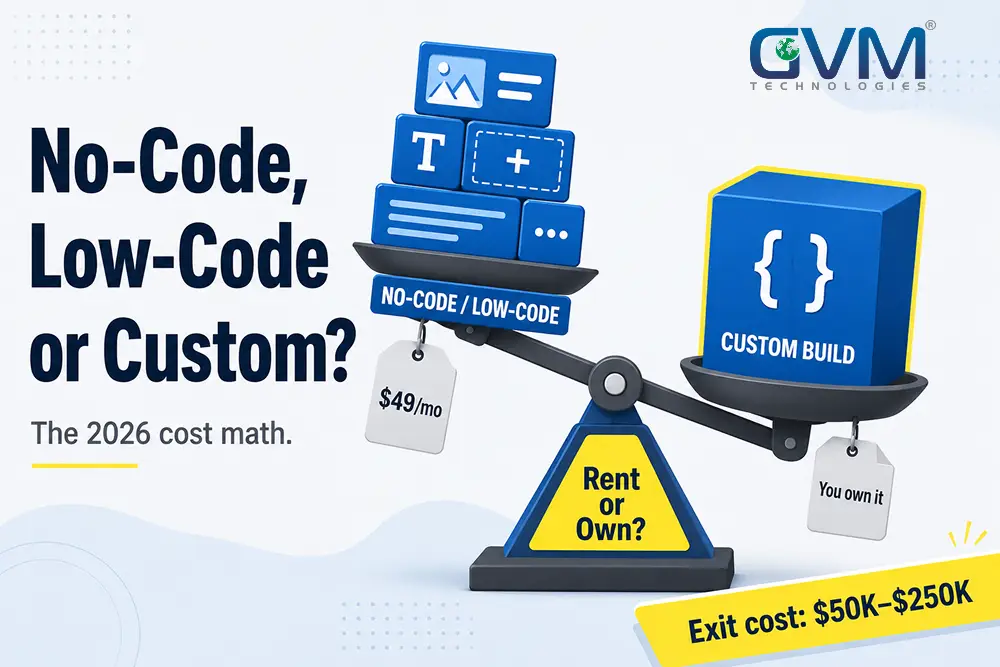
Quick Answer: Low-code vs custom development comes down to 1 question. Is this workflow the thing you get paid for, or the thing that supports it? Support work belongs on a platform. Revenue work belongs in custom software you own outright.
Nearly every expensive failure here is a team that got those 2 backwards, then funded the same application twice.
Key Takeaways
- Platform or custom is not a quality choice. It answers one question: who maintains this in 18 months?
- Microsoft stopped selling the $5 Power Apps per-app plan to new buyers on January 2, 2026.
- Rebuilding an outgrown platform app costs $50,000 to $250,000. That line is never in the original business case.
- Ceilings are published, not secret. AppSheet caps Enterprise databases at 200,000 rows.
- The final 5% of requirements eats more effort than the first 95%.
- Best answer for most builds: platform at the edges, custom at the core, joined by APIs you control.
What No-Code, Low-Code, and Custom Development Actually Mean
Sales decks use these 3 terms interchangeably. That is where the confusion starts, and it gets expensive once a contract is signed.
1. No-Code: Configuration, Not Construction
No-code means assembling an app from prebuilt blocks in a visual editor, with zero programming. Bubble, Glide, Softr, Webflow, and Google AppSheet live here.
You are not writing software. You are configuring someone else’s software to act like yours. That is not a pedantic distinction. It fixes a ceiling on what the app can ever do, and the vendor owns that ceiling.
2. Low-Code: Visual First, Code at the Wall
Low-code adds an escape hatch to the same visual builder: scripts, plugins, or functions when components fall short. Power Apps, OutSystems, Mendix, Retool, and Appian sit here.
The escape hatch is the whole pitch. It is also the trap. Lean on it hard and you have paid developers to write code inside an environment they cannot take with them.
3. Custom Development: You Own the Source
Engineers write the app in standard frameworks such as React, Node.js, Django, or .NET. You own the repository and the deployment target.
No row caps. No per-seat licence. No feature request queued behind a vendor’s roadmap. You also own maintenance, which teams underestimate just as badly in this direction.
The error almost everyone makes: “Low-code” describes how an app is authored, not how capable it is. A well-built model-driven Power App handles thousands of concurrent users against millions of Dataverse records. A sloppy custom app dies at 50. Authoring method and engineering quality are independent variables.
No-Code vs Low-Code vs Custom Development: Side-by-Side
| Factor | No-Code | Low-Code | Custom Development |
|---|---|---|---|
| First working version | 1 to 7 days | 2 to 8 weeks | 8 to 20 weeks |
| Who builds it | Business user | Developer or power user | Engineering team |
| Code ownership | None | Partial, platform-bound | Full |
| Customization ceiling | Hard, low | Hard, higher | None |
| Cost shape | Per-seat subscription | Subscription plus connectors | Build plus hosting |
| Scaling behaviour | Stops at published limits | Degrades on concurrency | Engineered to requirement |
| Integration depth | Prebuilt connectors only | Connectors plus custom APIs | Anything with an interface |
| Version control | Rarely usable | Partial, proprietary | Standard Git workflow |
| Automated testing | Manual QA mostly | Limited | Full test suite |
| Regulatory fit | Inherited, shallow | Inherited, partial | Designed to requirement |
| ROI horizon | Immediate | 6 to 12 months | 12 to 24 months |
| Exit cost | Full rebuild | $50,000 to $250,000 | Zero, already owned |
| Best fit | Forms, portals, CRUD | Internal tools, approvals | Core product, regulated data |
1. The Row Everyone Skips
Look at exit cost. Every other comparison buries it in a footnote.
It is the largest single number in this decision. Your vendor has zero incentive to help you calculate it.
2. The Honest Case for Platforms
Platforms genuinely beat custom builds where custom builds are wasteful. 4 cases stand out.
- Speed to evidence. A CRUD app with approvals and email alerts is a 1-day platform build. Custom needs 2 to 3 weeks with real QA.
- Compliance shortcuts. A Power App inside Microsoft 365 inherits identity, permissions, and audit logging. Teams report this cuts months of security review.
- Cheaper for small jobs. MIT’s student portal for 2,800+ users had cost roughly $100,000 as custom code. 1 person rebuilt it on Softr in under 3 months.
- Reversibility. Scrapping a 2-week platform build costs 2 weeks. Scrapping a 5-month custom build costs a quarter.
Our MVP development engagements often open by recommending a platform first.
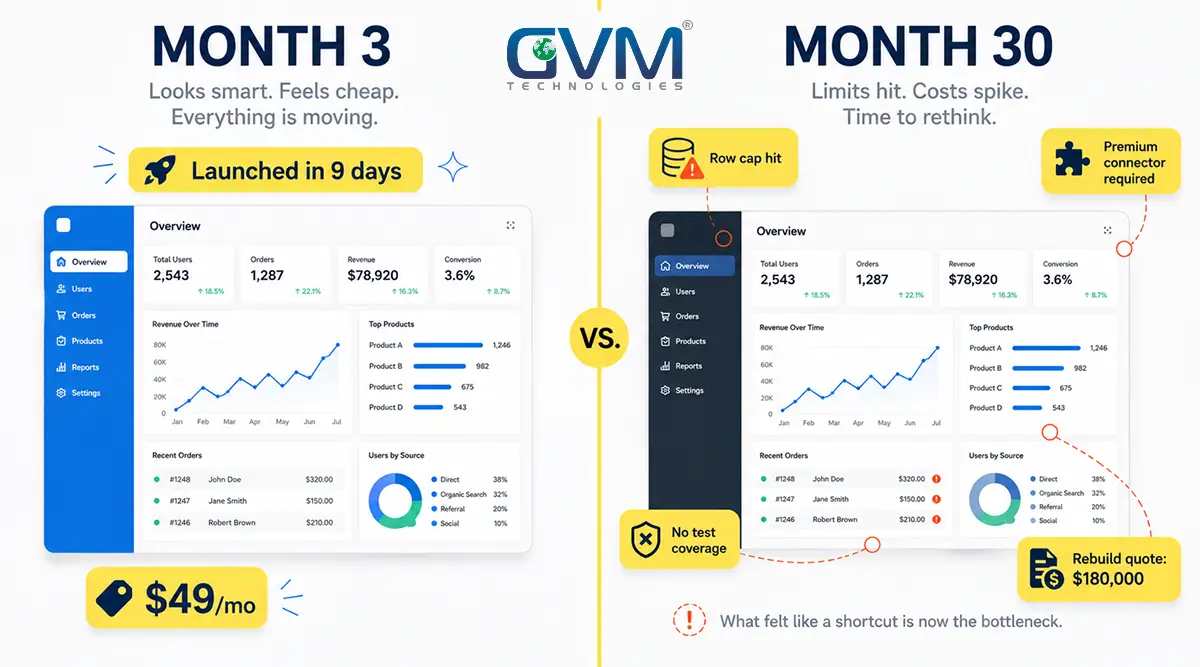
Spending $70,000 on a bespoke leave-request form is bad capital allocation. Saying so earns more trust than pretending otherwise.
The 5-Question Fit Test
Run these before opening a single pricing page. Each answer pulls you one way.
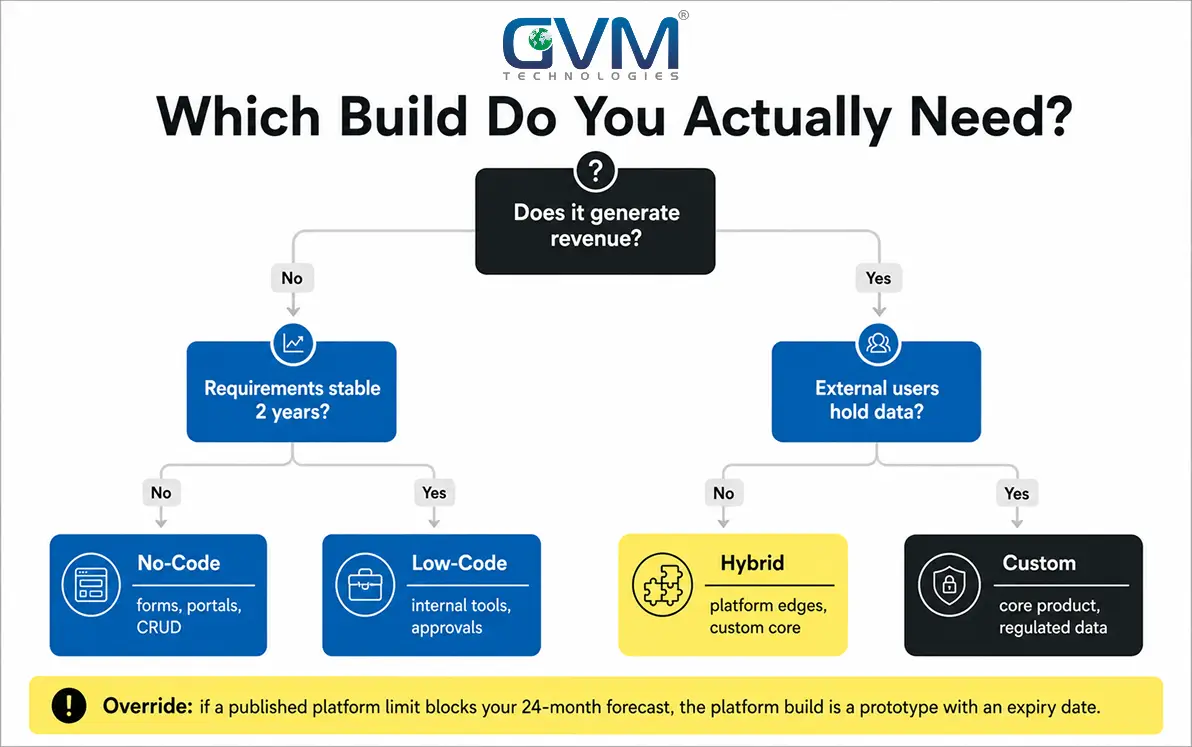
- Does this workflow generate revenue or serve external customers? Yes points custom. Internal-only points platform.
- Will strangers hold accounts and store personal or payment data? Yes points custom. Staff behind single sign-on points platform.
- Could a competitor copy your advantage off the screen? If differentiation lives in the logic, that logic should not live in a vendor’s format.
- Are requirements known today and stable for 2 years? Known and stable points platform. Evolving points custom, or a disposable prototype.
- If usage doubled every quarter for 2 years, what breaks first? A published platform limit means you already have a rebuild scheduled.
1. How to Read Your Score
- 4 or 5 favour platform: build on no-code or low-code and stop deliberating.
- 4 or 5 favour custom: go custom now. The platform version becomes a detour you fund twice.
- A 3 and 2 split: the majority case. The Core vs Edge Rule below is written for you.
2. The Override That Beats All 5 Answers
One condition outranks the whole test. If a published limit sits between you and your 24-month forecast, treat the platform build as a prototype with an expiry date.
That is the gap between a planned migration and an emergency one. The price difference is usually 6 figures.
Mobile deserves extra scrutiny. App store rules and native device features are where visual builders run out of room fastest.
Anything shipping as a real native app should be priced as mobile application development from day 1.
What Each Option Costs Across 3 Years
Sticker price is the wrong number. Total cost of ownership plus the cost of leaving is the number that decides your outcome.
| Cost line | No-Code (25 users) | Low-Code (200 users) | Custom Build |
|---|---|---|---|
| Build or configuration | $2,000 to $15,000 | $40,000 to $120,000 | $30,000 to $250,000 |
| Licensing, 3 years | $3,000 to $20,000 | $250,000 to $350,000 | $0 |
| Hosting | Included | Included, plus overage | $6,000 to $60,000 |
| Maintenance per year | Low | Medium, specialist-dependent | $12,000 to $50,000 |
| Cost to leave | Full rebuild | $50,000 to $250,000 | $0 |
Complex enterprise systems clear $500,000 on the custom side, occasionally $1 million. Our software cost breakdown shows how those ranges get assembled line by line.
1. The 2026 Repricing Nobody Budgeted For
Here is the detail most 2026 comparisons still miss. The Power Apps per-app plan, roughly $5 per user per app per month since 2021, hit end of sale for new customers on January 2, 2026.
New buyers now choose Power Apps Premium at about $20 per user per month, or a pay-as-you-go meter near $10 per active user per app through Azure.
Anyone who modelled a case on the $5 tier faces up to a 4x change in the per-user line.
Existing Enterprise Agreement customers keep their licence. The pain lands on new projects and expiring agreements.
The number matters less than the pattern. Platform economics are a policy decision made by someone who is not you, and it can move between your business case and your renewal.
Owned infrastructure behaves differently. Costs on a containerised deployment track usage you can measure, not a vendor’s licensing roadmap.
2. The Crossover Point Nobody Calculates
Platforms are cheap at small scale and hostile at large scale. You rent per seat forever, while a custom build is a one-time asset with a maintenance line.
For a mid-sized internal tool, crossover lands between month 18 and month 30, sooner if headcount grows.
- 5 years, 200+ users: the platform is almost never cheaper.
- 9 months, 20 users: custom is almost never justified.
- 2 to 3 years, 50 to 150 users: genuinely close. Exit risk decides it, not monthly spend.
3. The Staffing Line Nobody Budgets
Specialist platform skills are narrow and priced accordingly. Standard-stack skills are broad and portable.
The person who can truly fix a mature platform app is often a consultant at consultant rates, or a lone power user whose next promotion becomes an operational risk.
A React and PostgreSQL app can be picked up by thousands of engineers, which is why teams staff it with dedicated resources instead.
Where Platforms Break: The 95/5 Ceiling
Platforms handle most requirement sets comfortably. The failure mode is the final slice they were never designed for.
Experienced platform developers describe it identically. Roughly 95% works well, and forcing the last 5% through the platform is miserable.
One example makes it concrete. A config change taking 10 seconds in a native mobile toolchain became a 3-week project on a low-code platform.
The only path was learning the underlying engine, building a plugin, then wrapping it to expose the result back to the visual builder.
Same requirement. 3 weeks instead of 10 seconds. That is the 5% tax, and it never appears in a demo.
1. 4 Ceilings You Can Read Before Signing
Published constraints, not surprises. Check each against your 24-month forecast.
- Data volume caps. AppSheet’s database limits are 1,000 rows free, 2,500 on Starter and Core, 200,000 on Enterprise, plus 20 tables per database.
- Metered execution. Bubble prices by Workload Units, so spend tracks traffic and logic complexity. Teams report surprise charges when traffic spikes.
- Connector tiers. Standard connectors are cheap. Premium connectors reaching your ERP or on-premise SQL are what reprice the deal.
- Concurrency. Independent benchmarking flags fine-grained concurrency and resource scaling as the main blockers for high-scale deployments.
Some requirements cannot be expressed cleanly in a visual tool at all. Deeply nested iteration, recursion, and fine-grained transaction control are the usual casualties.
Platform maturity never fixes a paradigm mismatch.
2. The Engineering Discipline Problem
The harder ceiling is operational, and it is where platform projects quietly rot.
Ask a vendor these 5 questions and watch the answers get vague.
- How does a change get promoted from development to test to production?
- What commits to Git, and can a human review it in a pull request?
- Can we write unit tests and mock external dependencies?
- Can 2 people work on the same app without overwriting each other?
- When it breaks at 2 a.m., where are the logs?
Skip these and business-critical logic ends up spread across hundreds of drag-and-drop nodes with no version history.
In several visual integration tools, what lands in the repository is generated JSON. A reviewer opens a diff nobody can meaningfully assess.
That is software built without software practices, which our agile delivery process and independent QA testing exist to prevent on either side of the line.
3. The Orphan App Problem
Here is the governance failure no comparison table includes, and the one we see most.
Non-developers can build on a platform. They usually cannot maintain what they built.
The original builder moves on. The app stays business-critical. It lands on engineering anyway, minus documentation, in a tool the engineers do not know.
Decide who owns the app in year 3 before you build it in year 1. That question prevents more project rescue work than any technical review.
The Core vs Edge Rule: The Hybrid That Works
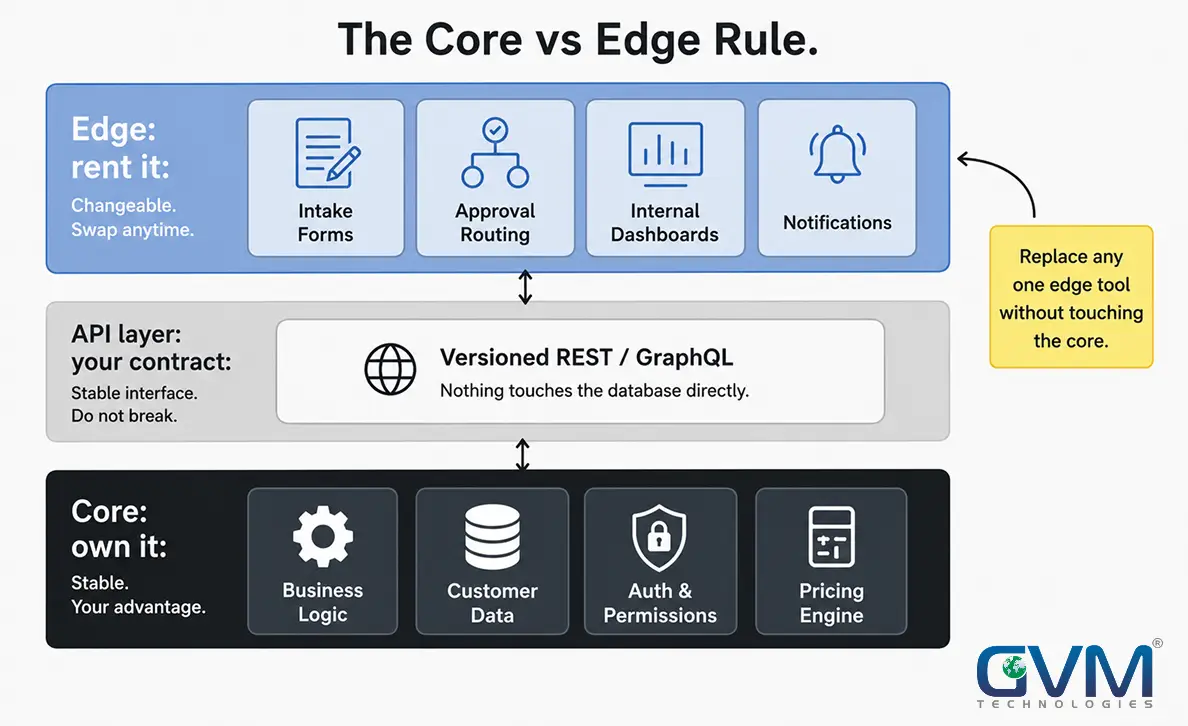
The rule that resolves most real cases: put custom code where your differentiation lives, platforms everywhere else.
Custom owns pricing engines, matching algorithms, proprietary calculations, customer-facing surfaces, and anything touching regulated data.
Platforms own intake forms, approval routing, internal dashboards, notifications, and back-office admin screens.
1. What a Working Hybrid Looks Like
- Core in code you own. Business logic, data model, and authentication live in your repository on standard frameworks.
- A documented API layer between. Platform tools talk to the core through versioned APIs, never straight to the production database.
- Platform tools at the edges. Internal teams get forms and dashboards without filing an engineering ticket.
- A clean seam for replacement. When one edge tool outgrows its ceiling, you replace that tool, not the business.
That API seam is the entire point. Migrations cost 6 figures because logic and data end up entangled inside the platform.
Keep both outside it and the platform becomes a replaceable component. DevOps and cloud infrastructure you control keeps that seam honest.
2. The Hybrid Most Teams Reach Anyway
Watch what mature platform teams end up doing. They hit the 5% wall, then start hosting real single-page apps inside platform containers and calling their own services.
That is the hybrid arriving late, after the tuition is paid. Interface-heavy products get there fastest, which is why UI/UX prototyping belongs before the build tool is picked.
3. Where to Start, By Situation
- New and unvalidated: validate on a platform, learn the real requirements, then build the core. Give version 1 a written end date.
- Validated but straining: rebuild the core, leave the edges alone. That is the shape of most SaaS product engagements.
- Regulated data or payments: start custom. Our money transfer platform and healthcare app both needed auditability designed in, not retrofitted.
- AI in the roadmap: keep models and pipelines in owned code. AI services integration and machine learning work outgrow connector tooling fast.
Get a Straight Answer on Your Build
Send us 4 things: the workflow, current user count, your 24-month forecast, and the platform you are weighing.
You get back which parts belong on a platform, which parts will cost you a rebuild, and what each path costs across 3 years.
No obligation. No pitch for custom development where a $49 subscription does the job better.
Book a build assessment with GVM Technologies and review how we scoped this call for other teams.
How to Pick a Platform You Can Leave
If a platform is right, the criteria that predict pain 2 years out are not the ones in the demo.
| Criterion | Why it sets your exit cost | What good looks like |
|---|---|---|
| Data export fidelity | Some exports land in formats no database accepts | Clean SQL or documented JSON, tested before signing |
| Code export | Decides whether leaving means migrating or rebuilding | Real framework output you can self-host |
| Git integration | Enables review, branching, rollback | Native repo sync, human-readable diffs |
| Environment separation | Dev to test to prod without manual copying | Built-in deployment pipelines |
| Pricing shape | Per-seat scales linearly with your success | Flat or capacity-based, published overage |
| Licence stability | Vendors retire tiers mid-contract | Multi-year price protection in writing |
| Vendor durability | Yahoo Pipes, Popfly, App Maker and Coghead all shut down | Source code escrow or self-hosting |
1. The 2-Hour Test Worth 6 Figures
Export your data before you commit, not after.
Load the file into an ordinary database and see what survives.
Check whether relationships, field types, and attachments arrive intact, or whether you get a flat dump needing reconstruction.
That exercise is the cheapest insurance anywhere in this decision.
2. Ask for Escrow in Writing
Any serious vendor will discuss source code escrow, which keeps you running if they fold or sunset the product.
The list of dead platforms is long enough to make this a normal commercial ask. Either way, your early technology decisions set how expensive your options are later.
6 Mistakes That Turn a Cheap Build Into a Rebuild
- Picking a platform to avoid hiring engineers. Platforms multiply people who understand data models and APIs. They substitute poorly for that knowledge.
- Scoping to today only. Requirements that will double in complexity need testing against the published ceiling, not the current feature list.
- Letting a prototype become production by accident. A platform build that turns business-critical with no governance review is the classic rescue story.
- Putting the platform at the centre. When it holds the data and the logic, everything else becomes a satellite and leaving becomes impossible.
- Skipping QA because the platform handles it. Platform apps break the same ways custom apps do, with worse logs and no test coverage.
- Treating the decision as permanent. It is an architecture choice with a review date, and that date belongs in the calendar on day 1.
The thread through all 6: teams optimise for the first 3 months and pay across months 18 to 36.
Naming that trade-off at kickoff is most of the fix. It is the same discipline behind avoiding the pitfalls that derail healthy projects.
FAQs
1. Is low-code cheaper than custom development?
Cheaper upfront, usually more expensive across 3 or more years at scale. Per-seat licensing keeps charging after a custom build becomes a paid-off asset. For a 200-user internal tool, crossover typically lands between month 18 and month 30.
2. Can no-code and low-code apps handle enterprise scale?
Some can. Mature platforms run apps with thousands of concurrent users and millions of records. The real limiter is platform-specific constraints, not raw scale. Heavy concurrency plus complex logic is where benchmarks show degradation.
3. What is the biggest hidden cost of no-code platforms?
The rebuild that is not in your budget, at $50,000 to $250,000. Second place goes to premium connector tiers, which reprice the deal the moment you need an ERP or on-premise database.
4. Should a startup build its MVP on no-code or custom code?
Use a platform while you are still testing whether anyone wants the product. Move to custom once you know what to build and real users store real data. Treat the platform version as a disposable experiment with a planned end date.
5. Do I still need developers if I use a low-code platform?
Yes, for anything past simple forms. The escape hatch that makes low-code powerful needs someone who can write and review code. Deployment, testing, and integrations still require full-stack and QA engineers.
6. How do I know when it is time to move off my platform?
4 signals: you build workarounds more often than features, the licence bill outgrows delivered value, engineering keeps getting pulled in to debug it, or you hit a published limit. Any 2 together mean start planning now.
7. Which approach is better for regulated industries?
Custom, in almost every case where you carry the compliance obligation. Platforms accelerate internal tools by letting you inherit identity and audit logging. Shallow control over data residency and retention becomes the problem during a real audit. Our commercial insurance platform needed that control built in, not inherited.
Conclusion: What to Do This Week
Low-code vs custom development is not a quality ranking. It decides what you rent and what you own.
Rent what supports the business: forms, approvals, dashboards, back-office screens. Own what is the business: the logic, the data, the customer-facing product.
The teams that get burned did not pick a platform. They put the platform in the middle, met the ceiling at month 20, and funded the same app twice.
3 actions, in order:
- Run the 5-Question Fit Test on your most painful workflow. 20 minutes.
- Export your data from any platform you already depend on. Load it into a normal database and see what survives. 2 hours.
- Write down who owns that app in year 3. If the answer is a person rather than a team, you have a governance gap, not a tooling gap.
Do those 3 and you will decide better than most organisations spending 10x your budget on this call.
Want a second opinion grounded in real cost ranges instead of vendor marketing?
GVM Technologies has run this assessment for teams on both sides of the line since 2012. The work is in our portfolio.