Skip to content

ISO 27001:2022 | ISO 20000-1:2018 | ISO 9001:2015 certified serving clients since 2012

+1 (786) 947-6105
Book a Free Consultation

AI-Powered HMS, EMR & EHR

AI-Powered HMS, EMR & EHR

Industry

Healthcare

Target Market

Global

Introduction

Hospitals generate enormous amounts of operational and clinical data every day. Patient registrations, appointments, consultations, prescriptions, laboratory tests, pharmacy transactions, bed occupancy, billing, nursing activity, inventory, radiology, staff operations and financial information all need to work together. The real challenge is not simply digitizing these processes, but helping hospital management, doctors and operational teams understand what is happening across the hospital in real time.

GVM Technologies developed a fully integrated AI-powered Hospital Management System (HMS), Electronic Medical Record (EMR) and Electronic Health Record (EHR) platform that centralizes hospital operations and transforms healthcare data into meaningful operational intelligence. Instead of relying on multiple reports and departments for information, hospital leadership gets a unified operational picture.

The Challenge


Hospitals operate through multiple departments that depend on each other, and when their processes are fragmented they face challenges such as:

  • Fragmented Patient Journey: A patient moves from Registration to Consultation, Prescription, Laboratory, Pharmacy, Admission, Nursing, Billing and Discharge, and every stage generates additional information.
  • Duplicate & Delayed Data: Duplicate data entry and delayed information slow every department down.
  • Limited Management Visibility: Lack of management visibility and manual reporting.
  • Pharmacy & Laboratory Delays: Pharmacy coordination issues and laboratory delays.
  • Billing & Bed Problems: Billing discrepancies and bed management problems.
  • Incomplete Records & Shortages: Missing patient history, incomplete clinical information, inventory shortages and poor departmental coordination.
Problem-solving-bro

Our Findings

Hospital management needed instant answers to questions such as:

  • Admissions & OPD Load: How many patients are currently admitted, and what is today’s OPD load?
  • Bed Capacity: Which wards are approaching capacity, and how many beds are occupied?
  • Pending Work: Which laboratory orders are pending, and which prescriptions are waiting for dispensing?
  • Collections: What is today’s collection, and how much payment is outstanding?
  • Department Load: Which departments have the highest patient load?
  • Immediate Attention: Which patients require immediate operational attention, and what is today’s hospital summary?

Traditionally, these answers meant opening different modules or waiting for departments to prepare reports. The goal was to make this information available instantly.

Search-engines-bro

Our Approach

GVM Technologies designed an integrated AI-first hospital management platform where clinical, operational and financial workflows operate within one centralized system. AI analyzes data, generates management summaries, identifies exceptions, surfaces important KPIs and provides conversational access to hospital information. The result is not simply another HMS. It is an intelligent hospital operations platform.

AI-Powered Hospital Command Center

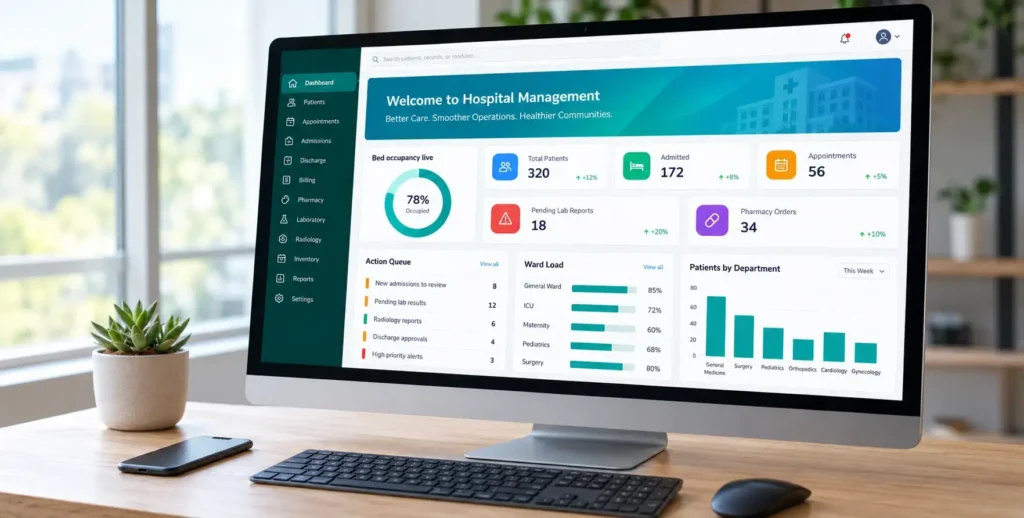
A centralized management dashboard with real-time indicators for patients, bed occupancy, appointments, pharmacy and laboratory queues, revenue and alerts.

Unified Patient & Clinical Records

Patient management, EMR and EHR create one unified patient record covering visits, prescriptions, laboratory and radiology records.

Clinical & Diagnostic Workflows

Appointments, doctors, pharmacy, laboratory, radiology and nursing connected through structured order-to-result workflows.

Bed, Billing & Inventory Management

Bed and ward management, billing and payment management, and inventory with low-stock alerts in the same system.

KPI Dashboard & AI Reporting

A hospital KPI layer with AI-generated daily and weekly management reports.

Conversational AI & Exception Management

A conversational AI hospital assistant, proactive operational alerts and role-based access control.

Key Capabilities & Business Value

The AI-powered HMS, EMR and EHR platform is designed to create a unified digital environment for hospital operations.

Key Capabilities & Business Value

Centralized Records & Visibility

  • Centralized patient records and clinical records.
  • Improved hospital visibility.
  • Improved billing visibility.

Faster Departmental Workflows

  • Faster pharmacy workflow and better laboratory tracking.
  • Better departmental coordination.
  • Improved bed utilization visibility.

Faster Decisions & Reporting

  • AI-generated management reports reduce manual reporting.
  • Real-time KPI monitoring and conversational access to hospital information.
  • Faster access to management information and faster operational decision-making.

Inventory & Spreadsheet Reduction

  • Better inventory management.
  • Reduced dependency on spreadsheets and disconnected applications.

AI-Powered Hospital KPI Dashboard

The HMS includes a comprehensive KPI layer covering clinical, operational and financial activities, creating a real-time operational picture of the hospital.

  • Patient KPIs: Registered, new and returning patients, OPD visits, IPD admissions, emergency visits, patient wait time and cancellation rate.
  • Bed Management KPIs: Total, occupied and available beds, bed occupancy percentage, ward-wise and ICU occupancy, bed turnover and average stay duration. Example: 6 occupied beds from a capacity of 12 = 50% occupancy.
  • Laboratory KPIs: Total orders, pending, completed and in-progress tests, critical results and turnaround time.
  • Pharmacy KPIs: Pending and dispensed prescriptions, pharmacy queue, low-stock medicines and pharmacy revenue.
  • Appointment KPIs: Today’s, confirmed, completed and cancelled appointments, no-shows and doctor schedules.
  • Financial KPIs: Revenue collected, outstanding amount, payment status and department-wise revenue.
  • Nursing KPIs: Open and completed nursing tasks, ward workload and patient assignments.
AI-Powered Hospital KPI Dashboard

AI Reporting & Conversational Assistant

  • Daily Management Report: Covers patient activity, admissions, discharges, emergency patients, bed occupancy, laboratory status, pharmacy activity, revenue, outstanding payments and critical operational issues.
  • Weekly Executive Report: Summarizes hospital performance, department workloads, patient and revenue trends, bed utilization, operational exceptions and KPI movement.
  • Conversational AI Hospital Assistant: Authorized users ask questions such as “How many beds are currently available?” or “Give me today’s management summary” and get answers based on their access level.
  • Today’s Hospital Summary: 12 patients registered, 12 appointments scheduled, 6 of 12 beds occupied, 10 prescriptions pending, 6 laboratory orders in queue, 5 nursing tasks pending, 64,355 collected, 4,86,465 outstanding, 2 critical laboratory results and 2 active emergency patients.
  • AI-Based Trend Analysis: Patient volume, bed occupancy, department workload, pharmacy demand and revenue trends support better operational planning and hospital resource planning.
AI Reporting & Conversational Assistant

Platform Capabilities

  • Patient, EMR, EHR & Appointments: A unified patient record, consultation notes, vitals, diagnosis, a longitudinal view across visits, and appointment booking with queue management.
  • Pharmacy Management: Doctor Prescription, Pharmacy Queue, Medicine Verification, Dispensing, Billing and Inventory Update stay connected, with low-stock alerts.
  • Laboratory & Radiology: Doctor Order, Laboratory Queue, Sample Processing, Test Execution, Result Entry and Clinical Review, with critical results surfaced on the dashboard.
  • Bed, Ward & Nursing Management: Ward allocation, bed transfer, ICU occupancy and ward load across Cardiology, General, ICU, Neurology, Oncology and Orthopaedics, plus nursing tasks.
  • Billing & Inventory Intelligence: Billing for consultation, admission, laboratory, pharmacy, radiology and procedures, and insights on medicines approaching low stock and unusual inventory movement.
  • Exceptions, Alerts & Action Queue: STAT laboratory tests, emergency patients, pending prescriptions, critical results, high ward occupancy and pharmacy or laboratory backlog are surfaced proactively.
  • Role-Based Access Control: Administrator, Doctor, Receptionist, Pharmacist, Laboratory Technician, Nurse, Accountant and Manager each see the modules relevant to their responsibilities.

Conclusion

Traditional hospital software primarily records activity. An intelligent hospital system helps management understand what is happening now, what requires attention, where operational pressure exists, which KPIs are changing and what information management needs to know today. By combining HMS, EMR, EHR, analytics, automation and artificial intelligence, the platform turns hospital data into actionable operational intelligence, the transition from a traditional Hospital Management System to an AI-powered Hospital Intelligence Platform.

GVM Technologies develops custom Hospital Management Systems, EMR platforms, EHR solutions, healthcare SaaS platforms, AI healthcare dashboards, clinical workflow systems and healthcare automation solutions. Whether the requirement is to modernize an existing hospital system or develop a complete healthcare management platform, GVM Technologies can build AI directly into everyday hospital operations.